

Key Takeaways
- Imagine You’re a Host in Idaho: The Law Just Changed Overnight You’ve invested in a charming cottage in Lava Hot Springs, Idaho, planning to operate it as a short-term rental (STR).
- However, expect “reasonable regulation” to remain a live legal battleground—a poorly crafted noise or trash ordinance that targets only non-owner-occupied homes, for instance, could still land a local government in court.
- In Idaho, for now, the scales have tipped toward property rights and state-level uniformity.
- You can also contact your local planning department directly or consult with a real estate attorney who practices in your area.
Imagine You’re a Host in Idaho: The Law Just Changed Overnight
You’ve invested in a charming cottage in Lava Hot Springs, Idaho, planning to operate it as a short-term rental (STR). Suddenly, your business license is denied—not because of safety or nuisance complaints, but because you’re not living there. For years, municipal ordinances have drawn firm lines, often excluding non-owner-occupied STRs from residential zones. Now, the Idaho Supreme Court has upended that legal landscape, setting a statewide precedent with ramifications for property owners, local governments, and Idaho’s entire hospitality market.
The Idaho Supreme Court’s Clear Message: State Law Trumps Local Bans
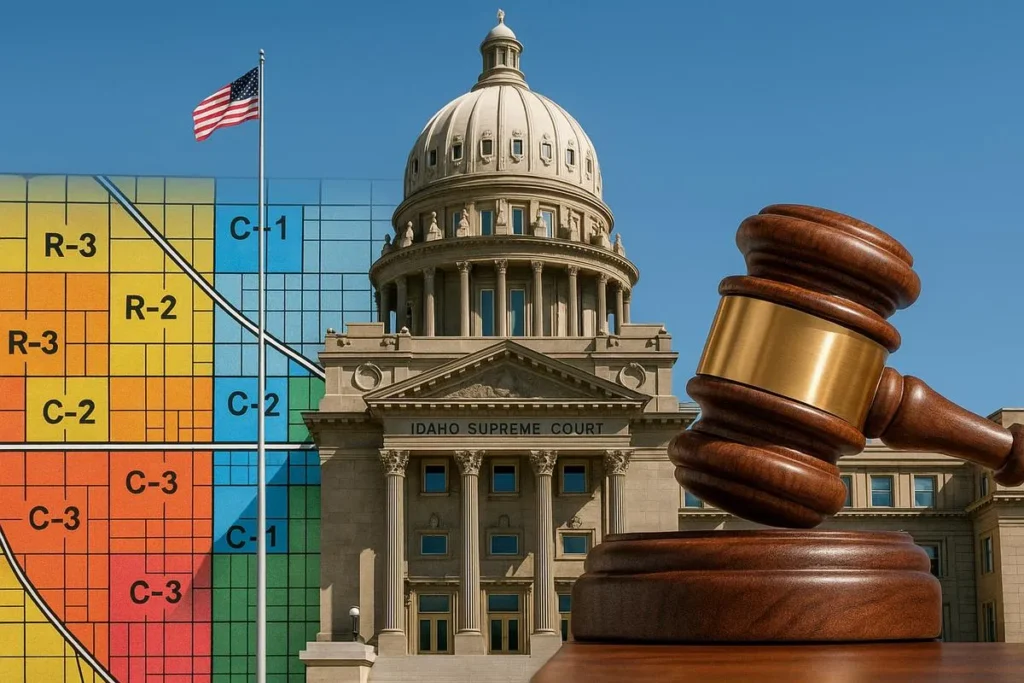
On May 21, 2025, in Idaho Association of Realtors, Inc. v. City of Lava Hot Springs, the Idaho Supreme Court unanimously invalidated the City’s ordinance banning non-owner-occupied STRs in residential zones.[^1] The decision is unambiguous: Idaho’s Short-Term Rental and Vacation Rental Act (“the Act”), enacted in 2017, preempts local rules that categorically bar any of the Act’s three protected STR types from residential zones—non-owner-occupied units, owner-occupied rentals (like a room in your home), and short-term condos/timeshares. That means cities can no longer use zoning to exclude non-owner STRs from residential neighborhoods.
The Court’s opinion, authored by Chief Justice Bevan, stresses that municipal regulations cannot “expressly or practically” prohibit STRs of any defined type, even under claims of protecting neighborhood welfare. Allowing only owner-occupied STRs isn’t enough; all types must be permitted residentially, and only truly “reasonable regulations” are allowed.
What Counts as a “Reasonable Regulation?” The Court’s Subtle Line in the Sand
The most significant legal nuance is the distinction between a regulation—a rule controlling behavior—and a prohibition—which bars it outright. The decision clarifies:
- Health, safety, or operational regulations (noise, parking, occupancy limits) remain fair game for localities—provided they don’t single out non-owner-occupied properties for outright exclusion.
- Owner-occupancy requirements, numeric caps, or proximity bans targeting just one STR type are now highly vulnerable to legal challenge, unless municipalities can show their rules don’t effectively “severely hinder” operation of any covered category.[^2]
- STRs are classified as a “residential land use” under state law, so treating them as inherently commercial is a non-starter for Idaho zoning boards.[^3]
For mayors, city planners, and neighborhood groups anxious about STR proliferation, this is a narrow path. Courts are likely to look closely at city ordinances for evidence that any regulation tips over from “regulating” to “banning”—especially when aimed at investor-owned properties.
Why This Matters: The Balance of Power and Policy in STR Regulation
For Property Owners and Investors
This ruling decisively strengthens property rights in Idaho. Investors seeking to operate STRs in residential neighborhoods now have a robust, court-recognized shield against categorical local bans. However, expect “reasonable regulation” to remain a live legal battleground—a poorly crafted noise or trash ordinance that targets only non-owner-occupied homes, for instance, could still land a local government in court.
For Local Governments
Idaho municipalities must immediately revisit their STR ordinances for compliance. They lose an important tool—zoning-based differentiation by ownership status—but may still regulate via general rules for health, safety, and neighborhood livability. Implementing and enforcing these operational standards (think: 24/7 local contact requirements, trash collection mandates, on-site parking minimums) will likely grow more complex and resource-intensive, especially in tourism-heavy small towns.
For Neighborhoods and Residents
The core challenge remains: How can Idaho communities balance the economic vitality STRs bring with protection against housing shortages, changing neighborhood character, and nuisance issues? If “reasonable regulations” can’t solve these pressures, locals may increasingly push for amendments to state law.
National Trends: Idaho Isn’t Alone
This case mirrors a nationwide clash between state legislatures keen on protecting STRs (often at industry urging) and municipalities defending local autonomy.[^4] Similar battles in Arizona, Texas, Pennsylvania, and Montana highlight the recurring property rights vs. local control debate. In most instances, the trend is toward state preemption limiting cities’ ability to restrict STRs wide-scale—a fact that savvy investors are quick to note, and that neighboring Idaho cities will need to weigh as they draft new ordinances.
What Should You Do Next?
Whether you’re a property owner, aspiring host, or a city official, the next step is to:
- Review your local ordinances. Are any rules differentiating by owner-occupancy status? If so, legal risk just went up.
- Follow the evolution of “reasonable regulation” litigation. Definitions and boundaries will almost certainly be refined in future court battles.
- Assess your property’s earning potential under compliant rules. Check out StaySTRa Analyzer for forecasts based on actual Idaho market data.
- Stay engaged with policy discussions. As Idaho’s legal landscape continues to evolve, regulatory changes will likely impact both the STR market and community life for years to come.
Ultimately, regulations around short-term rentals are a mirror of a community’s priorities and values. In Idaho, for now, the scales have tipped toward property rights and state-level uniformity. But the story of how, and how much, local authority can adapt and respond, is far from finished.
Sign up for our StaySTRa Insider mailing list to get updates on Idaho STR law, market data, and best practices as the rules keep changing.
[^1]: Idaho Association of Realtors, Inc. v. City of Lava Hot Springs, Docket No. 50888 (Idaho S. Ct. May 21, 2025).
[^2]: See Idaho Code § 67-6539(1): “no county or city may enact or enforce any ordinance that has the express or practical effect of prohibiting short-term rentals or vacation rentals…”.
[^3]: The Act, Idaho Code § 67-6539, classifies STRs as a residential land use.
[^4]: For a summary of recent state preemption trends, see National League of Cities: How States Preempt Local Laws.
Frequently Asked Questions
Do I need a permit to operate a short-term rental?
Most cities and counties require some form of permit, license, or registration to operate a short-term rental legally. Requirements vary significantly by jurisdiction, so check your local government website or contact your city clerk before listing your property. Operating without required permits can result in fines ranging from several hundred to several thousand dollars per violation.
How do I find the STR regulations for my area?
Start by searching your city or county government website for short-term rental or vacation rental ordinances. Many municipalities have a dedicated STR registration page with application forms and requirements. You can also contact your local planning department directly or consult with a real estate attorney who practices in your area.
Do I need an LLC for my short-term rental?
An LLC provides important personal liability protection by separating your rental business from your personal assets. If a guest is injured or files a lawsuit, an LLC limits exposure to the assets within that entity. Most real estate attorneys recommend forming an LLC before your first guest checks in, especially given the higher liability exposure of short-term rentals compared to long-term.
What is a Series LLC and is it good for rental investors?
A Series LLC creates separate compartments under one parent entity, each with its own asset protection. This means a lawsuit against one property cannot reach your other properties. Texas, Delaware, and several other states recognize Series LLCs. They are increasingly popular with multi-property investors because they provide individual protection without the cost of forming a separate LLC for each property.
What safety features does my Airbnb need?
At minimum, every STR needs working smoke detectors in each bedroom and hallway, a carbon monoxide detector on each floor, a fire extinguisher in the kitchen, and a clearly posted emergency exit plan. Many jurisdictions also require exterior lighting, handrails on all stairs, and pool fencing if applicable. Airbnb requires hosts to confirm safety equipment in their listing.
Become a StaySTRA Insider
Join free — get our newsletter + 6 free property analyses/month.
No spam. Unsubscribe anytime. Free membership includes property analyses and market insights.