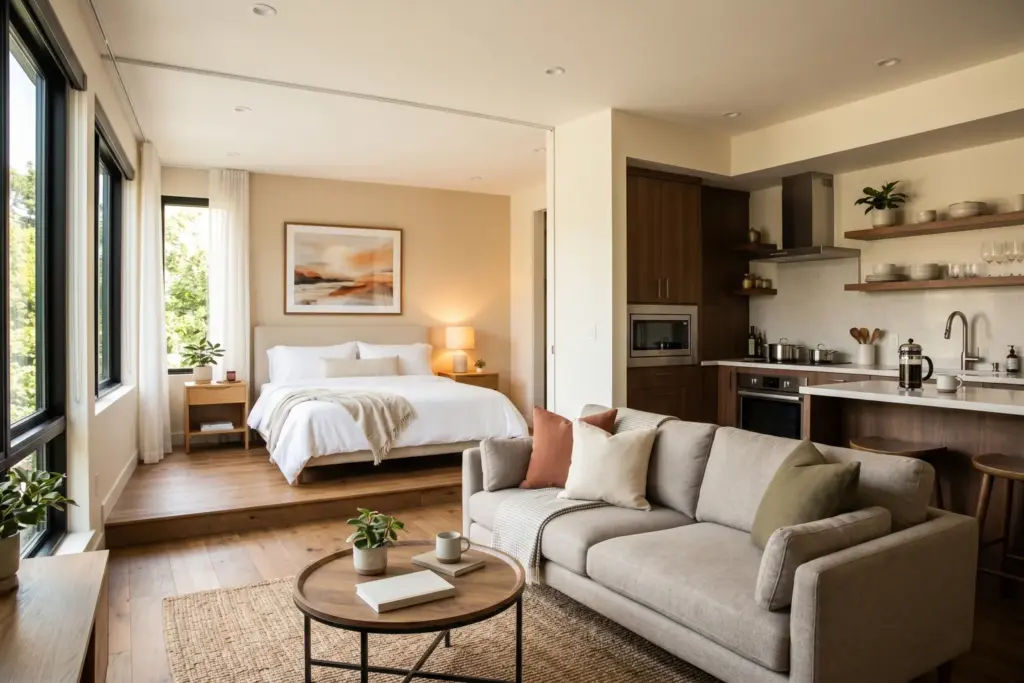
Key Takeaways
- Properties with hot tubs earn 14-20% more per night than comparable listings without them, with mountain market premiums reaching even higher during peak season.
- The mattress is your single highest-leverage furnishing purchase. Hospitality data shows each one-star rating improvement correlates with 5-9% more revenue.
- A 2-bedroom STR can be furnished at a fully functional mid-range level for $8,000-$15,000. Spending more does not automatically produce more revenue.
- Pools add an average 18.5% to ADR in warm-weather markets and lift occupancy an additional 5 percentage points over comparable listings without pools.
- Decor, throw pillows, and wall art are the lowest-ROI furnishing category. Guests leave bad reviews over mattresses and kitchens, not your gallery wall choices.
Properties with hot tubs in mountain markets command average daily rates that run 14 to 20 percent higher than comparable listings without them. In Gatlinburg, where StaySTRA data shows average daily rates ranging from $338 in the slow months to $478 at the seasonal peak, that premium compounds fast. Think of it this way: if the base-model listing is the economy trim at the car lot, the hot tub property is the upgrade package that costs $10,000 more upfront but earns $45 to $70 more per night depending on the season. Over the course of a year, that premium adds up faster than most hosts expect. The math works. The question every new STR owner should ask before spending a dollar is which investments actually show up in the numbers, and which ones just make for nice photos.
After forty years of looking at data sets, I have developed a healthy skepticism of advice that lacks numbers behind it. Most furnishing guides for Airbnb hosts are really shopping lists dressed up as strategy. This one is not. We are going to look at what StaySTRA market data and broader STR industry research actually show about which investments drive revenue, and we are going to build a practical framework for allocating your furnishing budget before you spend anything.
What the Data Actually Shows About Amenity Premiums
The most useful thing about StaySTRA market data is what it reveals when you put markets side by side. Scottsdale runs average daily rates between $442 and $588, with occupancy holding steady at 49 to 52 percent. Nashville, a strong urban market with solid demand, runs $326 to $366 in ADR with occupancy between 33 and 46 percent. Some of that gap is market type and demographics. But a meaningful portion is amenity profile. StaySTRA data shows Scottsdale top performers almost universally feature private pools, outdoor entertaining areas, and premium finishes. Guests filtering specifically for those amenities in warm-weather leisure markets pay a measurable premium to get them.
For hot tubs specifically, STR analytics data puts the average ADR premium at 14 to 20 percent above comparable listings without them. In mountain markets like Gatlinburg, Park City, or the Smoky Mountains, that figure can run even higher during peak season. The RevPAR impact, which captures both rate and occupancy together, reaches 34 percent in some mountain market research. Do not let that number scare you into thinking a hot tub is mandatory to succeed. What it tells you is that in the right market, it is one of the highest-return capital investments you can make to a property. Installation costs typically run $3,000 to $15,000, with annual maintenance around $500 to $1,500. That is a meaningful but recoverable investment when the revenue premium is this clear.
Pools show a similar but distinct pattern. In warm-weather markets, STR analytics research shows pools add an average 18.5 percent to ADR, lift occupancy by 5 percentage points, and drive a combined 24 percent RevPAR improvement. That is a significant number when you are already starting from a Scottsdale property pulling $500 per night. Pools matter almost exclusively in warm-weather leisure markets, though. Adding one to a Nashville urban condo would do very little for your revenue, and the maintenance costs would eat your margin. Market context is everything here, which is why I always tell new buyers to run their target market through the StaySTRA Analyzer before making any capital upgrade decisions.
Full kitchens sit in a different category from hot tubs and pools. They are not a premium differentiator so much as a baseline requirement. Airbnb guest review data consistently shows “fully equipped kitchen” as a top filtering criterion for stays longer than two nights. Listings without sufficient kitchen supplies earn more “came expecting a kitchen but could not actually cook here” complaints than almost any other amenity gap. The revenue penalty for an inadequate kitchen is real, but you do not capture a premium for having one. You simply avoid the discount that comes from having an inadequate one.
What to Spend the Most On: The Sleep Equation
Stay with me here while I make what might seem like an obvious point, but one I have watched hosts get wrong repeatedly. The mattress is not furniture. It is infrastructure. Every single guest sleeps on it. Guest review analysis from STR property managers consistently shows mattress quality as the single most cited negative complaint in one and two-star reviews. Not decor. Not lighting. The mattress.
Hospitality research on the revenue impact of sleep quality shows that each one-star improvement in guest ratings correlates with 5 to 9 percent more revenue. For a property earning $2,500 per month, a 7 percent lift from solving a mattress problem is worth $175 per month, or $2,100 per year. A commercial-grade STR mattress costs $900 to $1,500 per unit and lasts 5 to 7 years when paired with a waterproof encasement (which run $30 to $50 each). Without the encasement, annual mattress replacement rates in STR settings run around 6.5 percent due to staining and guest damage. With the encasement, that drops to 1.9 percent.
The math is not complicated. A $1,200 mattress plus a $40 encasement is a roughly $1,240 investment that lasts seven years and protects a revenue stream worth far more. The $350 mattress from a big-box furniture store will last eighteen months in an STR setting and generate the kinds of reviews that hurt your search ranking and suppress future bookings. I have seen this pattern enough times that it no longer surprises me. Buy the good mattress.
What to look for: foam density of at least 1.8 pounds per cubic foot, a warranty that explicitly covers commercial or hospitality use, and medium-firm support (the most broadly acceptable comfort level across diverse guest profiles). When furnishing multiple rooms at once, buy mattresses in sets. Per-unit costs from hospitality suppliers typically drop 15 to 25 percent below retail on bulk orders.
Bedding follows the same logic. Percale or sateen cotton in the 300 to 400 thread count range is the sweet spot for STR use: comfortable for guests, durable through repeated commercial washing, and easy to replace when worn. Do not buy the cheapest sheets. Guests feel cheap sheets. But do not buy the most expensive ones either. They fade and wear at the same rate as mid-tier cotton under high-turnover conditions, with none of the durability advantage.
Bed frames deserve more attention than most first-time hosts give them. Squeaky or wobbly frames generate explicit complaints. Platform frames with slat systems are generally more durable than box-spring setups because they have fewer moving parts. Solid wood or metal construction outperforms particle-board options that degrade under heavy use. Budget $200 to $400 per full or queen frame. King frames run $350 to $600.
What to Spend Moderate Amounts On
After the sleeping surfaces, the kitchen is where your furnishing dollars have the next-highest return. The question is not whether to have a kitchen. It is whether guests can actually cook in it. A complete mid-tier kitchen for STR use means a full set of pots and pans in multiple sizes, cutting board, knife set, mixing bowls, measuring cups, a can opener, and enough plates, bowls, and glasses to serve the maximum occupancy of your listing. Hosts routinely understock. A family of six renting a four-bedroom should not be searching for a second spatula.
The specific brands matter less than completeness and quality. Mid-range cookware sets in the $80 to $150 range hold up well in STR use. Skip the ultra-budget sets with thin construction. They warp, scratch, and generate complaints within a season. Skip the premium brands too. Guests are not bringing professional cooking skills to your rental kitchen. The $400 professional knife set will live untouched in the drawer.
The living room sofa endures more use per square inch than any other piece of furniture in a rental property. A sofa that seats four adults comfortably, holds up through hundreds of turnovers, and cleans easily is worth spending $600 to $1,200 on. Look for performance fabric (microfiber, polyester blend, or stain-treated upholstery) rather than cotton or linen, which absorb spills and show visible wear faster. A sofa that sags or stains will appear in your photos and your reviews. That is a double penalty.
Dining tables and chairs should match the occupancy capacity of the property. If you are listing for six guests, you need six seats at the dining table. This is a common oversight. Farmhouse tables with bench seating handle variable group sizes well. Metal or solid wood chairs in bistro or ladder-back styles clean easily and last through commercial use better than upholstered dining chairs, which trap crumbs and absorb stains.
Lighting falls in the moderate-spend category because it has an outsized impact on photography, which drives booking rate. Properties with warm, layered lighting photograph dramatically better than those with overhead-only illumination. Budget for floor lamps in living areas, bedside table lamps in each bedroom, and under-cabinet lighting in the kitchen if the space allows. You do not need designer fixtures. Mid-range sources work perfectly well. Budget $40 to $80 per lamp, and $150 to $300 for a statement pendant or chandelier in the main living area if the space warrants it.
What to Keep Cheap
Decor is where first-time STR owners most often overspend. No one has ever left a negative Airbnb review because the throw pillows were not hand-embroidered. Guests leave bad reviews over mattresses, noise, cleanliness, and parking. Not the gallery wall.
This does not mean your property should look like a hotel conference room. Visual coherence matters for listing photos, which directly affect click-through rates and first-impression booking decisions. But there is a wide gap between “visually coherent enough to photograph well” and “maximally decorated.” The former costs $500 to $800 in decor for a full property. The latter costs $3,000 to $5,000 and generates almost no measurable revenue difference.
Practical approach: pick one accent color and buy three or four throw pillows, one area rug, and one or two pieces of wall art that work with it. That is your decor done. Neutral base furniture (gray, cream, or tan sofa, white or wood-tone dining table) works with any accent palette and photographs cleanly. Frame a few large-format prints from budget photo print services. Resist the impulse to keep shopping once the space looks coherent in photos.
Outdoor furniture falls in the cheap-but-present category for most markets. A patio table and chairs, a couple of comfortable seats, and a grill if the market and property type call for it. Resin furniture has improved significantly and holds up in STR outdoor conditions better than wood alternatives that require seasonal maintenance. Budget $300 to $600 for basic outdoor seating. You are not furnishing a resort terrace.
Accent tables, ottomans, TV stands, and secondary pieces can all come from budget sources. Guests do not notice that the coffee table was $89. They notice whether it is solid enough not to wobble. Buy functional rather than impressive for secondary pieces.
Budget Frameworks by Property Size
These are mid-range functional budgets, not bare minimums or luxury buildouts. They assume standard-quality furnishings that will last three to five years under STR use conditions.
Studio or 1-Bedroom: $3,500 to $8,000
The studio or one-bedroom is where you get the clearest ROI feedback per dollar spent because every purchase covers an essential function. Mattress and bedding ($800 to $1,200), bed frame ($250 to $400), sofa or loveseat ($500 to $800), kitchen furnishings including cookware and dishware ($300 to $500), lighting ($200 to $300), decor and accent pieces ($300 to $500), small appliances including coffee maker and toaster ($150 to $250), miscellaneous essentials including extra linens and cleaning supplies ($200 to $300). Total functional core: $2,700 to $4,250. With contingency, plan on $3,500 to $8,000 depending on market tier.
2-Bedroom: $8,000 to $15,000
The two-bedroom is the most common first STR purchase, and the one where the furnishing-to-revenue ratio tends to be most favorable. Two mattress and bedding sets ($1,600 to $2,400), two bed frames ($500 to $800), sofa ($700 to $1,200), dining table and four to six chairs ($500 to $900), full kitchen kit ($500 to $800), lighting throughout ($400 to $600), decor ($500 to $800), small appliances ($200 to $400), linens and extras ($400 to $600). Core total: $5,300 to $8,500. Plan for $8,000 to $15,000 with contingency and market-appropriate finishes.
3-Bedroom: $15,000 to $28,000
At the three-bedroom level you are hosting groups, families, or multi-couple bookings. The kitchen needs to handle real cooking for five or six people. Living room seating needs to accommodate the full party. Outdoor space becomes more important. Three sleep setups ($3,500 to $5,000), living room ($1,500 to $2,500), dining for six ($800 to $1,200), kitchen ($700 to $1,200), lighting and decor ($1,200 to $1,800), outdoor area ($500 to $1,200), extras ($800 to $1,500). Core range: $9,000 to $14,400. Plan for $15,000 to $28,000 with contingency and any market-driven upgrades like a fire pit or hot tub evaluation.
4-Bedroom: $25,000 to $45,000
Four-bedroom properties attract event gatherings, extended-family bookings, and corporate retreats. Guest expectations are higher at this price point. The mattress investment alone runs $4,000 to $6,000 for quality sleep surfaces across four rooms. Budget for a commercial-level kitchen and seating for eight or more. This is the property tier where a hot tub or pool most dramatically changes your ADR profile in the right market. Four sleep setups ($4,500 to $6,500), living room ($2,000 to $3,500), dining for eight ($1,200 to $2,000), kitchen ($1,000 to $1,800), lighting and decor ($1,500 to $2,500), outdoor ($800 to $2,000), extras ($1,200 to $2,500). Core range: $12,200 to $20,800. Plan for $25,000 to $45,000 fully appointed.
A useful industry rule of thumb: budget 8 to 12 percent of your expected first-year gross revenue for furnishings. If StaySTRA data shows your target market averaging $36,000 per year in gross revenue for comparable properties, budget $2,900 to $4,300 for a lean setup or up to $4,300 on the fuller end of that range. Properties furnished at that ratio tend to earn the revenue they were underwritten to generate.
One note on timing: furniture costs vary meaningfully by season. January and July typically offer the deepest discounts on sofas, beds, and dining sets. Holiday weekends (Memorial Day, Labor Day, Black Friday) reliably produce 20 to 40 percent off at major furniture retailers. If your closing timeline gives you any flexibility on furnishing timing, a January purchase and delivery is often the cheapest window of the calendar year.
The Amenities That Cost You Revenue
This section is just as important as the spending frameworks. Several things hosts invest in actively reduce their revenue by generating bad reviews or creating operational friction that shows up in response-time and cleanliness metrics.
Cheap coffee makers. This surprises many first-time hosts. The coffee maker gets used by nearly every guest, every morning. Drip machines that brew weak coffee or develop scale quickly generate explicit review complaints. Invest $40 to $80 in a mid-tier drip machine or a basic pod brewer. The pod system has a slight advantage in STR use because guests do not have to measure or grind. Keep it stocked at turnover.
No blackout curtains in bedrooms. Guests will not mention this until they are lying awake at 5 AM because of a streetlight or sunrise. Blackout curtains or shades in every bedroom are a $40 to $80 investment per window that prevents a category of complaint that appears in reviews more often than you would expect.
Outdoor seating below the occupancy capacity of the listing. If your listing mentions a patio or deck, guests expect to use it with their full group. A four-bedroom that sleeps eight with a two-chair patio set will get flagged for it in reviews. Match your outdoor seating to your listing occupancy.
Mattresses without waterproof encasements. Covered above in the mattress section, but worth repeating here. An unprotected STR mattress averages a 6.5 percent annual replacement event due to staining or guest damage. A $40 encasement drops that rate to 1.9 percent and signals to cleaning staff that the mattress surface is protected. This is not optional equipment.
Insufficient Wi-Fi documentation. Not a furnishing issue, but it is the most commonly cited operational complaint in STR reviews and entirely preventable. Display the network name and password prominently in at least two places: the welcome book and a laminated card on the kitchen counter or coffee table. Properties that make guests hunt for Wi-Fi credentials generate frustration that lands in reviews.
The underlying principle behind all of these is that guests measure their experience against the expectations your listing photos create. A property that looks like $250 per night should feel like $250 per night in every detail. The gap between photo quality and actual quality is the source of most negative reviews. The best furnishing strategy is one where nothing disappoints.
Is Professional Interior Design Worth the Investment?
This is the question that comes up most often from hosts who have done their initial furnishing and are considering an upgrade. Research from STR interior design firms shows professional design produces average ADR improvements of 10 to 25 percent, with competitive markets seeing gains of 40 to 60 percent in cases where listings were previously under-designed relative to market norms. The breakeven timeline typically runs 6 to 16 months depending on the market and the magnitude of the ADR lift.
The honest answer: it depends on your market tier. In Scottsdale or Palm Springs, where ADR is already $400 to $600 per night and guest expectations are calibrated to design quality, professional design very likely delivers. In a rural drive-to market where guests are booking primarily for outdoor access and expect a functional cabin experience, a $10,000 design refresh will recover slowly if at all.
The option many hosts overlook: professional photography before full design intervention. Strong photography improves click-through rates and can lift booking volume at no change to the property itself. Before spending $5,000 to $15,000 on a design overhaul, spend $400 to $800 on a good photographer. The photography ROI is faster and the photos will reveal exactly which aspects of your current setup photograph poorly and might need physical upgrades versus better light or staging.
If you want to see what properties with specific amenities are actually earning in your target market before making capital decisions, the StaySTRA Analyzer gives you real-time revenue data by market. For context on which markets offer the strongest overall fundamentals for first-time STR buyers, the Best Airbnb Markets 2026 rankings are a good starting point. And if you have already purchased and need the full setup picture beyond just furnishings, the complete Airbnb setup checklist covers everything from listing creation to getting your first booking.
Furnishing well on a budget is not about being cheap across the board. It is about spending precisely where investments show up in ratings and revenue, and holding back where they do not. Get the mattress right. Get the kitchen complete. Keep the decor coherent but simple. Match your outdoor amenities to what guests in your specific market are actually filtering for. Let the data guide the rest, not the Instagram accounts of people who furnish vacation rentals for content rather than profit.
Frequently Asked Questions
How much does it cost to fully furnish an Airbnb?
The realistic mid-range runs from $3,500 to $8,000 for a studio or one-bedroom, $8,000 to $15,000 for a two-bedroom, $15,000 to $28,000 for a three-bedroom, and $25,000 to $45,000 for a four-bedroom. A useful rule of thumb from industry data: budget 8 to 12 percent of your expected first-year gross revenue. If the market data suggests you should earn $36,000 in year one, plan to spend roughly $3,000 to $4,300 on furnishings. Premium markets with higher guest expectations will push those ranges upward.
Is a hot tub worth the investment for an STR?
In the right market, yes. STR analytics data shows hot tubs generate a 14 to 20 percent ADR premium over comparable listings without them, with mountain market premiums running even higher during peak season. At a 15 percent ADR premium on a property earning $2,500 per month, that is $375 in additional monthly revenue, or $4,500 per year. A $10,000 installation breaks even in roughly 27 months in that scenario, then generates pure additional return. That math changes substantially in markets where hot tubs are not a primary guest draw, like urban properties or warm-climate coastal markets where pools serve the same function.
What is the single most important furnishing purchase for an STR?
The mattress. Every guest sleeps on it, mattress complaints are among the most cited negative review categories in STR data, and hospitality research shows each one-star rating improvement correlates with 5 to 9 percent more revenue. A commercial-grade STR mattress costs $900 to $1,500 and lasts 5 to 7 years with a waterproof encasement. The budget mattress at $300 to $400 generates bad reviews within the first season and must be replaced. The long-term economics strongly favor quality here.
What furnishing items are a waste of money for Airbnb hosts?
Premium decorative accessories, designer kitchen gadgets guests will not use, expensive upholstered dining chairs that absorb stains and show wear quickly, and luxury bedding that does not hold up to commercial washing. Guests leave reviews about mattresses, cleanliness, kitchen functionality, and parking. No one gives a five-star review because the accent pillows were from a boutique design shop. Spend on durability and function. Stage for photography at minimal cost.
Should I hire an interior designer for my Airbnb?
It depends on your market tier. Professional design produces average ADR improvements of 10 to 25 percent, with breakeven in 6 to 16 months in competitive markets. In premium destinations like Scottsdale, Palm Springs, or Aspen, where guests compare your listing against other professionally designed properties, design investment tends to have clear ROI. In rural or budget drive-to markets where guests are booking for access rather than aesthetics, the return is slower and less predictable. A strong intermediate step: professional photography before a full design overhaul. Photography lifts booking click-through rates with a faster payback period and reveals which physical upgrades would actually show on camera.
Sponsored — OfferMarket
Buy Your First STR With Long-Term Rental Financing
Flexible, long-term financing for short-term rental buyers. Rates from 5.75%. Instant online quote, no credit pull.
Explore RTL Financing Options →Affiliate disclosure: StaySTRA may earn a referral fee.
We do our best to keep our data accurate and up to date, but markets move fast and we are only human. Always verify current figures directly with local sources before making investment decisions.
Become a StaySTRA Insider
Join free — get our newsletter + 1 free property analysis/month.
No spam. Unsubscribe anytime. Free membership includes property analyses and market insights.