Key Takeaways
- Hochatown, Oklahoma filed suit against Airbnb on July 15, 2026, in McCurtain County District Court, alleging the platform’s ZIP-code tax routing sent approximately $4.3 million per year in lodging taxes to neighboring Broken Bow instead of Hochatown.
- The root cause is structural: Hochatown has no ZIP code. Airbnb’s system defaults to the nearest assigned ZIP, so lodging taxes from every Hochatown booking flowed to the wrong city.
- Airbnb “acknowledged mapping and address-related issues but failed to implement adequate system-wide corrections,” according to Hochatown’s attorney Liz George.
- Resort communities, rural markets, islands, and other areas with non-standard addressing face the same structural exposure. Platform-remitted taxes may not be reaching the jurisdiction where your property actually sits.
- The lawsuit asks the court to order an escrow account for disputed revenue and a declaration establishing which municipality is legally entitled to the taxes going forward.
$4.3 million. That is how much Hochatown, Oklahoma collects in lodging taxes every year, and it represents nearly half of what the small resort community runs on. For years, according to a lawsuit filed July 15, 2026, in McCurtain County District Court, a meaningful share of that money was landing in a neighboring city’s account.
Not stolen. Not embezzled. Just rerouted by a ZIP code that does not exist.
Hochatown has no ZIP code. That single administrative gap, a legacy of a post office that operated from 1894 until the 1960s when the original townsite was flooded to build Broken Bow Lake, sits at the center of what has become the clearest documented case of Airbnb lodging tax misdirection to surface in the resort STR industry this year. The lawsuit names Airbnb Inc., the Oklahoma Tax Commission, and the City of Broken Bow as defendants. The amount misdirected is described in court filings as “presently unknown but believed to be substantial.”
For STR investors who rely on platforms to collect and remit lodging taxes on their behalf, this case is not just a local government dispute. It is a test of whether platform tax infrastructure actually works for the communities that need it most.
The ZIP Code That Broke the System
When a guest books a Hochatown cabin through Airbnb, the platform calculates applicable state and local taxes and adds them to the reservation total. Airbnb then routes those taxes through the Oklahoma Tax Commission to what it determines is the appropriate municipality. According to the lawsuit, the routing decision turns on ZIP code.
Airbnb’s system matches a property’s ZIP code to a municipality. The municipality the ZIP belongs to receives the lodging tax. It is a logical system in most of the country, where ZIP codes and city boundaries overlap cleanly enough for the math to work.
Hochatown is not most of the country.
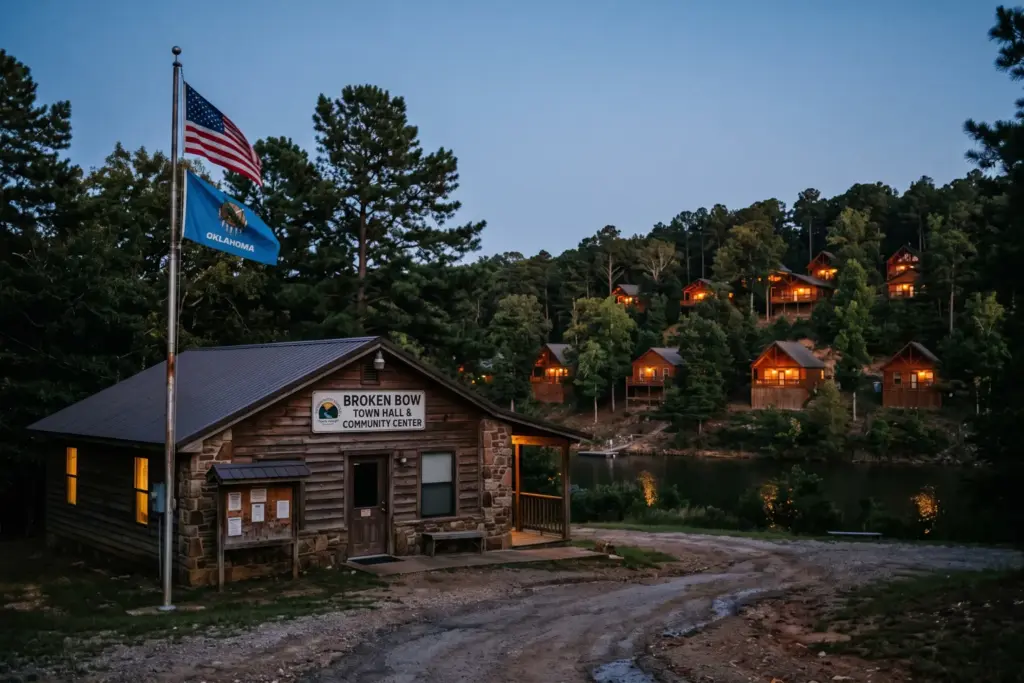
The community sits in McCurtain County in southeastern Oklahoma, surrounded by the Ouachita National Forest and Broken Bow Lake. Because Hochatown has no ZIP code of its own, its properties use Broken Bow’s ZIP code for mailing purposes. Airbnb’s system read that ZIP, identified Broken Bow as the municipality, and sent the taxes there. Every booking. Every year.
Hochatown’s attorney Liz George described the failures in court filings as “improper coding, mapping, categorization, or otherwise assigning” properties to the wrong jurisdiction. Documents show the company was not unaware of the problem. According to George, Airbnb “acknowledged mapping and address-related issues but failed to implement adequate system-wide corrections.”
The error was not an unknown unknown. It was a known problem that persisted.
What Is Actually at Stake
Hochatown collects approximately $4.35 million in lodging taxes per year. That figure represents close to 48 percent of the town’s total annual revenues. For a community of fewer than 300 year-round residents that generates more than $22 million annually in tourism activity, lodging tax is not supplemental income. It is the operating budget.
Airbnb’s overall footprint in Oklahoma provides context for the scale of what the platform manages. The company handled more than $22 million in Oklahoma tourism taxes in the most recent fiscal year and has remitted $93 million statewide since 2017. The infrastructure is capable of moving significant sums. The Hochatown situation suggests it is not always sending them to the right place.
The exact dollar amount misdirected to Broken Bow over the affected period is not specified in available court filings. The lawsuit describes it as “presently unknown but believed to be substantial,” which is itself telling. Hochatown does not know how long the misdirection has been occurring or how much has accumulated. That uncertainty is part of what makes the escrow remedy central to the town’s legal strategy.
The Lawsuit: Claims, Defendants, and Relief Sought
Filed July 15, 2026, in McCurtain County District Court, the suit distributes responsibility across three defendants. Airbnb handled the tax collection and made the routing error. The Oklahoma Tax Commission processed those remittances without catching the jurisdictional mismatch. Broken Bow received funds it was not entitled to under Oklahoma law.
Hochatown restored its official municipal status in November 2022, more than 60 years after the original townsite was submerged beneath Broken Bow Lake. That civic restoration is what gives the community legal standing to claim the revenue and to argue that taxes collected from properties within its boundaries belong to Hochatown, not its neighbor.
“We want it to be clear that this litigation was a necessity to protect and ensure the appropriate allocation of this community’s tax dollars,” attorney Liz George said.
The relief sought is practical rather than punitive. Hochatown is asking the court to order all disputed lodging taxes from Hochatown properties held in an escrow account during the litigation, stopping further misallocation while the case plays out. The town is also seeking a judicial declaration establishing which municipality is entitled to those taxes, creating a legal framework for correct allocation going forward.
This is not a damage claim designed to punish Airbnb. It is a legal mechanism to force a system correction that did not happen through normal channels, after the company was already on notice.
What Airbnb Says
Airbnb’s public response was brief. A company spokesperson confirmed the company “can’t comment on active litigation” and stated that “Airbnb is committed to fair and accurate tax collection.”
The company did not dispute handling more than $22 million in Oklahoma tourism taxes last year or remitting $93 million statewide since 2017. At the macro level, the system works. At the property-level routing layer in ZIP-code-absent communities, Hochatown argues otherwise.
The City of Broken Bow and the Oklahoma Tax Commission have not issued public statements on the suit.
Which Other Markets Face the Same Risk
The Hochatown case exposes a vulnerability in how platform tax collection is engineered, and the structural conditions that created it exist in dozens of U.S. resort markets.
Data indicates that any community sharing a ZIP code with a neighboring municipality, lacking its own ZIP, or sitting in an unincorporated area that uses a nearby city’s postal code faces the same potential mismatch. The ZIP code is the routing mechanism. If the ZIP code points to the wrong municipality, the taxes follow it there.
Consider the market categories where this applies most directly. Island communities that share a ZIP code with a mainland town. Unincorporated resort areas within county limits but outside any incorporated city. Special tourist districts that overlay existing cities with different tax structures. Rural cabin clusters that use the nearest town’s ZIP for delivery purposes but sit inside a different taxing jurisdiction for legal purposes.
Creating a new ZIP code is not a realistic fix for communities in this position. The U.S. Postal Service estimates that establishing a new ZIP code costs approximately $800 million. Hochatown has been fighting to have its original ZIP code restored for years. That fight has not resolved, and communities like it are likely to remain in the same addressing gap for the foreseeable future.
Whether VRBO, Booking.com, or other platforms use the same ZIP-based routing and face identical exposure in non-standard address markets is not confirmed in current reporting. The Hochatown lawsuit targets Airbnb specifically. But the architectural question applies to any platform that relies on ZIP code lookups without independent GIS verification of actual municipal boundaries.
What STR Investors Should Do Right Now
If you own a short-term rental in a resort community, rural market, island destination, or any area where your mailing address and your legal taxing jurisdiction might diverge, the Hochatown case is a prompt to verify things most investors have never checked.
Pull your platform tax remittance records. Both Airbnb and VRBO provide documentation of taxes collected and remitted by property. Review yours and note the jurisdiction listed as the receiving municipality. If that jurisdiction does not match where your property sits legally, you have a routing error worth investigating before it compounds.
Compare against your county assessor’s parcel data. Your county assessor’s record shows the legal taxing jurisdiction for your specific property. Compare that to the jurisdiction named in your platform remittance records. They should match. If they do not, that is the gap to investigate.
Contact your local municipality directly. Ask whether they have a record of receiving lodging taxes from your property through the platform. A mismatch between what the platform reports remitting and what your local government shows receiving is a signal worth escalating.
Understand your personal liability exposure. In most states, lodging taxes are ultimately the host’s responsibility. If your platform sends taxes to the wrong jurisdiction, you may still owe the correct municipality its share, even if you never received the money. This is not hypothetical. It is the structural consequence of what Hochatown is alleging played out at scale. Work with a tax professional familiar with STR compliance in your state. StaySTRA’s complete guide to STR tax deductions covers the federal landscape; local lodging tax obligations require a local accountant who knows your jurisdiction’s rules.
Know your filing deadlines regardless of platform remittance. Lodging tax obligations often carry annual filing requirements that apply even when a platform is remitting on your behalf. StaySTRA’s STR compliance deadline calendar is a useful reference for what is due and when across major U.S. markets.
The Broader Platform Accountability Question
The Hochatown lawsuit arrives at a moment when state legislatures are moving to hold platforms directly accountable for tax remittance accuracy. Illinois’s Public Act 104-0468, which took effect July 1, 2026, classifies platforms with significant in-state revenue as hotel marketplace facilitators required to register and remit occupancy taxes directly to the state. The theory is that platforms are better positioned to collect accurately than individual hosts.
The Hochatown case complicates that theory. If Airbnb’s routing system sent taxes to the wrong municipality in this documented instance, the question becomes how many other instances exist that no community has yet surfaced. Small resort towns rarely have the legal resources or political leverage to discover a routing error, document it, and file suit. The ones that do become visible. The ones that do not may never know what they are missing.
Sources reveal that the gap reflects a broader pattern in how platform tax infrastructure is built. Systems optimized for high-volume standard markets may not be calibrated for the edge cases where STR investment often concentrates. The Hochatowns of the American tourism economy, resort destinations with constrained housing supply, outsized demand, and strong STR returns, tend to be exactly the markets where addressing is least standardized and platform routing assumptions are most likely to fail.
For investors evaluating platform mechanics and fees, StaySTRA’s comparison of Airbnb, VRBO, and Booking.com for hosts covers how each platform structures fees and handles key host operations. What it cannot tell you is whether your specific property’s address maps correctly to your taxing jurisdiction in the platform’s backend. That verification falls to you.
Airbnb has remitted $93 million in Oklahoma taxes since 2017. The system mostly works. But “mostly” is not the same as “always,” and in the resort markets where it fails, the failure can reach $4.3 million per year before anyone with standing to sue finally does.
For investors building or expanding portfolios in resort and rural markets, verify your market’s fundamentals before you close, and verify your tax routing after you do. Use the StaySTRA analyzer to assess occupancy, ADR, and revenue data in any target market. Then make the calls to your county assessor and your local municipality to confirm the money actually lands where it should.
We do our best to keep our reporting accurate and up to date, but situations evolve and we are only human. Always verify current details directly with local officials and sources before making decisions.
Frequently Asked Questions
What is the Hochatown Airbnb lawsuit about?
Hochatown, Oklahoma sued Airbnb in McCurtain County District Court on July 15, 2026, claiming the platform’s ZIP-code tax routing system sent lodging tax revenue from Hochatown short-term rentals to neighboring Broken Bow. Hochatown has no ZIP code because its original post office closed when the townsite was flooded to create Broken Bow Lake in the 1960s. The lawsuit also names the Oklahoma Tax Commission and the City of Broken Bow as defendants and seeks an escrow account for disputed funds and a judicial declaration establishing the correct tax allocation going forward.
How much money is involved in the Hochatown Airbnb tax case?
Hochatown collects approximately $4.35 million per year in lodging taxes, which represents close to half of the town’s total revenues. The exact amount misdirected to Broken Bow is described in court filings as “presently unknown but believed to be substantial.” Airbnb has remitted more than $93 million in Oklahoma lodging taxes since 2017 and handled over $22 million in Oklahoma tourism taxes in the most recent fiscal year alone.
Why did Airbnb send Hochatown lodging taxes to Broken Bow instead of Hochatown?
Airbnb’s tax routing system uses ZIP codes to determine which municipality receives lodging tax revenue from a booking. Because Hochatown has no ZIP code, its properties use Broken Bow’s ZIP for addressing purposes. Airbnb’s system identified Broken Bow’s ZIP code and directed the taxes there. According to Hochatown’s attorney Liz George, Airbnb acknowledged the mapping and addressing issues but did not implement adequate system-wide corrections.
Could this Airbnb tax routing problem affect STR investors outside Oklahoma?
Potentially yes. Any STR property in a resort community, rural market, island destination, or unincorporated area that uses a neighboring municipality’s ZIP code for addressing faces the same structural risk. If the platform’s tax routing system resolves the ZIP code to a different municipality than where the property legally sits, the taxes may flow to the wrong jurisdiction. Investors should verify that their platform remittance records name the correct taxing authority for their specific property’s legal location.
What should STR investors do to verify their platform lodging tax remittances?
Request a tax remittance statement from your platform showing the specific jurisdiction receiving taxes for your listing. Compare that to your county assessor’s record of your property’s taxing jurisdiction. Contact your local municipality to confirm they have a record of receiving lodging taxes through the platform for your property. If there is a mismatch, contact the platform’s host support and consult a local tax professional to assess your liability before the discrepancy grows further.
Sponsored — OfferMarket
Buy Your First STR With Long-Term Rental Financing
Flexible, long-term financing for short-term rental buyers. Rates from 5.75%. Instant online quote, no credit pull.
Explore RTL Financing Options →Affiliate disclosure: StaySTRA may earn a referral fee.
Become a StaySTRA Insider
Join free — get our newsletter + 1 free property analysis/month.
No spam. Unsubscribe anytime. Free membership includes property analyses and market insights.
Sponsored — OfferMarket
Buy Your First STR With Long-Term Rental Financing
Flexible, long-term financing for short-term rental buyers. Rates from 5.75%. Instant online quote, no credit pull.
Explore RTL Financing Options →Affiliate disclosure: StaySTRA may earn a referral fee.