

Key Takeaways
- Gatlinburg has 6,194 active short-term rental listings for a resident population of just 3,577, giving it roughly 1.73 STR listings per person, one of the highest ratios in the country.
- StaySTRA data shows Gatlinburg’s last-twelve-month occupancy at 62.1%, with an average daily rate of $282 and average monthly revenue of $4,685 per listing (Nov 2025 baseline).
- The broader Smoky Mountains corridor (Gatlinburg, Pigeon Forge, Sevierville) holds over 21,600 combined active listings and generated $3.93 billion in visitor spending in 2024.
- October is the revenue peak ($6,538/month per listing at 77.4% occupancy), driven by fall foliage demand across the Great Smoky Mountains, while January and February dip below 36% occupancy.
- Tennessee’s Short-Term Rental Unit Act (2018) prevents local governments from prohibiting STRs, giving operators in the Smoky Mountains a relatively stable regulatory foundation.
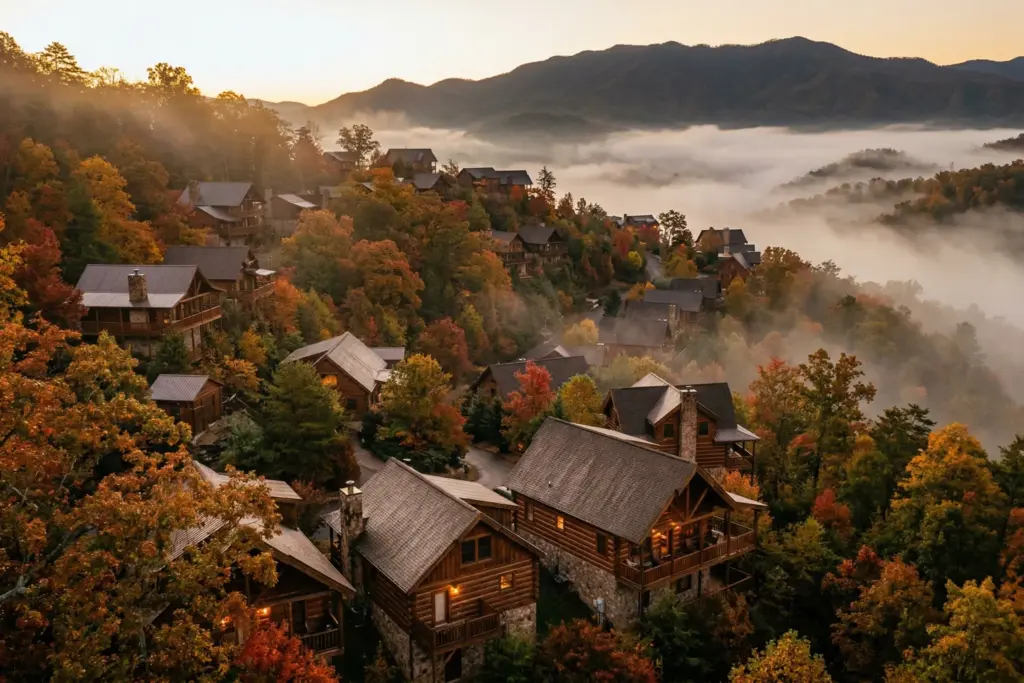
For every person who calls Gatlinburg, Tennessee home, there are nearly two short-term rental listings waiting for the next guest. That ratio, 1.73 active STR listings per resident, makes this small mountain town at the entrance to Great Smoky Mountains National Park one of the most cabin-dense rental markets in America. And the people who live here will tell you that is not a problem. It is the whole point.
I have been writing about STR markets for a while now, and most of the stories follow a familiar pattern: a city grows, tourism arrives, rentals multiply, neighbors push back. Gatlinburg flips that script entirely. Aqui, los alquileres a corto plazo no son la controversia (here, short-term rentals are not the controversy). They are the foundation. The cabins were here before the debate, and the community was built around them.
StaySTRA data shows 6,194 active listings in Gatlinburg as of the November 2025 baseline, serving a town with a permanent population of just 3,577. To put that in perspective, most major STR markets in America have listing-to-resident ratios well under 0.05. Gatlinburg’s ratio is more than 30 times that. This is not a city with an STR sector. This is a city that IS an STR sector.
What the Gatlinburg STR Numbers Actually Look Like
The headline numbers for Gatlinburg tell one story. The monthly breakdown tells a richer one.
Across the last twelve months, Gatlinburg’s STR market posted a 62.1% occupancy rate, a $282 average daily rate, and $4,685 in average monthly revenue per listing. RevPAR sits at $220. For a mountain cabin market where nearly every property is a standalone vacation rental (not an urban condo or downtown apartment), those numbers represent solid performance, especially when you factor in the seasonal swings that define Smoky Mountain tourism.
October is king. At 77.4% occupancy and $301.70 ADR, the average Gatlinburg listing pulled in $6,538 in revenue during peak fall foliage season. July follows close behind at $6,618 on the strength of summer travel, with occupancy hitting 80.7%. December, powered by Gatlinburg’s famous Christmas lights and holiday cabin demand, held steady at 61.3% occupancy and $5,295 in monthly revenue.
The valleys are sharp. January drops to 35.5% occupancy and $2,716 in revenue. February is nearly identical at 35.7% and $2,421. For operators, this means nearly two months of the year where a Gatlinburg cabin sits empty more than half the time. Smart pricing and minimum-stay strategies become essential during these shoulder months.
Spring rebounds quickly. By March, occupancy climbs back to 64.5% as wildflower season draws hikers into the national park. April holds at 60%, and by June the market is back to $5,833 in monthly revenue. If you are evaluating a Gatlinburg cabin investment, the seasonal curve is the first thing to understand. The market rewards operators who price dynamically and who know which weeks carry premium demand.
The Smoky Mountains Corridor. More Than Just Gatlinburg
Gatlinburg does not exist in isolation. It is the northern anchor of a three-city corridor that stretches through Pigeon Forge and into Sevierville, all within Sevier County. Together, these three towns form the densest concentration of vacation cabins in the eastern United States.
StaySTRA tracks 3,722 active listings in Pigeon Forge and 11,779 in Sevierville. Combined with Gatlinburg’s 6,194, the corridor holds over 21,600 active short-term rentals. The total resident population across all three towns is roughly 27,000. That means the corridor has nearly one STR listing for every resident, a figure that would trigger alarm bells in most American cities but is simply the economic reality of the Smoky Mountains.
Each city has its own character. Pigeon Forge leans into entertainment (Dollywood, dinner theaters, go-kart tracks), with an LTM ADR of $260 and average monthly revenue of $4,393. Sevierville, the largest of the three by population, actually commands the highest ADR at $292 and the highest monthly revenue at $4,954, likely reflecting a larger share of upscale cabin properties. Gatlinburg, the gateway to the park itself, sits in the middle at $282 ADR and $4,685 monthly revenue.
Walking through Gatlinburg on a weekday morning, even in the off-season, you notice something. The town hums. No me refiero al ruido de los turistas (I do not mean the noise of tourists). I mean the infrastructure: the cleaning crews moving between cabins, the maintenance trucks on mountain roads, the property management offices lined up along the Parkway. This is a town where the STR economy is not a layer on top of the local economy. It IS the local economy.
Why the Demand Engine Never Really Stops
Great Smoky Mountains National Park recorded 11.5 million visitors in 2025, making it the most visited national park in the United States for the 20th consecutive year. Even in what was considered a “down” year (a 5.4% decrease from 2024’s 12.2 million), the Smokies drew more than double the visitors of the second-place park, Zion, which saw 4.9 million.
That visitor volume is the demand engine that powers Gatlinburg’s entire STR economy. And it operates on a calendar that STR investors should study closely.
- Summer (June through August): Peak travel season. July hits 80.7% occupancy with ADR above $305. The park’s most popular trails require advance reservations during this window.
- Fall foliage (October): The peak of peaks. 77.4% occupancy, $301.70 ADR, and $6,538 in monthly revenue. The Smokies are among the top fall color destinations in the eastern U.S., and Gatlinburg cabins book months in advance.
- Holiday season (December): Gatlinburg’s Winterfest and its legendary trolley ride of lights keep occupancy at 61.3% and revenue above $5,200. This is unusually strong for a mountain market in winter.
- Wildflower spring (March through April): The park’s synchronous firefly event and spring bloom draw a dedicated visitor base. Occupancy recovers to 60-65%.
- Deep winter (January through February): The only true slow period. Occupancy below 36%, revenue below $2,800. Many operators use this window for maintenance and renovation.
The pattern matters because it means Gatlinburg has four distinct demand seasons, not just a summer peak and an off-season. Most mountain STR markets run on two. The Smokies run on four, and that gives operators more revenue weeks to work with across the calendar year.
A Town Built on Cabins, Not Disrupted by Them
In most of the STR markets I cover, the narrative centers on tension. Long-term residents versus vacation rental operators. Housing affordability advocates versus property rights defenders. City councils caught in the middle. It is a story I know well, and it plays out from Maui to Sacramento to Phoenix.
Gatlinburg is different. Not because there is zero friction (no community of 3,500 people absorbing 14 million annual visitors operates without friction), but because the vacation cabin came first. The town’s identity was formed around tourism, not disrupted by it. The cabins are not newcomers here. They are the reason the town exists in its current form.
Sevier County generated $3.93 billion in visitor spending in 2024, according to Tennessee state tourism data, a 2% increase over 2023. That spending generated roughly $251 million in state tax revenue and $187 million in local tax revenue. Without tourism, each county household would need to pay an estimated $11,191 more in annual taxes to replace those funds.
Eso es lo que la gente no entiende desde afuera (that is what people do not understand from the outside). When you hear “cabin rental market,” you might picture a handful of investors buying up houses in a quiet neighborhood. In Gatlinburg, the cabin IS the neighborhood. The cleaning company, the linen service, the handyman who fixes the hot tub at 10 PM on a Saturday, the restaurant that stays open because 14 million visitors need somewhere to eat. Everybody works in the cabin economy, because the cabin economy is the only economy.
What the Cabin Property Mix Tells Investors
Gatlinburg’s listing inventory breaks down in a way that is distinct from most STR markets. Two-bedroom cabins are the largest segment at 1,734 listings, followed by one-bedrooms at 1,372. Three-bedrooms account for 1,149, and the combined four-bedroom-plus segment holds 1,243 listings.
The dominance of one- and two-bedroom units reflects the market’s appeal to couples and small groups. A romantic mountain getaway with a hot tub and a fireplace is Gatlinburg’s bread and butter. But the 1,243 properties with four or more bedrooms point to a growing segment: large-group bookings, reunion weekends, and multi-generation travel.
Home values offer context for the investment math. The typical home value in Gatlinburg sits at $396,473, with a median list price of $578,299. At $4,685 in average monthly revenue ($56,220 annualized), a Gatlinburg cabin generates a gross revenue yield of roughly 14.2% on typical home value. That is before expenses (property management, cleaning, maintenance, utilities, insurance, and mortgage), but it explains why investor interest in the Smoky Mountains remains persistent even as other STR markets cool.
Booking patterns show strong forward demand. StaySTRA data indicates 62.3% of available nights are booked in the 1-3 month window, 70.4% in the 4-6 month window, and 73.3% in the 7-9 month window. That forward booking curve suggests guests are planning Smoky Mountain trips well in advance, which gives operators pricing leverage and revenue visibility that more impulsive, last-minute markets do not offer.
Tennessee’s Regulatory Framework. Stable Ground for Operators
Tennessee passed the Short-Term Rental Unit Act in 2018 under Governor Bill Haslam. The law’s most significant provision prevents local governing authorities from prohibiting the use of a property as a short-term rental. It also restricts municipalities from regulating STRs based solely on classification, use, or occupancy in ways that would effectively ban them.
For Gatlinburg operators, this means something specific: the state has your back, at least on the question of whether your cabin can legally be rented short-term. Local municipalities can still impose safety requirements, tax collection obligations, and operational standards. But they cannot pass an outright ban or create zoning rules designed to eliminate vacation rentals.
This is a meaningful distinction in 2026, as STR markets nationwide face varying degrees of regulatory pressure. Cities like Sacramento and Santa Barbara have moved toward supply caps. Maui passed a phase-out. Nashville requires primary-residence permits for non-owner-occupied listings. Gatlinburg, operating under Tennessee’s state framework, faces none of those structural risks.
That regulatory stability is one reason the Smoky Mountains corridor continues to attract new cabin development. It is also worth noting that Idaho recently passed its own STR preemption law (HB 583), following a model similar to Tennessee’s approach. The preemption trend is expanding, and operators in states that already have these protections are building on a more predictable foundation.
The Risks Gatlinburg Investors Should Watch
No market is without risk, and Gatlinburg’s profile carries a few that are specific to its geography and structure.
Seasonality concentration. While Gatlinburg has four demand seasons, the gap between October ($6,538 revenue) and January ($2,716) is steep. A 58% revenue swing month-to-month means cash flow planning is not optional. Operators who price for annual averages instead of seasonal curves will underperform.
Supply density. With 6,194 active listings in a town of 3,577, Gatlinburg is already one of the most saturated STR markets by any measure. New cabin construction continues in the surrounding mountains. If visitor demand flattens while supply grows, occupancy pressure will follow. The 62.1% LTM occupancy rate, while solid, leaves less room for slippage than a market running at 70% or above.
Natural disaster exposure. The 2016 Gatlinburg wildfires destroyed over 2,400 structures and caused 14 deaths. The Smoky Mountains region sits in a geography where wildfire, severe storms, and flooding are recurring threats. Insurance costs for mountain cabins have risen, and STR-specific coverage is essential. Operators should factor disaster preparedness into their cost models.
Infrastructure strain. Fourteen million annual visitors funnel through a town built for a fraction of that volume. Traffic on the Parkway during peak weekends can turn a 10-minute drive into an hour. Guest experience can suffer when the infrastructure strains under demand, and that shows up in reviews.
What Gatlinburg Teaches the National STR Conversation
I have covered markets where short-term rentals are seen as a threat. Gatlinburg is the counterpoint. Here, the vacation cabin is not an invasion. It is an inheritance. The town was built on tourism before anyone coined the term “short-term rental,” and the community’s relationship to these properties is nothing like what you see in urban markets fighting over housing supply.
That does not make Gatlinburg a template for every market. A town of 3,500 people that exists to serve millions of visitors is not comparable to a residential block in Austin or a neighborhood in Nashville. But it does prove something that gets lost in the national conversation: there are places where STRs and the community are the same thing, where the rental economy supports local jobs, funds local infrastructure, and sustains a way of life that would not exist without it.
Para Gatlinburg, los alquileres no son el futuro (for Gatlinburg, the rentals are not the future). They are the present, and the past, and the foundation everything else is built on.
Note: StaySTRA market data reflects the November 2025 baseline. All dollar figures are in USD.
Frequently Asked Questions
How many short-term rental listings are in Gatlinburg, Tennessee?
StaySTRA tracks 6,194 active short-term rental listings in Gatlinburg as of the November 2025 baseline. This gives Gatlinburg roughly 1.73 STR listings per permanent resident, making it one of the most cabin-dense rental markets in the United States.
What is the average monthly revenue for a Gatlinburg cabin rental?
The average Gatlinburg STR listing generates $4,685 in monthly revenue across the last twelve months, with seasonal peaks reaching $6,538 in October (fall foliage) and $6,618 in July (summer travel). January and February are the slowest months, averaging $2,400 to $2,700.
What is the occupancy rate for short-term rentals in Gatlinburg?
Gatlinburg’s last-twelve-month occupancy rate is 62.1%, with summer months reaching above 80% and winter months (January, February) dropping below 36%. The market benefits from four distinct demand seasons rather than the typical two-season mountain pattern.
Are short-term rentals legal in Gatlinburg and Tennessee?
Yes. Tennessee’s Short-Term Rental Unit Act (2018) prevents local governments from prohibiting the use of property as a short-term rental. Gatlinburg operates under this state framework, which provides operators with a relatively stable regulatory environment compared to states where cities can impose bans or supply caps.
When is the best time to invest in a Gatlinburg vacation rental?
Gatlinburg’s seasonal revenue data suggests the market supports year-round demand across four seasons: summer (June through August), fall foliage (October), holiday (December), and spring wildflower (March through April). Investors should model for the January-February trough, when revenue drops to $2,400 to $2,700 per month, and price acquisition based on the full annual revenue curve of approximately $56,000.
Run the Numbers for Gatlinburg
The data in this article paints the market-level picture. If you are evaluating a specific Gatlinburg cabin or comparing it against other Smoky Mountains properties, the StaySTRA Gatlinburg analyzer lets you pull property-level revenue estimates, occupancy projections, and comp data. Pair it with the Gatlinburg market dashboard for the full picture.
Become a StaySTRA Insider
Join free — get our newsletter + 1 free property analysis/month.
No spam. Unsubscribe anytime. Free membership includes property analyses and market insights.
We do our best to keep our content accurate and up to date, but things change and we are only human. Always verify details directly with local sources before making decisions.