

Key Takeaways
- Listing your primary residence on Airbnb can violate your conventional mortgage’s owner-occupancy covenant and give your lender grounds to declare a default, even before any formal Fannie Mae or Freddie Mac enforcement.
- Neither Fannie Mae nor Freddie Mac has a single rule that says “no Airbnb on your primary home,” but the occupancy clause in every standard security instrument requires you to use the property as your principal residence for at least one year after closing.
- Lenders are actively tightening occupancy verification: Fannie Mae’s SEL-2025-04 added mandatory prefunding occupancy assessments, and its automated underwriting system now flags properties showing rental activity inconsistent with owner-occupancy.
- DSCR loans carry no owner-occupancy requirement and are designed specifically for investment properties, including short-term rentals, making them the structurally correct financing tool for dedicated STR investments.
- Second home loans permit some rental activity, but the borrower must retain exclusive calendar control and cannot hand operations to a rental management company without triggering a property reclassification.
The Direct Answer First
Running an Airbnb on a property financed with a conventional owner-occupied mortgage can violate your loan’s occupancy covenant. That violation may not trigger enforcement immediately, and in many cases it never comes up at all. But the contractual exposure is real, lenders are looking harder than they used to, and the mechanics matter if you are about to close on a property you plan to list, or if you are already hosting from a home you financed as your primary residence.
I have reviewed more mortgage documents than most people have unread emails, and the owner-occupancy clause is almost always the section nobody reads before signing. Which is a problem, because it is often the section that matters most the moment you decide to put a key lockbox on your front door and open your Airbnb calendar.
Here is what the fine print actually says, what Fannie Mae and Freddie Mac guidelines actually require, and how to structure your financing so this issue does not come back to find you.
What Your Mortgage Contract Actually Says
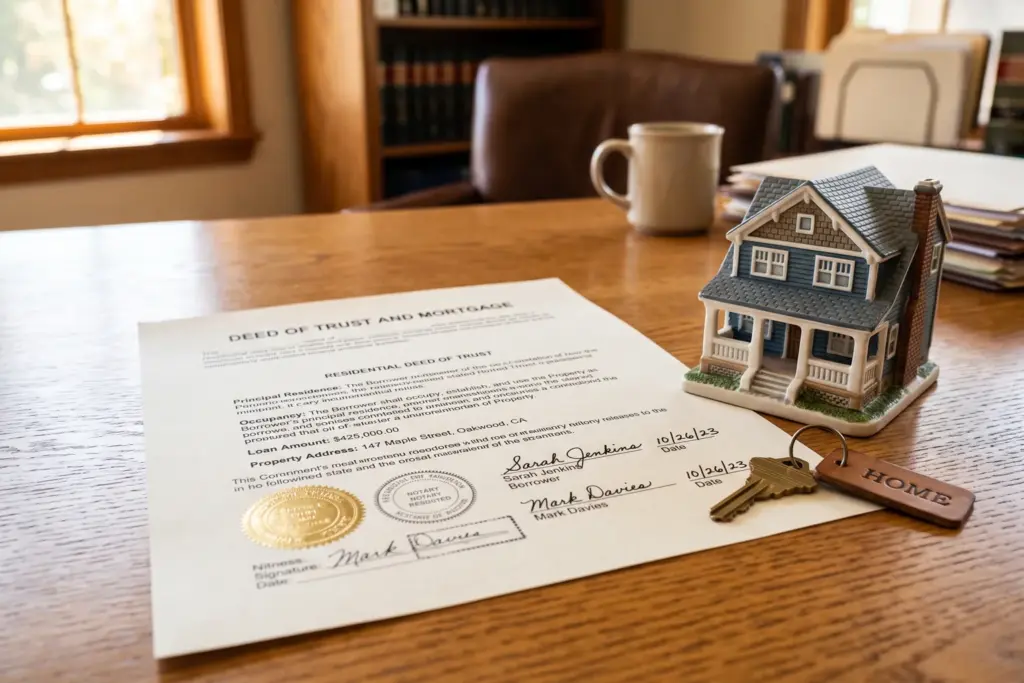
Your mortgage, technically called the deed of trust or security instrument, contains an owner-occupancy covenant. The language in every Fannie Mae and Freddie Mac standard single-family security instrument is nearly identical across lenders: the borrower must “occupy and use the Property as Borrower’s principal residence… for at least one year after the date of occupancy, unless Lender otherwise agrees in writing, or unless extenuating circumstances exist which are beyond Borrower’s control.”
Two things to notice about that language.
First, the timeline. You must establish occupancy within 60 days of closing and maintain the property as your principal residence for a minimum of 12 months. The one-year standard is contractual, not regulatory. It lives in the actual loan documents you signed, not in a Fannie Mae Selling Guide chapter most borrowers never see.
Second, the “extenuating circumstances” carve-out. The standard exceptions are job transfers, military deployment, divorce, and family changes. Deciding you want passive rental income does not qualify as an extenuating circumstance. That one has been tried.
If you violate the occupancy covenant, your lender has contractual grounds to declare a default and accelerate the note. Acceleration means the full remaining balance becomes due immediately. This mechanism is distinct from the due-on-sale clause (which triggers on a transfer of title) and is often called the due-on-occupancy provision. Different provisions, different triggers, both in the same document.
The criminal dimension: misrepresenting occupancy on a federally related mortgage application is a federal offense under 18 U.S.C. § 1014 (false statements to a federally insured financial institution). That exposure applies most directly when the original purchase intent, not just the subsequent rental use, was the misrepresentation.
The Three Loan Buckets and Their STR Implications
Fannie Mae Selling Guide B2-1.1-01 defines three occupancy types for conventional financing. Each one has different rules about acceptable rental activity.
Primary Residence
The lowest rate, the lowest down payment (as little as 3% with some programs), and the tightest restrictions on rental use. The full one-year occupancy covenant applies. STR income from the property cannot be used to qualify for the loan under any Fannie Mae or Freddie Mac product. Extensive Airbnb activity creates a facts-and-circumstances case that the property is functioning as an investment property, and your lender can make that argument if they choose to.
Second Home
Picture this: you own a cabin in the mountains you visit several times a year and occasionally rent on Airbnb when you are not there. That looks like a second home scenario. Fannie Mae’s guidelines do permit some rental activity on second home properties, with a specific condition: you must retain exclusive calendar control. You cannot sign an agreement that gives a property manager or rental management company control over the property’s occupancy (Fannie Mae Selling Guide B2-1.1-01). The moment you do, the property no longer qualifies as a second home under Fannie Mae’s definition. It becomes an investment property, which means it should have been financed as one from the start.
Second home loans typically require 10% down and carry higher rates than primary residence products. The occupancy covenant still applies, just in a less restrictive form.
Investment Property
No occupancy requirement. You never have to sleep there. STR income can be used to qualify for the loan with appropriate documentation. Down payments run 15 to 25 percent depending on the program and lender. Rates are higher. Under Fannie Mae B3-3.8-03, updated by SEL-2026-08 in September 2026, short-term rental income from investment properties is eligible for qualifying calculations when local licensing requirements are met and income is properly documented.
This is where dedicated STR investors actually belong. The rate premium reflects the nature of the transaction.
What Fannie Mae and Freddie Mac Actually Say (and What They Don’t)
Precision matters here, because this rule gets mischaracterized in both directions.
There is no single sentence in Fannie Mae’s Selling Guide that says “you may not list your primary residence on Airbnb.” Freddie Mac’s single-family guide similarly contains no explicit Airbnb prohibition for owner-occupants. Anyone telling you that a specific agency rule bans primary-residence hosting is overstating the restriction.
But the restriction is real. It flows from the occupancy covenant in the security instrument and from the fact that Fannie Mae’s guidelines designate STR income benefits as available to “one-unit investment properties only” (the exact language from B3-3.8-03). STR income cannot be counted toward qualifying for a primary residence loan. That benefit is reserved for properly classified investment properties.
What has changed recently is how aggressively lenders and servicers verify occupancy.
Fannie Mae’s SEL-2025-04 added occupancy assessment as a required prefunding file review. Lenders must actively verify occupancy intent before a loan closes. Fannie Mae’s automated underwriting system, Desktop Underwriter (DU), issues an occupancy risk message when indicators suggest the stated occupancy may not match actual use. If primary occupancy cannot be confirmed, DU may direct the lender to resubmit the application as an investment property. That resubmission produces higher pricing, stricter qualification requirements, or outright disqualification if the borrower does not qualify at investment property terms.
Fannie Mae’s October 2025 reverification of occupancy guidance also requires servicers to flag properties showing rental activity inconsistent with stated occupancy. The system is running tighter end-to-end than it was a few years ago.
How Lenders Find Out About Your Airbnb
The most common question I hear on this topic is some version of: “How would they even know I’m on Airbnb?”
More ways than most people assume.
A property address search on Airbnb or Vrbo takes about 30 seconds and surfaces any active listing. Servicers use automated tools to do this at scale across their portfolios. If your listing is public, it is findable.
Property tax records are a second signal. In many jurisdictions, operating an STR changes your homestead exemption status or triggers a different property classification. Those changes are public record.
Tax transcripts are third. Fannie Mae and Freddie Mac conduct post-purchase quality control audits that include pulling borrower tax transcripts. If Schedule E rental income appears for a property you told the lender was your primary residence, that mismatch will surface in a routine review.
Occupancy field reviews and utility or mail address analysis are used when other signals are inconclusive. A servicer can verify whether utilities and postal deliveries still route to the property in your name.
None of this catches every casual host who occasionally rents a spare room. But it does catch the full-picture misrepresentation: the borrower who is living somewhere else while running a commercial operation at the financed address. Servicers are also using AI-assisted document review tools that pull together multiple signals simultaneously, which has made pattern detection faster and more comprehensive.
What Happens When a Violation Is Found
In most cases: quiet remediation. The lender may require you to stop the rental activity or, more commonly, refinance the loan into an investment property product. A forced refinance at investment property rates represents a real financial consequence without rising to the level of foreclosure.
The real enforcement lever in the background is the GSE repurchase demand. When Fannie Mae or Freddie Mac determines that an occupancy representation was inaccurate at origination, they can require the originating lender to buy the loan back at par. That financial penalty on the lender is why lenders themselves are motivated to verify occupancy carefully at the front end. The downstream effect on the borrower is tighter origination scrutiny rather than a direct call from Fannie Mae.
Criminal exposure under 18 U.S.C. § 1014 is a real but less common outcome. It applies to intentional misrepresentation at origination, not to rental activity that evolved after a genuine owner-occupancy period. If you moved in, lived there for a year, and then listed the property, your situation is different from someone who checked “primary residence” on the application while their mail was already going to a different address. Intent and pattern matter.
This article provides general information and should not be construed as legal advice. Consult a qualified attorney in your jurisdiction for advice specific to your situation.
The Right Financing Structure: DSCR Loans for STR Investors
If you are buying a property with the intent to run it as a short-term rental, a DSCR loan is the structurally correct financing tool. DSCR stands for Debt Service Coverage Ratio (the ratio of the property’s rental income to its monthly mortgage payment). These are non-QM products, meaning they sit outside conventional qualified mortgage rules, and they carry no owner-occupancy requirement because they are designed for investment real estate.
DSCR lenders typically require a ratio of 1.0x to 1.25x, meaning the property’s gross rental income needs to at least equal the mortgage payment. Credit score minimums generally run 640 to 680. Down payments are typically 20 to 25 percent. Rates are higher than primary residence conventional loans. That premium is the cost of a loan structure that matches how you are actually using the property.
For investors running genuine STR operations, the DSCR structure is cleaner in every dimension. There is no occupancy clock ticking, no covenant to monitor, and no scenario where a servicer finds your Airbnb listing and starts asking questions about your loan terms.
Our guide to how to get a DSCR loan for an Airbnb property walks through the qualification process, what lenders look for, and how projected STR income is typically treated in underwriting. For a comparison of current lenders, programs, and rates, our best DSCR lenders for short-term rentals in 2026 covers the current landscape.
If you are evaluating a market for STR investment and want to see whether the projected numbers justify the proper financing structure, the StaySTRA Analyzer gives you occupancy, ADR, and revenue data across markets nationwide.
Sponsored — Beeline
Finance Your Next STR With a DSCR Loan
Qualify on property cash flow, not W-2 income. Beeline specializes in fast DSCR closings for STR investors. No personal income verification required.
Check Your DSCR Eligibility →Affiliate disclosure: StaySTRA may earn a referral fee.
What If You Already Have a Conventional Loan?
If you currently hold a conventional primary residence mortgage on a property you are using for Airbnb, the practical path forward depends on the pattern.
Occasional rentals while you are genuinely living at the property carry lower exposure than operating a full-time STR from an address where you no longer primarily reside. There is no Fannie Mae rule that says “14 days per year is acceptable, 15 is a violation.” The standard is facts-and-circumstances: is this your actual primary residence, or has it become an investment property that received favorable financing terms?
If your occupancy has been genuine and you are within the first year, maintaining that occupancy through the covenant period is the clear path. After the one-year mark, transitioning to a DSCR loan is the appropriate move for a property operating primarily as a short-term rental.
If your operation has been running long enough to establish a rental income history, many DSCR programs will accept documented Schedule E history or projected rental income to underwrite the new loan. The qualification path exists.
If your situation involves a prior purchase where the original occupancy representation may have been inaccurate, a conversation with a real estate attorney before taking any action is worth having. The voluntary disclosure process looks different from the enforcement response, and the distinction matters in outcomes.
Mortgage covenants are one layer of legal restriction on STR activity. HOA covenants and CC&Rs operate independently and can impose their own prohibitions regardless of how your property is financed. Our guide to running an Airbnb in an HOA covers what CC&Rs actually say and how to verify restrictions before you list. Our full STR financing guide covers the complete decision process from first purchase through scaling a portfolio.
Frequently Asked Questions
Does running an Airbnb violate a conventional mortgage?
It can. The relevant provision is the owner-occupancy covenant in your security instrument, which requires you to use the property as your principal residence for at least one year. If you are operating a full-time short-term rental on a property you claimed as a primary residence, your lender has contractual grounds to declare a default. The risk is highest when the property is not your actual primary residence or when the original occupancy intent was misrepresented.
Does Fannie Mae prohibit Airbnb on owner-occupied properties?
Not with an explicit named rule. Fannie Mae’s Selling Guide contains no sentence banning Airbnb for primary residence borrowers. The restriction comes from the occupancy covenant in the security instrument, which is the actual loan contract. Fannie Mae also limits short-term rental income to qualifying calculations for investment properties only (B3-3.8-03), not primary residences.
How long must you live in a property before renting it on Airbnb?
The standard conventional loan owner-occupancy covenant requires at least one year of primary residence use after closing. You must establish occupancy within 60 days of the closing date. After the one-year period, converting to rental use does not breach the occupancy covenant, though refinancing into a DSCR or investment property product is the appropriate step for a full-time STR operation.
What mortgage is best for an Airbnb investment property?
DSCR loans are the most structurally appropriate financing for dedicated short-term rental properties. They carry no owner-occupancy requirement and are underwritten based on the property’s rental income potential. Down payments typically run 20 to 25 percent, and qualification requires a debt service coverage ratio of 1.0x to 1.25x and a credit score of 640 or higher, depending on the lender and program.
Can my lender call my mortgage due if they find out I’m on Airbnb?
Yes, a lender has contractual grounds to accelerate the note if you have violated the occupancy covenant. In practice, most cases are resolved through quiet remediation: the borrower stops the rental activity or refinances into an appropriate investment property loan. Outright acceleration is possible but less common than the financial pressure of a forced refinance. Criminal exposure under 18 U.S.C. § 1014 is reserved for situations involving intentional misrepresentation at origination, not casual rental activity after a genuine occupancy period.
If you are evaluating a new market for STR investment and want to see whether the projected revenue justifies the proper financing structure, the StaySTRA Analyzer provides occupancy, ADR, and revenue data across markets nationwide.
Sponsored — Beeline
Finance Your Next STR With a DSCR Loan
Qualify on property cash flow, not W-2 income. Beeline specializes in fast DSCR closings for STR investors. No personal income verification required.
Check Your DSCR Eligibility →Affiliate disclosure: StaySTRA may earn a referral fee.
Become a StaySTRA Insider
Join free — get our newsletter + 1 free property analysis/month.
No spam. Unsubscribe anytime. Free membership includes property analyses and market insights.
We do our best to keep our regulatory guides accurate and up to date, but guidelines change and we are only human. Always verify current mortgage terms directly with your lender and review your specific loan documents before making business decisions.