
Key Takeaways
- University markets create year-round STR demand through football games, graduation weekends, move-in weeks, parents weekends, and alumni travel: events that beach and mountain markets simply do not have.
- StaySTRA data shows Madison (WI) reaching 63% occupancy, above the 57% average across the 107 markets StaySTRA tracks, while Ann Arbor (MI) averages 55% annual occupancy at $232 ADR.
- The academic calendar publishes demand windows months in advance, letting investors block high-revenue dates before competing properties even start thinking about pricing.
- Several popular college town markets have already capped STR licenses, including Fayetteville, AR (non-owner-occupied licenses) and Tuscaloosa, AL (multi-family licenses), so verifying local rules before buying is not optional.
- The StaySTRA Analyzer lets you model revenue potential in any university market before you make an offer.
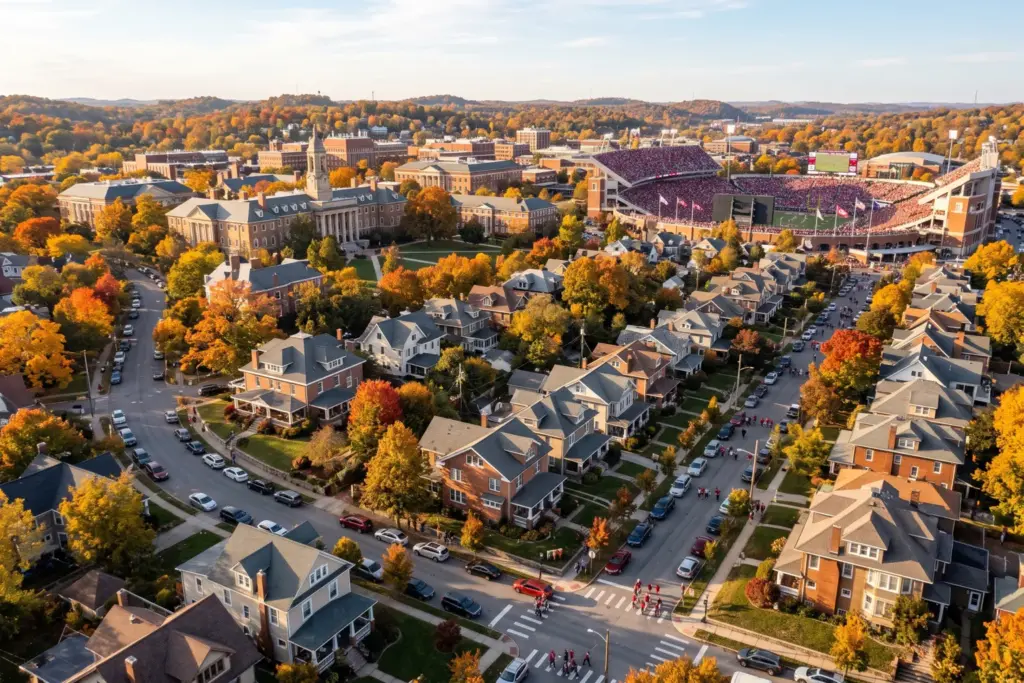
On a Saturday morning in early November, Knoxville goes orange. Every hotel within twenty miles of Neyland Stadium fills by Thursday. The STR hosts who figured this out a few years back have already blocked the weekend at a multiple of their standard rate, confirmed the reservation months earlier, and moved on to the next event on the university calendar. By the time a first-time buyer starts researching Knoxville, those dates are gone.
That pattern, repeated six, eight, ten times a year across football, graduation, homecoming, parents weekends, and move-in season – is what makes university town investing different from every other STR strategy. Es una demanda que no descansa (it is a demand that never rests). StaySTRA data shows Knoxville averaging 58% annual occupancy and $189 ADR across the last twelve months. The number that matters more than either of those is the floor: even in January, when beach markets are empty and ski towns are hoping for snow, a college town has students, visiting professors, conference groups, and a steady stream of campus visitors filling properties.
This guide is for the investor who is weighing their first or second STR purchase and asking whether a university market holds up better than a seasonal one. The short answer is yes, in specific ways and with real tradeoffs. The longer answer follows.
Why University Markets Create a Different Kind of Demand
Most STR markets run on one engine. A beach market sells summer. A ski town sells winter. A mountain cabin destination sells fall foliage and holiday weekends. When that one engine sputters – bad weather, a slow booking year, oversupply – the whole property feels it.
A college town runs on several engines at once, and they are set by an institution that has been publishing its schedule every year for a century.
Consider what happens across a standard academic year at a mid-major state university:
- August: Move-in weekend. Parents, siblings, grandparents, and loaded minivans arrive from across the state. Hotels book out first; STRs absorb the overflow. At larger flagship universities, move-in extends across two full weekends.
- September through November: Football season. Home games range from five to seven per season depending on scheduling. Each one generates demand from visiting fans, alumni who do not want hotel rooms, and groups making a weekend trip of it. Rivalry games pull people from hundreds of miles away.
- October: Homecoming and parents weekends. Many universities schedule these independently of football, creating additional demand windows even on non-game weekends.
- May: Graduation. This is the event that surprises most first-time college town buyers. Visitors travel from across the country. Hotels book eighteen months in advance. STR properties with space for extended groups, four bedrooms, two bathrooms, a full kitchen – command rates that hosts in other markets see only during peak summer. Requests come in October for May ceremonies.
- June and July: Academic conferences, graduate program orientations, summer institutes, visiting scholars. Softer demand, but it exists in a way that a beach market in January simply does not.
The issue is not just about the peaks. It is about the spacing. A beach market might have ninety high-revenue days clustered between Memorial Day and Labor Day. A well-positioned college town property has high-revenue dates distributed across nine months of the year.
What StaySTRA Data Shows About College Town Markets
StaySTRA data for Ann Arbor, Michigan, home of the University of Michigan – shows an average annual occupancy of 55% and an average daily rate of $232, with average monthly revenue of $3,425. The average across the 107 markets StaySTRA tracks with a full year of data (November 2025 through October 2026) sits at 57% occupancy and $217 ADR.
Madison, Wisconsin, home of the University of Wisconsin – reaches 63% average annual occupancy at $180 ADR and $3,153 monthly revenue (October 2025 through September 2026, the latest twelve months available). That occupancy figure is six percentage points above the 57% average across tracked markets. The revenue holds up because the demand distributes across the full year rather than concentrating in a single season.
Other university markets StaySTRA tracks:
- Fayetteville, AR (University of Arkansas): 50% occupancy, $196 ADR, $2,826 average monthly revenue
- Lexington, KY (University of Kentucky): 57% occupancy, $193 ADR, $3,099 average monthly revenue
- Knoxville, TN (University of Tennessee): 58% occupancy, $189 ADR, $3,098 average monthly revenue
- Gainesville, FL (University of Florida): 52% occupancy, $162 ADR, $2,305 average monthly revenue
None of these figures is extraordinary on its own. A well-positioned beach property during peak summer will beat any of them in a single month. The point is not the ceiling. The point is the floor – and the predictability of when the high-revenue dates arrive.
For investors using DSCR financing, that predictability matters. A lender underwriting a vacation rental wants to see cash flow, and cash flow is easier to model when you can point to six football Saturdays, a graduation weekend, and a parents weekend as fixed demand events. The DSCR loan requirements for vacation rental properties favor markets where revenue is demonstrable rather than speculative.
The Investor Scenarios That Play Out in These Markets
The stories that come back from university town hosts follow a few recognizable patterns. These are illustrative composites from the kinds of experiences that surface repeatedly in STR investor communities.
The investor who came for game days and stayed for graduation. The calculus at the beginning is usually football. An investor buys a three-bedroom within walking distance of a major stadium, prices it at two to three times normal for home game weekends, and calculates whether those blocked weekends alone cover the mortgage. For many markets, they come close. What the investor discovers in year one is that May commencement season earns as much as any football Saturday, sometimes more, because groups booking for graduation want longer stays and are less price-sensitive. A three-bedroom that earns well on football weekends often earns just as well, or better, during commencement week, when the group flying in needs every bed in the house for three or four nights.
The investor who was surprised by how shallow the offseason is. Someone coming from a beach market background expects a deep winter. University towns do not have a deep winter the way a coastal market does. January is slower, occupancy drops, and ADR comes down. But a college town January still has students who need housing for visiting relatives, faculty candidates interviewing for positions, and graduate students with advisors flying in. The floor is not zero. For an investor who bought a beach property and watched the occupancy calendar go dark for four months, the year-round baseline of a college town can feel like a revelation.
The investor who runs both a college town property and a beach property. The comparison that comes up consistently: the beach property earns more per night during peak summer. The college town property is more predictable across the full year. When a slow summer hits the coastal market – something that happens every few years – the college town property keeps its football season, its graduation, and its academic calendar running exactly as scheduled. The university does not cancel its season because of weather. That counter-cyclical quality is what experienced multi-property investors talk about when they describe what college towns do for a portfolio.
I have spent enough time listening to investors in university markets to notice a consistent theme: the ones who built their revenue model around the full academic calendar – not just football – are the ones who sleep well through January. El calendario nunca miente (the calendar never lies).
What to Look for When Buying in a University Market
Not every property near a university captures university demand. The variables that matter most:
Distance and Walkability
For game day and graduation visitors, walkability to campus and the stadium matters more than it does in most STR markets. A group arriving from Atlanta to watch their daughter graduate from Tennessee does not want to deal with parking on game weekend. Properties within a mile of campus and within two miles of the stadium consistently perform better than equally priced properties farther out.
Downtown proximity matters separately. Many university towns have an active downtown restaurant and entertainment district that is not adjacent to campus. Properties that sit between campus and downtown capture both the event visitor (here for the game) and the leisure visitor (here for the weekend trip).
Property Size
The graduation and game day premium concentrates in larger properties. A studio or one-bedroom apartment near campus will capture the individual visitor market, but it misses the large-group dynamic that drives graduation pricing. A four-bedroom house with two full bathrooms and a full kitchen commands a different category of rate during commencement week. If the investment thesis includes graduation season revenue, a property large enough to accommodate a full group is not optional: it is the thesis.
Parking
University towns are dense, and parking is often limited. A property with a driveway or dedicated off-street parking is worth a measurable premium over one without it. Guests driving to games or arriving from out of town with luggage price this in when they choose between listings.
Zoning and Licensing
This is where college towns diverge sharply from each other, and it is the variable that can change the investment case entirely. Several markets that look attractive from the outside have already restricted how many non-owner-occupied STRs can operate.
Fayetteville, Arkansas reached the citywide cap on non-owner-occupied STR licenses. New applicants join a waitlist. If you are buying a property in Fayetteville and planning to operate it as a non-owner-occupied STR, verify the license status directly with the city before closing.
Tuscaloosa, Alabama caps multi-family STR licenses in its downtown-campus district at 150 active licenses per year (Source) and has an operating day limit for certain residential properties in that zone.
Ann Arbor, Michigan generally prohibits investor-owned (non-principal residence) STRs in residential zones; only those established before March 1, 2021 may continue as a legal nonconforming use (Source). Otherwise, only principal residences (owner or 30+ day tenant) and properties in commercial or mixed-use zones are eligible for STR licenses. That restriction has a significant impact on the investment model for buyers who would not be living in the property.
Madison, Wisconsin requires three permits or licenses before a host can operate or advertise a short-term rental, and the rental must be the host’s primary dwelling while operating and for the 12 consecutive months before, with a $300 one-time zoning permit application fee (Source).
The pattern across all of these markets is the same: local governments near major universities are actively regulating STRs, and several have already hit license limits. The time to find out about those limits is before you make an offer, not after you close.
Comparing College Towns to Seasonal Markets
The comparison investors make most often is against coastal markets. The core tradeoff:
A beach market in a strong location will produce higher peak revenue during summer than most college towns. A well-positioned property in a popular beach destination earns at rates college towns cannot match in June and July. The question is what happens in October, November, February, and March.
A college town has events in October (football, homecoming), November (championship runs, late-season football), and a graduation cycle in December at some schools. February is slower, but it is not the near-zero occupancy that some coastal markets experience between Labor Day and Memorial Day.
The investor whose only property is a beach house takes all the risk of a bad summer. The investor whose only property is in a college town takes the risk of lighter demand when no major events fall on a given weekend – but graduation happens regardless of the win-loss record. The university does not cancel commencement because the basketball team underperformed.
For investors evaluating market types, the data-backed guide to STR markets for new investors covers the full range of market types and which combinations of risk profile and revenue potential fit different buyer situations.
How to Run the Numbers Before You Buy
A buyer in Knoxville evaluating a three-bedroom within two miles of Neyland Stadium needs to answer specific questions: What do comparable properties earn in September, October, and November? What is the occupancy pattern in January and February? What does graduation weekend in May contribute?
The StaySTRA Analyzer lets you model those questions against actual market data before you close. Enter the market, the property type, and the investment parameters, and you get the revenue picture from StaySTRA data rather than a broker’s pro forma. Run it on any university market you are considering before you rely on anyone else’s projections.
The full step-by-step process for buying your first STR is covered in the complete guide to buying an Airbnb property – from market selection through financing, licensing, and setup. College town buyers who are earlier in the process should start there.
University markets are not the highest-revenue markets in the country on a per-night basis. What they offer is something different: a demand calendar that does not change with the weather, a revenue floor that holds up when other market types falter, and a buyer community of investors who keep coming back to the same thesis. El rendimiento constante gana la carrera larga (consistent return wins the long race).
See the full StaySTRA best Airbnb markets guide for a broader view of other high-performing market types.
Frequently Asked Questions
Are college towns good for Airbnb investment?
College towns create predictable, year-round STR demand through football games, graduation weekends, move-in season, parents weekends, and academic conferences. StaySTRA data shows some university markets – including Madison, WI at 63% occupancy and Knoxville, TN at 58% – above the 57% average across the markets StaySTRA tracks. The key advantage is a demand floor that does not depend on weather or season.
What is the best college town for Airbnb investment?
The answer depends on your investment criteria, local licensing rules, and property budget. Among the markets StaySTRA tracks, Madison, WI and Ann Arbor, MI show strong occupancy figures. Knoxville, TN and Fayetteville, AR offer lower entry prices with solid event-driven demand. Use the StaySTRA Analyzer to model specific markets against your investment parameters before you buy.
Can I operate a non-owner-occupied STR near a university campus?
It depends on the city. Ann Arbor generally prohibits non-owner-occupied STRs in residential zones, except those established before March 1, 2021. Fayetteville, AR has capped non-owner-occupied licenses and the waitlist is active. Tuscaloosa, AL caps multi-family STR licenses in the downtown-campus district. Always verify local licensing rules before buying; several popular university markets have already hit their limits.
How much can game days increase Airbnb rates in college towns?
Game day premiums vary by market, matchup, and property type. Larger properties near campus typically see the strongest rate increases during football rivalry games and commencement week. Run market-specific data through the StaySTRA Analyzer to see how comparable properties price during high-demand events in the university market you are considering.
How is buying an Airbnb in a college town different from other STR markets?
The main difference is the demand structure. College towns have multiple distinct demand events spread across nine to ten months of the year rather than a single seasonal peak. Graduation, football season, homecoming, and move-in weekend each bring different visitor types with different booking patterns. The academic calendar is published years in advance, which gives hosts a planning advantage that weather-dependent markets do not offer.
We do our best to keep our content accurate and up to date, but things change and we are only human. Always verify details directly with local sources before making decisions.
Run the Numbers on Your University Market
Before you make an offer on a college town property, see what the data says about the market you are considering.
Use the StaySTRA Analyzer to model occupancy, ADR, and revenue potential in any university market. It takes a few minutes and gives you a data-backed picture of what comparable properties actually earn.
Become a StaySTRA Insider
Join free — get our newsletter + 1 free property analysis/month.
No spam. Unsubscribe anytime. Free membership includes property analyses and market insights.