

Key Takeaways
- Coachella 2026 attendees report a wave of last-minute short-term rental cancellations, with hosts canceling confirmed bookings and relisting at prices 2x to 3x higher on competing platforms.
- Airbnb’s host cancellation penalties top out at 50% of the reservation amount, but in markets where festival pricing spikes exceed 100%, those fees still leave hosts with a profitable arbitrage opportunity.
- Vrbo’s tiered penalty structure mirrors Airbnb’s at 10% to 50%, with a 100% fee only applying after check-in time or guest denial of entry.
- The biggest enforcement gap is cross-platform: a host who cancels on Airbnb and rebooks on Vrbo, Whimstay, or a direct channel faces no penalty from the original platform beyond a one-time fee.
- Neither Airbnb nor Vrbo has implemented event-specific cancellation protections that scale penalties with demand surges.
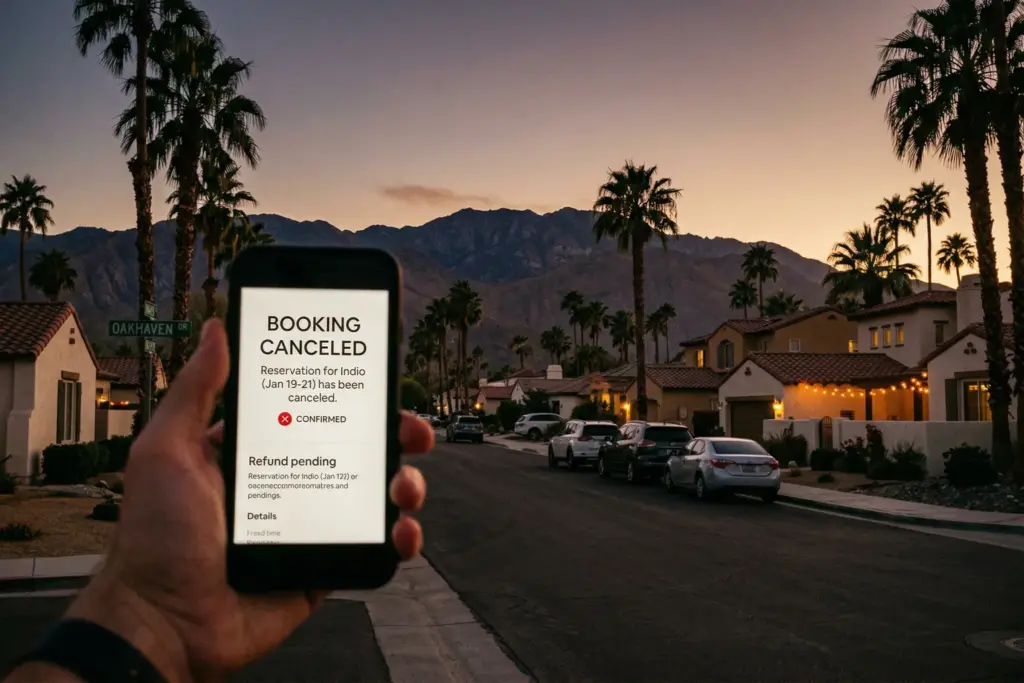
Sophie Rain booked her Coachella rental months in advance. She paid $29,000. Three days before the festival, her host canceled. The replacement listing she found cost $83,375.
Rain, a TikTok creator with 15 million followers, posted about the experience and became the most visible face of a problem that dozens of Coachella 2026 attendees reported across social media in the days leading up to Weekend 1. Hosts were canceling confirmed short-term rental reservations and, in many cases, relisting the same properties at dramatically higher prices. Some guests scrambled for alternatives. Others found nothing at all.
KESQ first reported the trend on April 8, documenting attendees who said they were left stranded in the Coachella Valley with no place to stay. One TikTok user, Drea Views, said her reservation was canceled on Easter Sunday despite having booked it the previous September. A Reddit thread titled “AirBnB canceled on you?” quickly filled with similar accounts.
The pattern is not complicated. A host locks in a booking months before the festival at a pre-surge rate. As the event approaches, demand pushes available inventory into a different pricing tier entirely. Data from AirROI shows that Indio asking rates during Coachella Weekend 2 hit $1,200 per night, a 109% premium over the early-May baseline of $573. La Quinta saw a 105% spike to $864 per night. Even Palm Springs, farther from the festival grounds, jumped 32% to $674.
The math favors canceling. Documents from Airbnb’s Help Center (Article 990) show the penalty structure that is supposed to prevent this.
What Airbnb’s Cancellation Penalties Actually Look Like
Airbnb charges hosts a fee when they cancel a confirmed reservation. The fee scales with timing:
- More than 30 days before check-in: 10% of the reservation amount ($50 minimum)
- 48 hours to 30 days before check-in: 25% of the reservation amount
- Within 48 hours of check-in or after: 50% of the reservation amount
The reservation amount includes the base rate, cleaning fee, and pet fees but excludes taxes and guest service fees. Beyond the monetary penalty, Airbnb blocks the listing’s calendar for the canceled dates to prevent the host from accepting a new reservation on the same property. Hosts also risk losing Superhost status and may face listing suspension for repeated cancellations.
On paper, those penalties look significant. In a normal market, a 25% to 50% fee would wipe out any profit from rebooking. But Coachella is not a normal market.
The Arbitrage Math That Makes Canceling Profitable
AirROI modeled the cancel-and-rebook economics for a typical Indio property during Coachella. The numbers tell the story.
A host who locked in a 3-night booking months ago at $550 per night collected a $1,650 reservation. Current Coachella asking rates in Indio sit around $1,260 per night, making that same 3-night stay worth $3,780. If the host cancels in the 25% penalty bracket (the most common window for Coachella cancellations, roughly 2 to 4 weeks before the festival), the fee is $412.50.
The net gain after paying the penalty: $1,717.50. That is a 104% profit increase on a single cancellation.
Even in the harshest bracket, the math still works. At the 50% penalty level, the host pays $825 on the original $1,650 booking. The rebooked reservation at $3,780 still yields a net gain of $1,305.
A single 3-night Coachella stay in Indio generates approximately $3,600 in revenue. AirROI notes that represents roughly 5% of a property’s annual income compressed into 0.8% of the calendar year. The incentive to optimize that window is enormous, and the penalties are not keeping pace.
Vrbo’s Penalty Structure: Similar Tiers, One Key Difference
Vrbo uses a nearly identical tiered approach for host-initiated cancellations. The fees break down the same way: 10% for cancellations more than 30 days out, 25% within 30 days, and 50% within 48 hours. The minimum fee is $50.
Where Vrbo diverges is at the extreme end. As StaySTRA previously reported on Vrbo’s cancellation policy changes, the platform charges a 100% cancellation fee when a reservation is canceled at or after check-in time, when a host is non-responsive in violation of the communications policy, or when a guest is denied entry without justifiable cause. That 100% tier took effect on October 1, 2025, and expanded to international properties in 2026.
But that 100% penalty only applies after check-in. Hosts who cancel days or weeks before the festival fall into the same 10% to 50% brackets that make arbitrage profitable on Airbnb. Vrbo does offer a waiver process (hosts have 10 days to submit a request), but eligible circumstances are limited to force majeure events like natural disasters.
The Cross-Platform Blind Spot
Here is the enforcement gap that neither platform has addressed. Airbnb blocks the canceled listing’s calendar so the host cannot rebook those dates on Airbnb. Airbnb also bans relisting at a higher price. Those are real deterrents within Airbnb’s ecosystem.
They mean nothing outside it.
A host who cancels on Airbnb and relists on Vrbo, Whimstay, Poppy, or a direct booking channel faces no additional consequence from Airbnb. The calendar block only applies to the Airbnb listing. The relisting ban only applies within Airbnb’s platform. Sources indicate that roughly half of short-term rental supply operates across multiple platforms or off-platform entirely, meaning the deterrent system has a structural hole that covers about half the market.
Airbnb responded to the Coachella cancellation reports by saying the company is “not seeing any notable uptick in cancellations over Coachella weekends.” A spokesperson said host cancellations are rare and that some recent cancellations were unrelated to Coachella, citing documentation provided by hosts. The platform pointed to its existing deterrents: fees, calendar blocks, and the relisting ban.
That response does not address the cross-platform gap. It does not address the fact that the penalty structure was designed for markets with 10% to 20% price variability, not 100%+ festival spikes where even maximum penalties leave hosts ahead.
What Guests Can Actually Do Right Now
Platform policy changes will not come in time for Weekend 2. For guests who have active Coachella bookings or are booking for future festivals, there are concrete steps that reduce exposure.
Book with Superhosts or Premier Hosts. These hosts have more to lose from cancellations. Superhost status requires maintaining a cancellation rate below 1%, and losing that badge affects search visibility, booking rates, and long-term revenue. A Superhost canceling a single reservation during a high-demand window risks a status they spent a year building.
Communicate early and directly. Guests who reach out to hosts before the festival to confirm the reservation create a documented paper trail. If the host later cancels, that documentation strengthens a dispute claim.
Use platform protections aggressively. Both Airbnb and Vrbo offer rebooking assistance and, in some cases, price-difference coverage when a host cancels. Guests should open a support case immediately upon receiving a cancellation notification. Waiting reduces options.
Consider booking on platforms with stronger host-cancellation enforcement. Booking.com, for example, handles cancellations differently for property-managed inventory. Our platform comparison breaks down how fees and enforcement differ across Airbnb, Vrbo, and Booking.com.
What Needs to Change at the Platform Level
Consumer advocates and affected guests have pointed to the same structural fix: dynamic cancellation penalties that scale with demand.
The concept is straightforward. If a market’s average daily rate has spiked 50% or more above its trailing baseline during the cancellation window, the host penalty should increase proportionally. A flat 25% fee that works in a normal week becomes a green light for arbitrage during Coachella, the Super Bowl, Formula 1, and every other event that creates outsized STR demand.
Cross-platform enforcement is harder but not impossible. Platforms already share listing data for regulatory compliance in cities like New York, where quarterly reporting requirements expose host behavior across platforms. A shared cancellation registry, where a host who cancels on one platform gets flagged on all of them, would close the cross-platform arbitrage loop. No platform has proposed this.
The third change is transparency. Neither Airbnb nor Vrbo publishes data on host cancellation rates during high-demand periods. Without that data, it is impossible to know whether the current penalty structure is working or whether the Coachella reports represent a systemic failure. Airbnb’s claim that cancellations are not notably elevated cannot be independently verified.
The Bigger Picture for STR Operators and Investors
For hosts who operate with integrity, the cancel-and-rebook problem creates collateral damage. Guest trust in STR platforms erodes with every viral TikTok about a booking getting canceled three days before a festival. That erosion pushes guests toward hotels, which have contractual protections against this exact scenario. Every guest who switches to a hotel for their next event is revenue the STR ecosystem loses permanently.
Investors evaluating STR properties in event-driven markets like the Coachella Valley should factor platform reliability risk into their analysis. StaySTRA’s analyzer tool can help model revenue projections for properties in these markets, but the cancellation enforcement gap is an externality that data alone cannot capture.
The platforms have the tools to fix this. Dynamic penalties, cross-platform flagging, and transparent cancellation data during high-demand periods would eliminate most of the arbitrage incentive overnight. What they lack, so far, is the will.
We do our best to keep our reporting accurate and up to date, but situations evolve and we are only human. Always verify current details directly with local officials and sources before making decisions.
Frequently Asked Questions
Can an Airbnb host cancel my Coachella reservation without penalty?
No. Airbnb charges hosts a cancellation fee ranging from 10% to 50% of the reservation amount depending on timing. However, those fees may not be large enough to deter cancellations in high-demand markets where replacement bookings can generate 2x to 3x the original price. Hosts also face calendar blocking and potential Superhost status loss.
What is Vrbo’s 100% cancellation penalty and does it apply to Coachella cancellations?
Vrbo charges a 100% cancellation fee when a host cancels at or after check-in time, fails to respond to guest communications, or denies entry without cause. This policy took effect October 1, 2025. Cancellations that happen days or weeks before the festival fall into lower penalty tiers (10% to 50%), which may still make rebooking profitable for hosts.
What should I do if my Airbnb host cancels my Coachella booking?
Contact Airbnb support immediately to open a case. The platform offers rebooking assistance and may cover price differences for comparable accommodations. Document all communications with the host. If you notice the same property relisted at a higher price on Airbnb, report it, as relisting at a higher price after cancellation violates Airbnb’s policy.
Can a host cancel on Airbnb and rebook on Vrbo at a higher price?
Yes, and this is the primary enforcement gap. Airbnb’s relisting ban and calendar block only apply within Airbnb’s platform. A host who cancels on Airbnb and rebooks the same dates on Vrbo, Whimstay, or a direct booking site faces no cross-platform consequence beyond the initial Airbnb cancellation fee.
Do Airbnb or Vrbo have special cancellation protections during festivals or major events?
Neither platform currently offers event-specific cancellation protections that increase penalties during high-demand periods. The standard tiered penalty structure applies regardless of whether cancellation occurs during a normal week or during a major event like Coachella, the Super Bowl, or Formula 1.
Run the Numbers Before You Buy
If you are evaluating short-term rental investments in event-driven markets like the Coachella Valley, understanding platform risk is just one piece of the puzzle. StaySTRA’s free analyzer tool lets you model revenue, occupancy, and market comparisons for any address in the country.
Become a StaySTRA Insider
Join free — get our newsletter + 1 free property analysis/month.
No spam. Unsubscribe anytime. Free membership includes property analyses and market insights.
Sponsored — OfferMarket
Buy Your First STR With Long-Term Rental Financing
Flexible, long-term financing for short-term rental buyers. Rates from 5.75%. Instant online quote, no credit pull.
Explore RTL Financing Options →Affiliate disclosure: StaySTRA may earn a referral fee.