

Key Takeaways
- The FTC’s Rule on Unfair or Deceptive Fees took effect May 12, 2025, and requires all short-term rental platforms to display the total price (including cleaning fees, service fees, and mandatory charges) upfront in search results.
- Airbnb rolled out global total price display on April 21, 2025. Vrbo enforced structured fee disclosure on May 12, 2025. Both platforms now show all-in pricing before checkout.
- Listings with high cleaning fees now look significantly more expensive in search results, especially for short stays where the per-night impact is largest.
- Hosts should audit their fee structures, consider rolling cleaning fees into nightly rates, and use length-of-stay discounts to stay competitive in the new pricing transparency environment.
- Violations carry civil penalties exceeding $51,744 per occurrence, and platforms like Vrbo can suspend accounts for non-compliance with structured fee disclosure requirements.
Every fee you charge is now visible the moment a guest starts searching. The FTC’s Junk Fee Rule, officially called the Rule on Unfair or Deceptive Fees, went into effect on May 12, 2025. It requires every short-term rental platform to show the total price upfront. That includes your cleaning fee, service fees, and all mandatory charges. No more revealing the real cost at checkout.
If you have been wondering why your booking pace changed or why your listing suddenly looks more expensive than the one next door, this is probably why. The rule has been live for nearly a year. The platforms have already rebuilt their search displays around it. And the hosts who adjusted early are pulling ahead of the ones still running $250 cleaning fees on two-night stays.
Here is exactly what changed, how Airbnb and Vrbo responded, and what you need to do about your pricing strategy right now.
What the FTC Junk Fee Rule Actually Requires
The FTC finalized this rule in December 2024 after years of rulemaking that started in 2023. The rule targets two industries: live-event tickets and short-term lodging. For STR hosts and property managers, the requirements are straightforward.
Any business offering short-term lodging must display the total price, inclusive of all mandatory fees, whenever they advertise, display, or offer a price. Short-term lodging under the rule includes hotels, motels, inns, vacation rentals, home shares, and any property listed on platforms like Airbnb or Vrbo.
The fees that must be included in the upfront total price:
- Cleaning fees (the big one for most STR hosts)
- Service fees charged by the platform
- Resort fees, amenity fees, pet fees, and any other mandatory charges
- Credit card surcharges if card payment is required
Taxes are handled differently. In jurisdictions where the platform collects occupancy or lodging taxes, those taxes are included in the total display. Where platforms do not collect taxes, those amounts appear separately but must still be shown before the guest consents to pay.
Optional charges that the guest selects (like early check-in or a pool heating add-on) do not need to be in the upfront total, but their purpose and amount must be clear before payment.
The penalty for violations? Civil fines exceeding $51,744 per occurrence, based on the FTC’s 2024 penalty thresholds. That is not a typo. And those penalties can stack.
How Airbnb Changed Its Pricing Display
Airbnb actually moved ahead of the FTC deadline. On April 21, 2025, the platform rolled out total price display as the global default. Before that, guests in the U.S. could toggle between a per-night view and a total price view. That toggle is gone now.
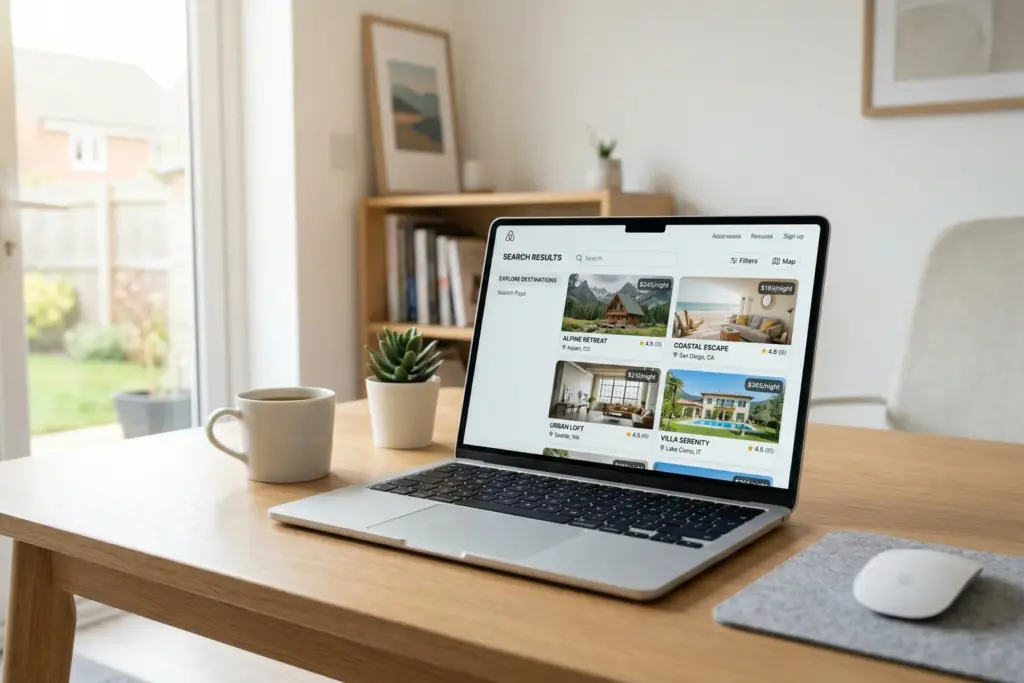
When a guest searches on Airbnb today, every listing in the results shows the total price for their selected dates. That total includes the nightly rate, cleaning fee, and Airbnb’s service fee. If Airbnb collects taxes in that jurisdiction, those are included too.
This is not a small UI tweak. It fundamentally changes how listings compete in search results. Before the change, a listing priced at $150/night with a $200 cleaning fee looked like a $150 listing in search. Now, for a two-night stay, that same listing shows up at roughly $350/night after the cleaning fee and service fee are factored in. The listing next door priced at $200/night with no cleaning fee shows around $225/night after service fees.
Which listing gets the click?
Airbnb’s own ranking algorithm factors total price into search placement. The platform ranks listings based on “total price and quality relative to similar properties.” So higher all-in prices do not just look less attractive to guests. They can push your listing lower in search results.
Airbnb also updated its Off-Platform Policy in May 2025, requiring hosts to either bundle all fees into a single price or clearly itemize them on direct booking websites as well. The transparency expectation extends beyond the platform.
How Vrbo Changed Its Pricing Display
Vrbo enforced its global pricing transparency policy on May 12, 2025, the exact date the FTC rule took effect. The implementation is slightly different from Airbnb but the result is the same: guests see the total price upfront.
Vrbo now requires all partners to enter fees into structured data fields. You cannot bury a cleaning fee in your property description or mention it only in the house rules. Every mandatory fixed fee must be entered into the designated platform fields so Vrbo can display accurate total pricing across all listings.
Search results on Vrbo show the total price excluding taxes alongside the nightly rate. All mandatory fees, including cleaning charges, resort access fees, and any other compulsory costs, are rolled into that total. Optional services selected by the traveler are not included.
The enforcement is strict. Hosts who charge undisclosed fees or fail to enter fees into the structured fields risk account suspension or removal. Vrbo is not treating this as a suggestion.
For hosts listing on both platforms (and you should be, according to our Vrbo vs. Airbnb comparison), the compliance work is similar: make sure every mandatory fee is entered in the correct platform field so it shows up in the upfront total.
Which Hosts Are Most Affected
Not every host feels this equally. The impact depends on your fee structure and your typical booking length.
High cleaning fee, short stay hosts. If you charge a $200 cleaning fee and your minimum stay is two nights, that cleaning fee adds $100 per night to your displayed total. On a one-night stay (where allowed), it doubles the visible cost. These listings took the hardest hit in search visibility after the pricing display changes rolled out.
Low nightly rate, high fee hosts. Some hosts kept nightly rates artificially low to rank well in search, then loaded up on cleaning fees and other charges. That strategy is dead. The total price is what matters now, and the old bait-and-switch pricing model is exactly what the FTC designed this rule to eliminate.
Multi-property managers with standardized cleaning fees. If you manage 10 properties and charge a flat $175 cleaning fee across all of them, some of those properties are probably overcharged relative to their size and market. A $175 fee on a studio is very different from a $175 fee on a four-bedroom house. The all-in pricing display makes that mismatch visible.
Longer-stay hosts. If your average booking is five to seven nights, the cleaning fee impact per night is much smaller. A $200 cleaning fee on a seven-night stay only adds about $29/night to the displayed total. These hosts are relatively insulated.
How to Adjust Your Pricing Strategy
The shift to total price display is not going away. This is the new normal. Here is how to compete in it.
Audit Your Cleaning Fee Against Market Data
Industry data shows the median U.S. cleaning fee is around $75 for a one-night stay. The average across all property sizes is $188. By bedroom count, the averages break down to $83 for studios, $102 for one-bedrooms, $156 for two-bedrooms, and $210 for three-bedrooms.
If your cleaning fee is significantly above the average for your bedroom count, you are at a competitive disadvantage in search results. Pull up your market on the StaySTRA Analyzer and compare your total nightly cost against comparable listings.
Consider Rolling Cleaning Fees Into Nightly Rates
Some hosts have eliminated their cleaning fee entirely and rolled the cost into a slightly higher nightly rate. The math works out the same for longer stays, but it makes short stays dramatically more competitive in search.
A listing at $180/night with no cleaning fee will outperform a listing at $130/night with a $200 cleaning fee on any stay shorter than four nights. And for the guest browsing search results, the no-fee listing just looks cleaner and simpler.
The trade-off? Longer stays become slightly more expensive, which could reduce your competitiveness for week-long bookings. This is where dynamic pricing tools like PriceLabs or Wheelhouse earn their subscription cost. They can adjust your base rate by booking length to offset the eliminated cleaning fee.
Use Length-of-Stay Discounts Aggressively
Both Airbnb and Vrbo support weekly and monthly discounts. If you rolled your cleaning fee into your nightly rate, offer a 10 to 15 percent weekly discount to make longer stays price-competitive. This recovers the margin you lose when a seven-night guest pays seven nights of a cleaning-fee-adjusted rate instead of one flat cleaning fee.
Price by Property, Not by Portfolio
If you manage multiple properties, stop using a blanket cleaning fee. A studio that costs $60 to clean should not carry the same fee as a four-bedroom house that costs $200. The all-in pricing display punishes this one-size-fits-all approach because it makes your smaller properties look overpriced in search.
For property managers running larger portfolios, understanding how Airbnb’s host-only fee model interacts with your pricing strategy is also critical. The 15.5% host fee comes out of your payout, and how you structure your visible pricing around that fee determines what guests actually see.
Monitor Your Conversion Data
After adjusting your fee structure, watch your search-to-booking conversion rate closely for 30 to 60 days. Airbnb provides views vs. bookings data in the Performance tab. If your views dropped after the pricing display change but your conversion rate held steady, you probably have a search ranking issue (price too high relative to competitors). If views held but conversions dropped, guests are seeing your listing but not booking, which could indicate a different problem like reviews or photos.
What About Direct Booking Websites?
The FTC rule applies to anyone offering short-term lodging, not just platforms. If you run your own direct booking website, you are also required to display the total price inclusive of all mandatory fees whenever you show a price.
That means your website’s search results page, your property listing page, and any advertising or social media posts that include a price must all show the total. You cannot advertise “$150/night” on Instagram and then reveal a $200 cleaning fee at checkout.
Most direct booking software (Lodgify, OwnerRez, Hospitable) has been updated to support total price display. Check your settings. If your software does not support it, that is a compliance gap you need to close. The FTC rule does not exempt small operators or individual hosts.
What This Rule Is Not
A quick clarification because this topic gets confused with a few other recent changes.
This rule is about pricing display and fee transparency. It is not about Airbnb withholding payouts (that is a separate payout policy issue). It is not about the FTC’s separate January 2026 rulemaking on long-term rental housing junk fees. And it is not about platform service fee changes. Those are all distinct topics.
The FTC Junk Fee Rule is specifically about ensuring guests see the real total price before they decide to book.
We do our best to keep our tech reviews accurate and up to date, but products evolve fast and we are only human. Always verify current features and pricing directly with vendors before purchasing.
Frequently Asked Questions
Does the FTC Junk Fee Rule apply to individual Airbnb hosts or only to platforms?
The rule applies to anyone who offers, displays, or advertises a price for short-term lodging. That includes platforms like Airbnb and Vrbo, but it also includes individual hosts who advertise prices on their own websites, social media, or direct booking platforms. If you show a price, it must be the total price.
Can I still charge a cleaning fee under the new rule?
Yes. The rule does not ban cleaning fees or any other fees. It requires that all mandatory fees be included in the total price displayed to guests upfront. You can still charge whatever cleaning fee you want, but guests will see that fee reflected in the total price from the very first search result.
What is the penalty for not complying with the FTC Junk Fee Rule?
Civil penalties exceed $51,744 per violation based on 2024 FTC penalty thresholds. Penalties can stack across multiple violations. Platforms like Vrbo can also suspend or remove host accounts for failing to enter fees into structured disclosure fields.
Should I eliminate my cleaning fee entirely and raise my nightly rate?
It depends on your typical booking length. Eliminating the cleaning fee and raising your nightly rate makes short stays more competitive in search results. But it can make longer stays less competitive since guests pay the built-in cleaning cost every night. Many hosts use length-of-stay discounts to offset this. Dynamic pricing tools can also adjust rates by booking length automatically.
When did Airbnb and Vrbo start showing total prices in search results?
Airbnb rolled out total price display as a global default on April 21, 2025. Vrbo enforced its total price display policy on May 12, 2025, the same day the FTC rule took effect. Both platforms now show all mandatory fees in the upfront price for every listing in search results.
The transparency era is here, and it rewards hosts who price honestly. If fee transparency is squeezing your margins and forcing you to rethink your STR investment strategy, it might be time to explore financing options that give you more room to operate.
Sponsored — OfferMarket
Buy Your First STR With Long-Term Rental Financing
Flexible, long-term financing for short-term rental buyers. Rates from 5.75%. Instant online quote, no credit pull.
Explore RTL Financing Options →Affiliate disclosure: StaySTRA may earn a referral fee.