

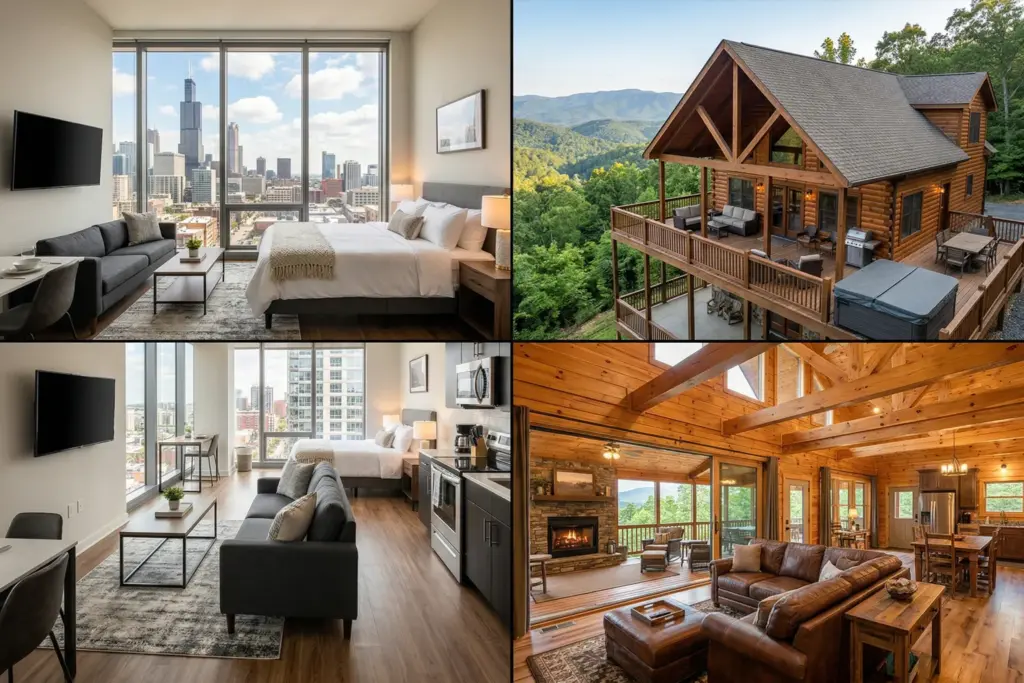
Key Takeaways
- A 5-bedroom STR generates $75,000 to $130,000+ in annual gross revenue nationally, roughly 4 to 5 times what a studio or 1-bedroom earns ($18,000 to $28,000).
- Bigger does not always mean better: studios and 1-bedroom units post the highest occupancy rates (often 70%+) in urban markets, while larger properties dominate revenue in mountain and resort destinations.
- Each additional bedroom adds roughly $12,000 to $25,000 in annual revenue in strong markets, but acquisition costs and operating expenses scale up too.
- The “best” property type depends entirely on the market category: urban investors should lean toward studios and 1-bedrooms, while resort and mountain investors benefit from 3-bedroom and larger properties.
- Entire houses outperform apartments and condos on gross revenue ($56,400 vs. $45,600 vs. $38,400 per year), but apartments and condos deliver higher occupancy rates.
A 5-bedroom short-term rental in the United States pulls in $75,000 to $130,000 or more per year in gross revenue. A studio or 1-bedroom in the same national dataset? Between $18,000 and $28,000. That gap is enormous, and it is the first thing most new investors notice when they start running numbers. But here is what 40 years of staring at data has taught me: the biggest number on the page is not always the smartest investment.
The real answer to “which property type makes the most money?” depends on where you are buying, what kind of guests that market attracts, and how much capital you have to deploy. I pulled data from StaySTRA’s market database, Airbnb host income reports, and industry benchmarks across 50 U.S. markets to break this down for you. Stay with me here, because the patterns are genuinely interesting.
Annual Gross Revenue by Bedroom Count
Let us start with the headline numbers. Think of bedroom count like engine size in a car: more cylinders generally means more power, but it also means more fuel, more maintenance, and a higher sticker price.
| Bedroom Count | Annual Gross Revenue | Average Nightly Rate (ADR) | Typical Guest Count |
|---|---|---|---|
| Studio / 1-Bedroom | $18,000 – $28,000 | $95 – $140 | 1-2 guests |
| 2-Bedroom | $28,000 – $45,000 | $140 – $200 | 2-4 guests |
| 3-Bedroom | $42,000 – $65,000 | $180 – $260 | 4-6 guests |
| 4-Bedroom | $58,000 – $85,000 | $230 – $320 | 6-8 guests |
| 5-Bedroom+ | $75,000 – $130,000+ | $290 – $450+ | 8-12 guests |
These are national averages. In strong markets, each additional bedroom adds roughly $12,000 to $25,000 in annual revenue. A 3-bedroom earning $65,000 per year might jump to $85,000 or more at 4 bedrooms in the same zip code. That is real money.
But look at the ADR column. A studio commands $95 to $140 per night. A 5-bedroom commands $290 to $450+. The gap in nightly rate is wider than the gap in annual revenue, and that tells us something important about how occupancy works at different property sizes.
Sponsored — Beeline
Finance Your Next STR With a DSCR Loan
Qualify on property cash flow, not W-2 income. Beeline specializes in fast DSCR closings for STR investors. No personal income verification required.
Check Your DSCR Eligibility →Affiliate disclosure: StaySTRA may earn a referral fee.
The ADR vs. Occupancy Tradeoff
Here is where the data gets interesting. Bigger properties charge more per night, but they sit empty more often. Smaller properties charge less per night, but they fill more consistently.
Across major U.S. markets, studios and 1-bedroom units routinely post occupancy rates between 65% and 78%. Entire apartments average 75% occupancy nationally. Condominiums (which skew toward 1- and 2-bedroom units) average 73%. Meanwhile, large homes with 4 or more bedrooms often land in the 45% to 60% range depending on the market and season.
Think of it like a restaurant. A small, intimate bistro can fill its 20 seats every night. A 200-seat banquet hall might only book events on weekends. Both can be profitable, but the economics look very different.
This tradeoff is why gross revenue alone can be misleading. A 4-bedroom house that earns $85,000 at 50% occupancy is generating that income over roughly 183 nights. A studio earning $25,000 at 75% occupancy is working 274 nights to get there. The house earns more per guest-night, but the studio’s consistency means steadier cash flow, lower vacancy risk, and less reliance on peak-season pricing to hit your numbers.
Revenue by Property Type (Not Just Bedrooms)
Bedroom count is the biggest factor, but the property type itself matters too. Industry data shows clear performance tiers:
| Property Type | Average Monthly Revenue | Estimated Annual Revenue | Average Occupancy |
|---|---|---|---|
| Entire House | $4,700 | $56,400 | 72% |
| Apartment | $3,800 | $45,600 | 75% |
| Condominium | $3,200 | $38,400 | 73% |
| Unique Property | $2,200 | $26,400 | 65% |
| Private Room | $1,800 | $21,600 | 78% |
Private rooms have the highest occupancy (78%) but the lowest revenue. Entire houses lead on revenue but sit slightly below apartments on occupancy. Apartments hit a sweet spot for many urban investors: strong occupancy, respectable revenue, and typically lower acquisition costs than a full house.
I have watched this pattern hold across four decades of housing data. The most common STR listing type nationally is a 2-bedroom home available approximately 90 days per year, which tells you where most hosts land when they weigh the tradeoffs.
Urban Markets: Where Small Properties Win
If you are buying in a city, smaller is often smarter.
Urban markets maintain 60% to 75% occupancy year-round because their demand comes from a steady mix of business travelers, couples, and solo visitors. These guests need a clean place to sleep, not a vacation compound with a pool table. Studios and 1-bedrooms thrive here because they match what the market actually wants.
StaySTRA data shows New York City’s STR composition tells this story clearly: out of 10,637 tracked properties, 1-bedroom units make up 5,334 listings (50.1%) and studios account for another 1,266 (11.9%). The market has voted with its wallet. NYC posts an 87% occupancy rate with an average ADR of $274, and that high occupancy is driven overwhelmingly by smaller units serving a year-round demand base of 65 million annual visitors.
Chicago follows the same pattern: 67% occupancy and $204 ADR, with 1- and 2-bedroom apartments dominating the inventory. Austin runs at 60% occupancy with a higher ADR of $284, though its 9,289 active listings create more competition in every size bracket. StaySTRA’s market pages break down these city-level numbers in detail.
The urban arbitrage play for investors is straightforward: acquire a studio or 1-bedroom condo in a high-occupancy metro, price competitively, and let consistency do the heavy lifting. Your revenue ceiling is lower, but your floor is higher. That is a meaningful advantage when you are servicing a mortgage.
Mountain and Resort Markets: Where Bigger Properties Dominate
Mountain markets flip the script entirely. In Gatlinburg, the Smoky Mountains, and Colorado ski towns, guests travel in groups. They want space. A couple does not typically book a cabin for a long weekend, but a group of 8 friends splitting a 4-bedroom lodge absolutely does.
The numbers in the Smokies are striking. StaySTRA data shows Gatlinburg’s 3,914 active listings average $338 ADR, with peak-month revenue hitting $7,566 in July. But that is the market average. When you break it by size:
- 3-bedroom cabins in the Smokies generate $75,000 to $80,000 per year
- 5-bedroom cabins cross the $100,000 mark
- 8-bedroom properties (the mega-cabins) have produced $398,000 to $411,000 in annual rental income
That is not a typo. An 8-bedroom cabin in the Smokies can generate nearly half a million dollars in gross revenue. The economics work because groups split the cost per person, making a $500-per-night cabin feel reasonable when it is $63 per head.
Market-wide occupancy in the Smokies tracks at 53% to 58%, which is healthy by national standards (the national average sits closer to 52%). Rate growth has stabilized around 3% annually after the 2021-2022 surge when operators pushed prices as hard as the market would tolerate.
Colorado mountain markets show similar dynamics. StaySTRA data shows Breckenridge averages $393 ADR with 62.5% occupancy and $5,346 in monthly revenue across its 5,008 listings, with peak February months hitting $11,116. If you are looking at this space, our coastal vs. mountain STR market comparison goes deeper on the seasonal patterns.
Coastal and Mixed-Demand Markets: The Middle Ground
Coastal markets like Miami and Nashville occupy interesting middle territory. They attract both couples (who book small) and groups (who book large), so property type performance is less lopsided than in pure urban or pure mountain markets.
StaySTRA data shows Miami’s 8,743 listings average $325 ADR and 49% occupancy, with a 90th-percentile performer pulling $9,595 per month. Peak season (March, at 69.8% occupancy and $6,293 monthly revenue) lifts all boats, but the spread between the 25th percentile ($1,458/month) and the 90th is enormous. Property type and positioning explain much of that gap.
Nashville’s 5,988 listings average $335 ADR, with October peak performance reaching $6,334 monthly revenue at 63% occupancy. The city’s event-driven demand (bachelor and bachelorette parties, music festivals, NFL games) favors 2- and 3-bedroom properties that can host small groups while still booking for couples on slower weekdays.
Asheville, with its smaller inventory of 1,853 listings, averages $244 ADR and peaks in October at $4,668 monthly revenue. The market has experienced significant occupancy compression since 2021, and average annual revenue per listing has declined from $4,778 to $3,317 as new supply absorbed demand. For investors eyeing these mixed-demand markets, our 50-market DSCR loan analysis breaks down the financing math by market.
Demand Growth: Which Property Sizes Are Gaining?
The national trend data adds one more layer to this picture. In 2025, large homes with 6 or more bedrooms experienced the fastest booking growth at 12.6% year over year. That is being driven by group travel, multi-generational vacations, and the continued popularity of “gathering” trips where extended groups split large properties.
Three-bedroom units also posted strong growth at 7.5% year over year, outpacing smaller listings. But here is the nuance: 1- and 2-bedroom units still have the highest absolute booking volumes nationally. They are not growing as fast because they are already the most booked segment. Smaller units are the workhorse of the STR industry. Larger units are the growth story.
Suburban markets add another wrinkle. Suburbs now outperform urban cores in 75.5% of large metropolitan areas, driven by remote work migration and generally more flexible STR zoning. A 3-bedroom suburban house with a yard and parking can capture both the “urban escape” traveler and the remote worker booking a week-long stay. That hybrid demand profile is hard to replicate in a downtown studio.
A Framework for Choosing Your Property Type
After 40 years of analyzing real estate data (and a few too many cups of black coffee at my desk in Santa Fe), I keep coming back to the same framework. The “best” property type is not the one with the highest gross revenue. It is the one that matches your market, your capital, and your risk tolerance.
Here is how I would think about it:
If you are buying in an urban market (Austin, Denver, Chicago, NYC): lean toward studios and 1-bedroom condos or apartments. Occupancy is your friend here. Steady 65%+ fill rates with lower acquisition costs mean you can break even faster and weather slow months without panic. StaySTRA data shows Denver’s 3,760 listings average $211 ADR and 54% annual occupancy, with the best performers (90th percentile) clearing $4,680 per month.
If you are buying in a mountain or resort market (Gatlinburg, Breckenridge, Big Bear): go bigger. Three bedrooms is the entry point where revenue starts to make a compelling case against acquisition and operating costs. Four and 5-bedroom properties are the sweet spot. The seasonality is real (Big Bear’s annual occupancy sits around 32% to 35%), but peak-season rates can carry the entire year if you price correctly.
If you are buying in a coastal or mixed-demand market (Miami, Nashville, Asheville): 2- and 3-bedrooms offer the best flexibility. You can book couples on weekdays and groups on weekends. Nashville’s event calendar drives demand for properties that can host 4 to 6 guests, and that is squarely in 2- to 3-bedroom territory.
If you are buying in a suburban market: 3-bedroom houses tend to perform well. They attract both remote workers and small groups, two of the fastest-growing STR guest segments. The acquisition cost is usually lower than comparable urban properties, and suburban zoning tends to be more STR-friendly.
Run the numbers for any specific market using the StaySTRA Analyzer. It will show you actual revenue, occupancy, and ADR data for the exact city and property configuration you are evaluating.
The 3-Bedroom Sweet Spot
If I had to pick one property size that works in the most markets across the most conditions, it would be the 3-bedroom. Not because it tops any single metric, but because it performs well across nearly all of them.
A 3-bedroom earns $42,000 to $65,000 per year nationally. It books well in urban, suburban, coastal, and mountain markets. It attracts couples who want extra space, small groups, and travelers who value room to spread out (without the operating complexity of a 5-bedroom property). Its demand growth of 7.5% year over year is healthy. And its acquisition cost sits in the middle of the range, which means the math works with a wider variety of financing options.
That said, I have seen investors do extremely well with studios in Manhattan and with 6-bedroom cabins in Pigeon Forge. The key is matching the property to the market, not picking a size and then shopping for a market that fits it.
We do our best to keep our data accurate and up to date, but markets move fast and we are only human. Always verify current figures directly with local sources before making investment decisions.
Frequently Asked Questions
What bedroom count generates the most STR revenue?
On a gross revenue basis, 5-bedroom and larger properties generate the most, with national averages ranging from $75,000 to $130,000+ per year. They also require the highest acquisition costs and have lower occupancy rates (often 45% to 55%). For most investors, 3-bedroom properties offer the best balance of revenue ($42,000 to $65,000 annually) and consistent demand across market types.
Do studios or 1-bedroom Airbnbs make money?
Yes. Studios and 1-bedroom units generate $18,000 to $28,000 per year nationally and post the highest occupancy rates in the industry (65% to 78%). In urban markets like New York, Chicago, and Denver, they are often the most reliable performers because demand from business travelers, couples, and solo visitors is consistent year-round. Lower acquisition costs also mean faster breakeven timelines.
Is it better to invest in a house or a condo for short-term rental?
Entire houses average $56,400 per year in gross revenue with 72% occupancy, while condominiums average $38,400 with 73% occupancy. Houses earn more but cost more to buy and maintain. Condos offer lower entry points and strong occupancy, making them attractive for first-time STR investors. HOA restrictions on short-term rentals are a critical factor to check before purchasing any condo for STR use.
Which markets favor smaller STR properties?
Urban markets with year-round demand strongly favor smaller units. New York City’s STR inventory is 62% studios and 1-bedrooms. Chicago, Denver, and Austin all show similar patterns where 1- and 2-bedroom properties dominate booking volume. Any market where business travel, convention traffic, or solo tourism drives demand will favor compact properties with high turnover.
How much does each additional bedroom add to STR revenue?
In strong markets, each additional bedroom adds approximately $12,000 to $25,000 in annual gross revenue. The jump from 1 to 2 bedrooms is typically the most impactful per dollar invested. Beyond 4 bedrooms, the revenue-per-bedroom gain starts to plateau in most markets, with the notable exception of mountain resort destinations where large group properties command premium pricing.
Run Your Own Numbers
The data in this article gives you the national picture. But STR investing is local. A 2-bedroom condo that crushes it in Miami Beach might barely break even in suburban Indianapolis. The only way to know what works in your target market is to run the numbers with real data.
The StaySTRA Analyzer shows actual ADR, occupancy, and revenue data for specific cities and property configurations. Plug in the market you are considering, select the bedroom count, and see what the data says before you make an offer.
Become a StaySTRA Insider
Join free — get our newsletter + 1 free property analysis/month.
No spam. Unsubscribe anytime. Free membership includes property analyses and market insights.