

Key Takeaways
- Aspen’s STR market commands an average daily rate between $640 and $1,025 depending on property type, making it one of the most expensive vacation rental markets in the United States.
- Permit caps in 8 of 14 residential zones and a use-it-or-lose-it renewal policy mean Aspen’s STR supply is constrained by design, not just by demand.
- Annual gross revenue averages $85,000 to $90,000 across all property types, with luxury ski-in properties earning well above $150,000.
- The aggregate tax burden on investment STR properties is 22.35%, the highest of any market in the Sprint 3 mountain series.
- With a median single-family home price of $13.2 million, the implied DSCR math only works for condo and townhouse buyers at the $3.5 million median entry point.
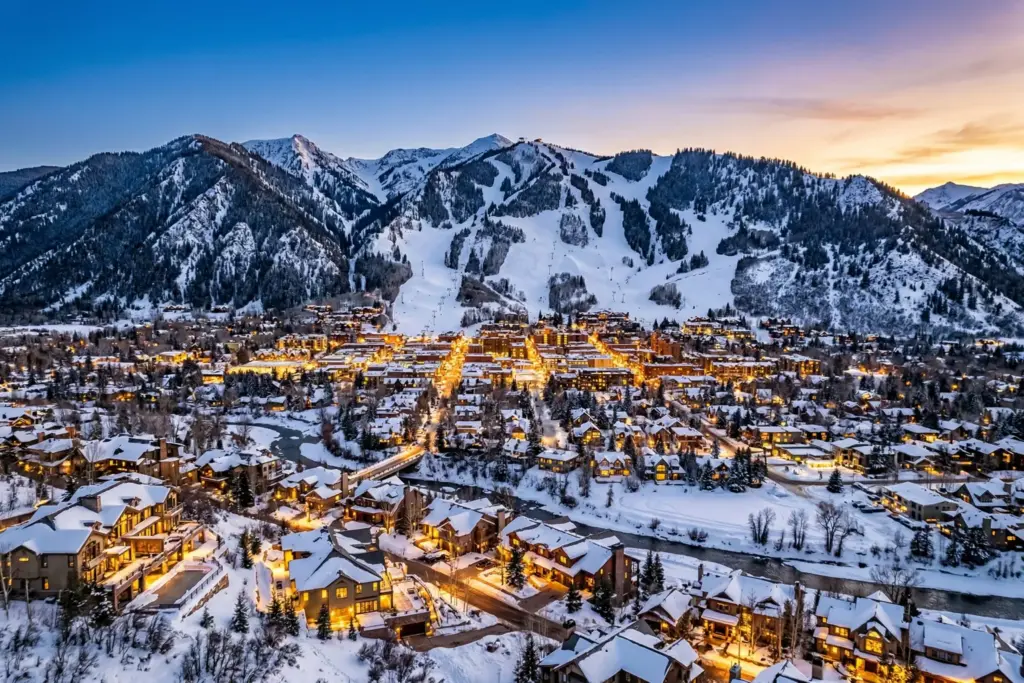
Aspen’s short-term rental market posts an average daily rate that ranges from $640 to over $1,000 depending on property type, with approximately 1,700 active listings competing for a visitor base that fills the Roaring Fork Valley in two distinct seasonal waves. Those numbers place Aspen at the extreme end of the Colorado mountain STR spectrum. Think of it as the difference between shopping at a department store and shopping on Worth Avenue. The inventory is smaller, the prices are steeper, and the buyers who show up tend to know exactly what they want.
Market-wide occupancy lands between 38% and 55% on a trailing twelve-month basis, which looks low on paper until you understand how this market actually works. Many Aspen STR properties are only rented during peak ski season and a summer window, sitting dark through the shoulder months by owner choice. The properties that do operate year-round see occupancy closer to 55%, while seasonal-only listings pull the average down. Year-over-year, Aspen’s STR performance has been ticking upward: occupancy rose 4.7%, ADR gained 0.9%, and RevPAR climbed 5.7% compared to the prior period.
Revenue by Season: Two Peaks and Two Valleys
Aspen’s revenue calendar looks nothing like a beach market. Where a Gulf Coast property earns the bulk of its income across one long summer arc, Aspen splits its revenue between two peaks: ski season (December through March) and summer (June through August). The numbers tell the story clearly.
During February, the highest-demand month, occupancy reaches 57.5% with ADRs pushing toward $1,228 and monthly revenue averaging around $19,694 for a typical listing. Summer months bring a second wave of hikers, mountain bikers, and festival-goers who keep ADRs elevated and occupancy solid, though not at winter levels.
The valleys matter just as much. May is the quietest month in Aspen, with occupancy dropping to 26.3% and ADRs sliding to $890. Monthly revenue in May averages just $5,410. That is a 3.6x swing from peak to trough. If you are used to markets where revenue flows more evenly across the year, stay with me here. Aspen rewards operators who can tolerate months of near-silence between two lucrative bursts. My 40 years of looking at data patterns has taught me that markets with pronounced seasonality like this tend to reward patient capital and punish operators who need consistent monthly cash flow to service debt.
Aspen Chamber of Commerce data from fall 2025 fills in some recent detail. September occupancy hit 60.3%, though that represented a 3.5% year-over-year decline, with ADR at $582. October recovered nicely, posting 54.5% occupancy (up 5.8% year-over-year) and total market revenue of $8.69 million, an 11.4% jump from the prior October. The city collected $599,684 in STR tax revenue for August 2025 alone, a 20.5% increase over the same month the prior year.
What You Will Actually Pay: Aspen Real Estate Prices
Here is where Aspen separates itself from every other market in this mountain series. The median single-family home sold for $13.2 million in 2025, with the average pulled even higher to $17.3 million by ultra-luxury transactions. For context, Colorado’s statewide median single-family price was $584,000 that same year. Aspen’s median is roughly 22.6 times the state figure.
Condos and townhouses offer a more realistic entry point at a median of $3.5 million, though “realistic” is doing heavy lifting in that sentence. Inventory is sitting on the market for about 70 days with a 9.4-month supply, which points to a buyer-friendly environment on paper. But this is Aspen. Buyer-friendly here means you have more time to negotiate, not that you will find a bargain.
The DSCR math tells the real story for investors. Take the $3.5 million condo median and assume a 25% down payment ($875,000) with a DSCR loan at 7.5%. Your annual debt service on a $2.625 million loan lands around $220,000. Against average annual gross revenue of $85,000 to $90,000, the numbers do not come close. You would need a property generating $150,000 or more in annual gross revenue (before expenses) just to approach a 0.7 DSCR, and most lenders want 1.0 or above. The single-family market at $13.2 million is not even worth modeling. Aspen works as an STR investment only if you are buying at well below market, bringing substantial equity, or treating the rental income as supplemental to personal-use value rather than as a pure investment vehicle.
The Permit System: Supply Constrained by Design
Aspen’s STR regulatory framework is one of the most structured in the country, and it serves as the single most important factor for investors to understand. The city operates three permit categories, each with different rules and economics.
STR-C (Classic) permits are what most investors think of first. They cost $394 annually, allow unlimited rental nights, and can be applied to any residential property. The catch: STR-C permits are capped at 75% of existing permits in certain residential zone districts, and 8 of 14 residential zones have already reached or exceeded their caps. If you buy a property in a capped zone that does not already carry an active STR-C permit, you go on a waitlist. There is no guarantee of when (or if) a permit becomes available.
STR-OO (Owner-Occupied) permits cost $394 annually and are available to primary residents who hold title. The limit is 120 rental nights per year, and you need two proof-of-residency documents. These permits have no zone caps, which makes them the more accessible path, but the 120-night ceiling puts a hard lid on revenue potential.
STR-LE (Lodge Exempt) permits run $148 per unit annually, cover lodge and condo-hotel properties under professional management, and have no night limits or zone caps. A single permit covers all units under one management company.
The city issued approximately 790 STR permits as of 2023, with Pitkin County adding another 111 in unincorporated areas. That total of roughly 900 licensed STRs across the greater Aspen area represents a tightly controlled supply pool. And Aspen enforces a use-it-or-lose-it rule: any permit that shows $0 in tax revenue during the calendar year becomes ineligible for renewal. Permits that are not renewed by the January deadline are terminated, and reapplication means entering the waitlist in capped zones.
The Tax Burden: 22.35% for Investment Properties
Tax rates in Aspen deserve their own heading because they materially affect your net operating income. The city’s aggregate tax obligation for STR-C (investment/second home) properties is 22.35% as of 2026. That includes all jurisdictional sales taxes plus a 10% STR excise tax specific to classic permits. Owner-occupied and lodge-exempt properties face a lower aggregate of 17.35%, reflecting their 5% excise rate instead of 10%.
Think of it this way. On a $1,000 nightly booking in an STR-C property, the guest is paying $1,223.50 after taxes. But the owner remits $223.50 of that to the city. On $85,000 in annual gross revenue, that is nearly $19,000 going straight to tax obligations. It is the highest tax burden of any market in our Sprint 3 mountain series, and it needs to be built into every pro forma you run.
Pitkin County’s unincorporated areas add a different fee structure. Permit fees there are calculated as a percentage of your property’s assessor home market value, ranging from 0.05% (20 nights or fewer per year) to 0.07% (61 to 120 nights). On a home assessed at $5 million, the 120-night seasonal fee would be $3,500 annually. The county also enforces a 120-night annual cap for all STR properties and requires a 4-night minimum per rental period.
How Aspen Compares to the Sprint 3 Mountain Markets
This is the fifth article in our mountain series, and the comparisons to Jackson Hole, Big Sky, Telluride, and Steamboat Springs are worth laying out directly.
On ADR, Aspen sits at the top. Its $640 to $1,025 range exceeds every other market in the series by a wide margin. Jackson Hole is the closest competitor on nightly rate, but Aspen’s luxury inventory pushes the upper bound higher.
On occupancy, Aspen runs lower than markets like Steamboat Springs, which benefits from a longer, more accessible ski season and a broader visitor demographic. Aspen’s seasonal concentration (two peaks, two dead zones) suppresses its annualized occupancy rate compared to markets with more distributed demand.
On regulatory complexity, Aspen and Telluride are the two tightest markets in the series. Both have permit caps, both enforce annual renewal requirements, and both use the regulatory framework as a tool to manage housing pressure. Steamboat Springs and Big Sky operate under less restrictive regimes, though Steamboat has been tightening.
On entry price, nothing in this series (or frankly in the national STR landscape) comes close to Aspen. The $3.5 million condo median is roughly the price of a single-family home in Jackson Hole. The $13.2 million single-family median exists in a category of its own.
The investment thesis for Aspen is fundamentally different from the other four markets. You are not buying Aspen for cash-on-cash return or DSCR qualification. You are buying a scarce permit in a supply-constrained market where the asset itself appreciates at rates that have historically outpaced every other mountain market in the Rockies.
Who This Market Actually Serves
After spending weeks with the data on these mountain markets, and after a lot of black coffee at my desk in Santa Fe, I can tell you that Aspen is not an STR investment market in the traditional sense. It is a wealth preservation and appreciation play that happens to generate rental income.
The investor profile that works here is someone who can bring $1 million or more in equity to a condo purchase, does not need the property to pencil out on a DSCR basis, and values the permit scarcity as a long-term competitive moat. The permits themselves have become an asset. When a zone is capped and the waitlist is long, an existing permit-carrying property commands a premium that a non-permitted property in the same building does not.
For investors looking at the Colorado STR regulatory landscape more broadly, Aspen represents the ceiling, not the template. Markets like Steamboat Springs and even Breckenridge offer more conventional investment math with lower entry prices and more accessible permits.
We do our best to keep our data accurate and up to date, but markets move fast and we are only human. Always verify current figures directly with local sources before making investment decisions.
Frequently Asked Questions
How many STR permits are available in Aspen?
Aspen had approximately 790 active STR permits as of 2023, with another 111 in unincorporated Pitkin County. STR-C (Classic) permits are capped at 75% of existing permits in 8 of 14 residential zone districts, and most capped zones have active waitlists. New investors should verify permit availability for their target zone before making an offer on a property.
What is the average Airbnb income in Aspen Colorado?
Average annual gross revenue for an Aspen STR runs between $85,000 and $90,000 across all property types. Luxury ski-access properties with strong management can exceed $150,000 annually. Peak winter months (December through March) generate the bulk of annual income, with February being the strongest month at approximately $19,694 in average monthly revenue per listing.
What are the tax rates for short-term rentals in Aspen?
Investment and second-home STR-C properties face an aggregate tax obligation of 22.35% as of 2026, which includes all jurisdictional sales taxes plus a 10% STR excise tax. Owner-occupied (STR-OO) and lodge-exempt (STR-LE) properties pay a lower aggregate of 17.35% with a 5% excise rate. These taxes are filed and remitted monthly through the MUNIRevs portal.
Can you still get an STR permit in Aspen in 2026?
It depends on the zone and permit type. STR-OO (owner-occupied) permits have no zone caps but require primary residency and limit you to 120 rental nights per year. STR-C permits are capped in most residential zones, and many zones have waitlists. STR-LE permits are available for lodge and condo-hotel properties. The annual renewal deadline runs from November 15 through January 14, and any permit with zero tax revenue in the prior year is automatically terminated.
Is Aspen a good market for DSCR loan STR investing?
Aspen is extremely challenging for conventional DSCR-based STR investing. At the $3.5 million condo median with 25% down and a 7.5% DSCR loan, annual debt service exceeds $220,000, while average annual revenue sits around $85,000 to $90,000. The numbers improve for below-market purchases or properties with proven luxury revenue above $150,000, but most investors in Aspen bring substantial equity and treat rental income as supplemental rather than as the primary return driver. For markets where DSCR math works better, see our best STR markets for DSCR borrowers analysis.
Run the Numbers on Aspen
If Aspen is on your radar, the next step is running your own projections against real market data. Our Aspen Airbnb calculator lets you plug in a specific property and see estimated revenue, occupancy, and seasonal patterns. For a broader look at the Aspen market, visit the Aspen STR market data page.
[easy_street_capital_cta type=”dscr”]
Want STR market data and analysis like this delivered to your inbox? Join the investors, hosts, and operators who rely on StaySTRA to stay ahead of the market.
Become a StaySTRA Insider
Join free — get our newsletter + 1 free property analysis/month.
No spam. Unsubscribe anytime. Free membership includes property analyses and market insights.