

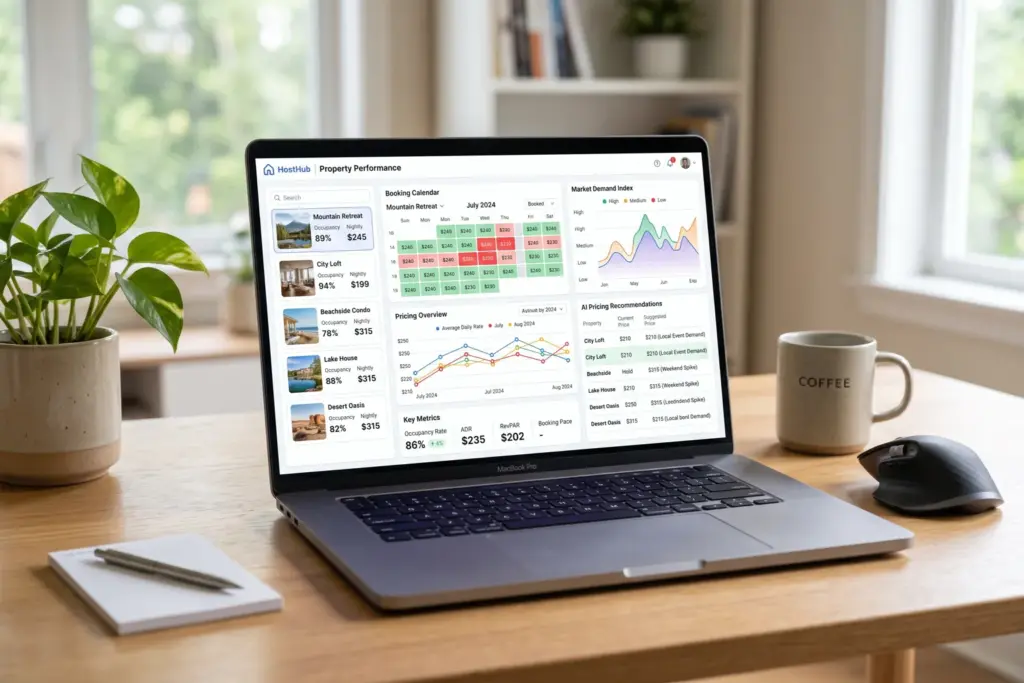
Key Takeaways
- Airbnb’s Fall 2026 Update (announced September 30) introduces a native dynamic pricing tool, an AI earnings dashboard for hosts with five or fewer listings, and a redesigned multi-listing calendar for hosts with six or more properties.
- The new AI pricing tool auto-adjusts nightly rates to daily supply and demand. Airbnb has not disclosed what signals it uses or how its recommendations compare to third-party tools like PriceLabs.
- The multi-listing calendar is the biggest workflow change for operators with six or more listings: it becomes the default desktop view and lets you update pricing, availability, cancellation policies, and discounts across properties in one place.
- AI-powered natural language and voice search are rolling out in the US this fall. Airbnb has not specified how the new search system affects host ranking.
- The Social Travel Map is a guest-facing social feature. Direct host impact on visibility or bookings is unconfirmed by Airbnb.
On September 30, 2026, Airbnb dropped its Fall 2026 update and for the first time, the platform shipped tools that overlap directly with what third-party software vendors have been selling to hosts for years. A native dynamic pricing tool. An AI-powered earnings dashboard. A bulk-edit calendar for multi-property operators. I read patent filings for fun, and this is one of the more aggressive product moves Airbnb has made in the host tools space in a long time.
But here is the honest take. The announcement is exciting. The practical details are thin. Airbnb has not told us what the AI pricing tool actually reads, how the earnings comparisons are built, or what the new search algorithm does to your ranking. That silence matters, especially if you already pay for a tool that does these things transparently.
This article walks through every feature from the Fall 2026 update. For each one, the question is the same: who benefits, who already has a better version of this, and what is Airbnb not telling you?
What Airbnb Announced on September 30
The Fall 2026 update shipped six distinct feature areas. Some are live now. Others roll out through the end of the year. Here is the full list before we dig in:
- AI earnings dashboard: Available first to hosts with five or fewer listings. Summarizes performance, compares your earnings against nearby similar listings, identifies factors affecting your results, and recommends actions like adding an amenity or enabling Instant Book.
- Dynamic pricing tool: Suggests a price range based on daily supply and demand. Hosts opt in, set a preferred range, and the tool adjusts nightly rates automatically. Rollout starts October 2026.
- Multi-listing calendar: A redesigned desktop calendar becoming the default for hosts with six or more listings. Lets you update pricing, availability, cancellation policies, and discounts across multiple listings at once.
- Top-rated guest discount: An optional 15 percent discount you can offer to guests with a rating of 4.8 or higher and at least three reviews.
- AI-powered natural language and voice search: Text and voice search rolling out in the US. Covers homes, experiences, and services. AI-generated summaries appear on listing cards in search results.
- Social Travel Map: Shows users where their connections have stayed and where they are headed. Users control what they share. Neighborhood pages launch first in Paris.
The update also includes 3D floor plan tools (scan your space with an iPhone Pro (12 or later) or an iPad Pro (2020 or later) to generate an interactive layout, per Airbnb) and continued Smart Setup expansion for eligible US homes. Both are useful quality-of-life improvements but are less consequential for experienced operators than the headline features.
The AI Earnings Dashboard: Useful for New Hosts, Limited for Everyone Else
The AI earnings dashboard is smart positioning by Airbnb. It rolls out first to hosts with five or fewer listings, which covers the majority of Airbnb hosts by count. For a host who does not pay for a data tool, having Airbnb surface comparisons to nearby similar listings is a real upgrade. The dashboard can tell you your listing is underperforming comps by a certain percentage and suggest adding a specific amenity or turning on Instant Book. That is a genuine workflow improvement.
For hosts already benchmarking with the StaySTRA Analyzer or a third-party analytics platform, this adds less. You already get market benchmarks. The dashboard delivers them inside the Airbnb app, which saves a tab switch, but the underlying insight is not new.
What Airbnb has not specified: exactly how the comp set is built. Are comparable listings filtered by bedroom count, property type, and amenity profile? Or is it a simpler radius-based average? That detail matters. A cabin and a condo three blocks apart are not the same comp. Until Airbnb publishes the methodology, treat the benchmark figures as directional, not precise.
The recommended actions are worth reading carefully. Airbnb has a direct financial interest in hosts enabling Instant Book, lowering prices, and minimizing cancellations. The dashboard’s suggestions may be good advice. They may also align with what the platform wants from you. Those are not always the same thing.
The Dynamic Pricing Tool: What Airbnb Is Not Telling You
This is the feature with the most direct revenue impact, so it deserves the most scrutiny. Here is what Airbnb has confirmed: the tool suggests a nightly rate range, hosts opt in and set guardrail prices, and the algorithm adjusts rates within that range based on supply and demand. Hosts can review and override at any time. Rollout starts in October 2026.
That is a solid foundation. The tool works the way every dynamic pricing tool works in concept: read the market, adjust the price, let the host set limits.
Here is what Airbnb has not disclosed: the specific signals the model reads.
Compare that to PriceLabs. With PriceLabs, you can see exactly what is driving a recommendation. Local events spiking demand. How far in advance comparable listings are booking. Where your property sits in the market hierarchy on a given night. The algorithm is not open-source, but the reasoning is visible. You can agree or override with context. For a detailed look at how a purpose-built AI pricing tool is constructed, see our review of the PriceLabs Athena AI Revenue Analyst.
Airbnb’s tool is a black box by comparison. The announcement says it reads “supply and demand.” Does it read competitor hotel rates? Does it factor in event calendars? Does it weight your property’s historical booking pace against market averages? Airbnb has not said.
For hosts who already use PriceLabs, Wheelhouse, or Beyond Pricing: stay with the tool that is working. Track record matters. These tools have been calibrating market-specific models for years. Airbnb’s tool is new. Give it six months of real-world performance data before switching based on convenience.
For hosts managing one or two properties who have never used dynamic pricing at all: this is a genuine improvement over setting rates manually. Free beats nothing. The risk of a black-box recommendation is low when you are starting from manual pricing. But check your results against the StaySTRA Analyzer to benchmark whether the AI’s suggested rates align with what your market actually supports for your property type.
The Multi-Listing Calendar: The Biggest Workflow Change in This Update
For operators managing six or more Airbnb listings, this is the feature that changes your daily workflow the most. The redesigned desktop calendar becomes your default view. You can update pricing, availability, cancellation policies, and discounts across multiple listings in a single session instead of opening each property one by one.
That is a real time improvement. Anyone managing six or more Airbnb listings knows how painful the current calendar is at scale. You change a policy, you replicate it manually across every listing. Holiday pricing updates take an hour. A last-minute availability block requires touching each listing individually. The new calendar addresses all of that.
But let us be specific about what this does and does not do.
It does give you a consolidated view and bulk editing. That is the core promise, and the announcement supports it clearly. Rollout to hosts with six or more listings happens over the coming months, so not everyone will have it immediately.
It does not replace a property management system. If you use Hostaway, OwnerRez, Guesty, or a similar tool to manage bookings across Airbnb and VRBO simultaneously, this calendar only solves the Airbnb side. Cross-platform sync, unified inbox, owner reporting, cleaning task routing: those still live in your PMS. The multi-listing calendar is an Airbnb-only improvement, not a full operations solution.
The six-listing threshold matters too. If you manage four or five properties and have been weighing a PMS subscription, this update does not change that calculus. You still get the old calendar experience. For the full picture of which tools make sense at different scales, see our guide to the best property management software for STR hosts in 2026.
AI Search: What Changed and What It Means for Your Listing
Airbnb is rolling out natural language and voice search across homes, experiences, and services. Guests can now describe what they want in plain English instead of clicking through category filters. Type or say “a cozy mountain cabin with a hot tub near a ski resort for four adults in February” and the search engine tries to return exactly that.
The update also adds AI-generated summaries to listing cards in search results. This means the first description a guest reads on a results page may not be the description you wrote. Airbnb’s AI synthesizes a summary from your listing content and reviews. Your words are the input. The AI controls the output.
Here is what Airbnb has not specified: how the new search system affects ranking.
The platform’s existing algorithm uses dozens of factors including response rate, acceptance rate, listing completeness, reviews, pricing competitiveness, and Instant Book status. Whether and how natural language search changes those weights is unknown. Airbnb has said AI search mode was initially limited to desktop browsers in English. The fall rollout expands availability, but the scoring logic has not been published.
The practical implication for hosts right now: make your listing description specific, accurate, and complete. AI search systems work by matching natural language queries to structured listing data. Vague descriptions lose to specific ones. “Peaceful mountain retreat” is harder to match than “three-bedroom cabin with private hot tub, 10 minutes from the ski resort, gas fireplace, and mountain views from every bedroom.” The second version answers the guest’s actual query.
One risk worth watching: AI-generated summaries can misrepresent your property if your listing data is inconsistent. If your title says “lake view” but your photos and description do not clearly support it, the AI summary may omit the feature or create a mismatch that leads to disappointed guests. Audit your listing for consistency before natural language search becomes the dominant discovery path.
The Social Travel Map: Should Hosts Care Right Now?
The Social Travel Map lets Airbnb users see where their connections have stayed and where they are heading. Users connect by invitation. They control what trips they share. Individual trips can be hidden or removed at any time. Neighborhood pages that draw on host and guest feedback are launching first in Paris.
From a practical host perspective, this is the least consequential feature in the fall update. It does not change pricing, calendar management, or search ranking. Airbnb has not described any direct mechanism by which the map improves an individual host’s visibility in search results.
The longer-term angle is more interesting. If the Social Travel Map becomes a primary discovery path where people choose destinations based on where friends have stayed, it shifts influence from algorithm optimization toward word-of-mouth reputation. Highly rated listings in destinations guests enthusiastically recommend benefit from that shift. Listings with mediocre reviews do not, regardless of algorithm optimization.
For now, treat this as a feature to monitor rather than act on. Neighborhood pages in Paris signal a cautious rollout. If the feature expands to US markets and engagement data looks strong, the implications change. Watch for updates in early 2027.
Native Tools vs. Third-Party: What the Fall Update Changes
The Fall 2026 update is the clearest signal yet that Airbnb wants to be your primary management platform, not just a booking channel. The AI earnings dashboard, dynamic pricing tool, and multi-listing calendar all move into territory that third-party tools have owned for years.
For single-platform hosts who only list on Airbnb and manage five or fewer properties, the native tools are becoming meaningfully more capable. The case for paying a third-party pricing subscription gets harder to make when the platform offers a free alternative.
For multi-platform operators and hosts managing six or more properties across multiple channels, third-party tools still win on two dimensions. First, they work across platforms. Airbnb’s pricing tool only adjusts Airbnb rates. PriceLabs updates rates on every channel at once. Second, they are transparent. Knowing why a price was recommended matters when it directly affects your primary income.
The question going into 2027 is whether Airbnb makes these tools more transparent and multi-platform capable. Right now, the gap is real. A year from now, the gap may be smaller.
What to Do This Week
Turn on the AI earnings dashboard when it rolls out to your account. Review the benchmark comparisons. Act on recommendations that make sense for your specific property and market, not just the ones Airbnb prefers.
On dynamic pricing: if you are currently not using any tool, opt in when it arrives and monitor your occupancy and ADR over 60 days. If you already use a third-party pricing tool, hold and evaluate in 90 days. Let the market show you the difference before switching.
If you manage six or more listings, watch for the multi-listing calendar rollout. It will save time on Airbnb-side management. Keep your PMS for cross-platform work.
Audit your listing description today regardless of anything else. Make it specific, consistent, and detailed. That work helps you in any version of Airbnb search, AI-powered or otherwise.
The fall update is real progress. Airbnb built tools that will genuinely help certain segments of hosts. The platform will keep closing the gap with third-party alternatives. The hosts who track that gap closely will make better software decisions going forward.
We do our best to keep our tech reviews accurate and up to date, but products evolve fast and we are only human. Always verify current features and pricing directly with vendors before purchasing.
Frequently Asked Questions
What features did Airbnb announce in the Fall 2026 Update?
The Fall 2026 Update (announced September 30, 2026) includes a native dynamic pricing tool, an AI earnings dashboard for hosts with five or fewer listings, a redesigned multi-listing calendar for hosts with six or more properties, an optional top-rated guest discount, AI-powered natural language and voice search, a Social Travel Map, and expanded 3D floor plan tools. Most features are rolling out through October and November 2026.
How does Airbnb’s new AI dynamic pricing tool work?
The tool suggests a nightly price range based on supply and demand signals. Hosts opt in, set a preferred price range, and the algorithm adjusts rates within that range automatically. Hosts can review and change prices in the calendar at any time. Airbnb has not disclosed the specific data inputs the tool uses. The rollout begins October 2026.
Should I switch from PriceLabs to Airbnb’s native pricing tool?
If you currently use PriceLabs or a similar tool and manage listings on multiple platforms, do not switch yet. Airbnb’s tool only adjusts Airbnb rates, while third-party tools update pricing across all connected channels simultaneously. Third-party tools also show their reasoning, which helps you make informed overrides. For single-platform hosts who have never used dynamic pricing, Airbnb’s free tool is a genuine improvement over manual rate-setting.
Who gets Airbnb’s new multi-listing calendar?
The redesigned multi-listing calendar is rolling out as the default desktop view for hosts with six or more listings. It allows bulk updates to pricing, availability, cancellation policies, and discounts across multiple properties at once. Airbnb says the rollout happens over the coming months. Hosts with fewer than six listings stay with the current calendar experience.
Does Airbnb’s new AI search affect how my listing ranks?
Airbnb has not specified how the new natural language and voice search system changes host ranking. The best response is to audit your listing and make sure the description is specific, accurate, and complete. AI search systems match guest queries to listing data, so vague and generic descriptions perform worse than specific ones that clearly describe what your property offers.
Use the StaySTRA Analyzer to benchmark your market and see whether Airbnb’s AI pricing guidance aligns with actual supply and demand data in your area. Independent occupancy, ADR, and revenue benchmarks let you evaluate any tool’s recommendations against real market numbers.
Become a StaySTRA Insider
Join free — get our newsletter + 1 free property analysis/month.
No spam. Unsubscribe anytime. Free membership includes property analyses and market insights.