

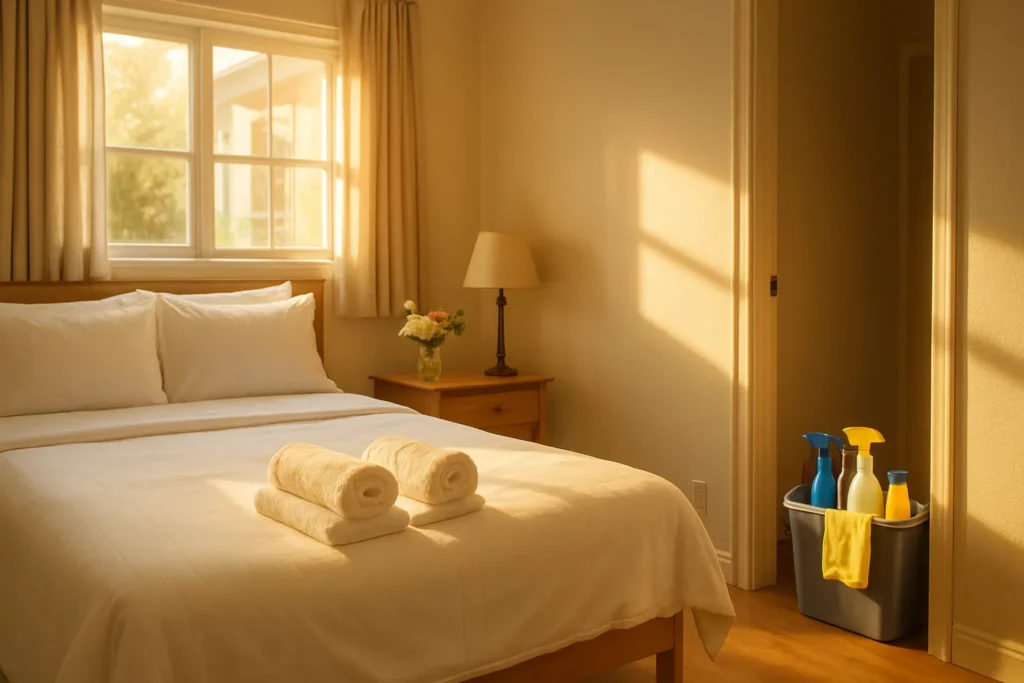
It is 10:47 on a Saturday morning. Your next guests check in at 3 p.m. You have not heard from your cleaner since Thursday. You send a text — nothing. You call — straight to voicemail. You are standing in your kitchen seventy miles away with a sinking feeling in your chest and a five-star reputation you have spent two years building.
Ask any host in any Facebook group, any Reddit thread, any backyard barbecue conversation about the hardest part of running a short-term rental, and the answer comes back the same: the cleaning. Not the regulations. Not the taxes. The cleaning. Specifically, the impossible task of finding someone reliable, keeping them, and making sure they show up when it counts.
“It is the number one thing I hear from hosts everywhere,” says one property manager who oversees a portfolio of eleven units across two markets. “You can have the best pricing strategy, the most beautiful listing photos, a perfectly worded welcome message — and if your Airbnb cleaning service falls apart, none of that matters.”
He is not wrong. A single missed turnover can mean a canceled booking, a one-star review, and weeks of recovery. In a business where a guest’s first impression starts the moment they push open the door, the clean is everything.
Why STR Cleaning Is Different
Here is what people outside the industry do not always understand: vacation rental cleaning is not the same as residential cleaning. It is closer to hotel housekeeping — with the unpredictability of a startup and the urgency of a live performance.
A regular house cleaner might have a flexible two-hour window. An STR cleaner might have ninety minutes between an 11 a.m. checkout and a 1 p.m. early check-in. They need to strip and remake every bed, restock toiletries, inspect for damage, photograph anything unusual, run a load of towels if the laundry is on-site, and leave the space looking like no one ever lived there.
And they need to do that every time, regardless of whether the last guests were neat travelers on a business trip or a family of five celebrating a quinceañera.
Speed matters. Standards matter. And trust — the quiet confidence that they will simply handle it without you micromanaging from across town — matters most of all.
How to Find Airbnb Cleaners Who Actually Know What They Are Doing
The search for a good STR cleaner usually starts with the same frustrating places: Craigslist, a Google search, a desperate post in a local Facebook group. Some hosts get lucky. Most do not, at least not on the first try.
The most consistently effective approach I have seen is what I think of as the community path. Ask your neighboring hosts. Join local STR host groups on Facebook and ask who people use. Word of mouth in this world travels fast, and a cleaner who already works properties in your neighborhood understands the local market, knows what guests expect, and probably has the commute dialed in.
Beyond your own network, dedicated platforms exist specifically to connect hosts with experienced STR cleaners. Turno (formerly known as TurnoverBnB) has built a marketplace with tens of thousands of users where you can find local cleaners who list their STR-specific experience, availability, and rates. Thumbtack and Angi also work for this — they let you browse by zip code and read reviews from real clients.
One piece of advice from the Breezeway team stuck with me: before you hire anyone, clean the property yourself at least once. Not because you should be your own cleaner, but because walking through that process gives you a concrete, specific list of expectations. You will know how long it really takes. You will notice the baseboards behind the bathroom door, the grease buildup above the stove, the spot under the bed frame where a sock can hide for three bookings. That knowledge makes you a far better partner to any cleaner you bring on.
The Interview and Trial Period
Hiring a cleaner for your STR is not like hiring a babysitter. The stakes are public. A bad clean can end up in a review that lives on your listing forever.
When you interview candidates, look for someone who has cleaned short-term rentals before — not just private homes. The rhythms are different. Ask specifically about their availability for same-day turnovers. Ask what they do when they discover damage or a missing item. Ask how they handle an unusually messy checkout. You are not just testing competence; you are testing judgment.
Then do a paid trial. Walk through the property together beforehand. Share your checklist. Let them clean, and then do a thorough walkthrough when they finish — not to nitpick, but to understand how they interpret your standards. The first clean is a conversation. The fifth clean is a rhythm. The fiftieth is trust.
According to guides from the team at Uplisting, one of the most common mistakes hosts make is skipping the checklist altogether and assuming a good cleaner will just know. They might. But they might also prioritize the kitchen while letting the bathroom mirrors go streaky, or fold towels in a way that feels sloppy to your guests. Visual references — photos of a made bed, a stocked welcome station, a properly folded bathroom setup — eliminate guesswork and build consistency from the start.
What to Pay, and How to Make It Worth Their While
Pay is where a lot of host-cleaner relationships quietly fall apart. The host pays market rate, the cleaner does solid work, and then a bigger account offers them two more hours of guaranteed weekly work at slightly better pay — and they are gone.
The national average for STR cleaning runs around $30 per hour, though that range stretches considerably based on market and property type. For flat-rate turnovers, expect to pay roughly $50 to $90 for a one-bedroom, $70 to $130 for a two-bedroom, and $100 to $150 or more for a three-bedroom. In higher-cost coastal markets, those numbers climb.
But pay alone is not what keeps great cleaners. What keeps them is predictability, respect, and the occasional bonus that says you noticed.
A few patterns I have seen work well: Pay promptly — ideally automatically. Tools like Turno and Breezeway can handle this, sending payment as soon as a clean is marked complete. If a cleaner covers a last-minute booking on a holiday weekend, a bonus of $20 to $40 on top of the standard rate goes a long way. If your property gets a five-star review that specifically mentions cleanliness, share it with them. Send it in a text. Acknowledge it.
One host I spoke with started giving her cleaner a small end-of-year gift card alongside a written note — nothing extravagant, but personal. “She told me it was the first time in two years of cleaning Airbnbs that a host had ever said thank you,” the host told me. That cleaner has now been with her for four seasons.
The Tools That Take the Chaos Out of Coordination
Even the best cleaner-host relationship can buckle under the weight of disorganized communication. A booking gets modified. Checkout moves up. A new guest arrives two hours early. If you are coordinating all of this by text message, something will eventually fall through.
This is where cleaning management platforms earn their keep. Three tools in particular have built strong reputations in the STR world.
Turno is often the first platform hosts encounter. It syncs directly with your booking calendar and automatically schedules cleaning assignments when a reservation is made. Hosts can create photo checklists, track cleaning progress in real time, and automate payments. For properties priced at volume, the time savings alone — reportedly 40 hours per year on payment coordination — justify the monthly cost.
Breezeway goes a step further. It is less a cleaner marketplace and more a full property operations platform, with GPS tracking for cleaning staff, dynamic lock code generation for access control, quality assurance tools, and detailed analytics on cleaning times and costs per property. For hosts managing multiple units, it can reportedly save 10 hours of scheduling work per week. The price point reflects its enterprise-level ambitions.
Turnify takes a different angle entirely. Built by a cleaning company that had processed over a million guest stays before writing a line of code, it offers three tiers: a self-managed automation layer, a managed team option, and a fully staffed professional service for hosts who want to hand off the entire operation. The founder’s background shows in the details — cleaner scorecards, amenity inventory tracking, and integrations with the major property management platforms.
None of these tools will find you a great cleaner if one does not exist in your market. But once you have good people, these platforms turn the coordination from a source of anxiety into something close to autopilot.
Always Have a Backup Plan
Let me return to that Saturday morning scenario I described at the top. The cleaner is unreachable. Guests arrive in four hours. What do you do?
If you have a backup plan, you make one call and move on. If you do not, you spend two hours in a panic before either cleaning it yourself or watching a booking collapse.
Every host with more than one or two active bookings should have a secondary cleaner on standby — someone who knows the property, has done at least one clean there, and understands that they are the backup. Some hosts cultivate a relationship with a local cleaning company alongside their primary independent cleaner. Companies have broader staff and can often cover short-notice gaps that solo cleaners cannot.
Turno’s marketplace also makes emergency fills more accessible than they used to be. If your primary cleaner goes dark, you can post the job to local cleaners in the network and often get someone confirmed within an hour or two.
Building a backup is not pessimism. It is the difference between a disruption and a disaster.
The Cleaner Who Sees Everything
There is one more thing worth saying about great STR cleaners that does not always make it into the practical guides: they are often the people who notice things first.
A leaking faucet. A cracked tile in the shower. A lamp that stopped working. A strange smell from the HVAC vent. They are in the property more than you are, and they see it fresh each time, the way a new guest sees it.
The best hosts I have encountered treat their cleaners as the first line of property maintenance — people whose eyes and judgment are genuinely valued. They build a simple reporting system (a checklist item, a photo to a shared album, a quick text) and they actually act on what their cleaner flags.
That kind of relationship does not just prevent bad reviews. It builds the kind of mutual investment where your cleaner takes pride in the property, watches out for it, and becomes, over time, something close to irreplaceable.
Eso es lo que buscamos — that is what we are all looking for. Not just a reliable vendor, but a real partner in the work.
We do our best to keep our content accurate and up to date, but things change and we are only human. Always verify details directly with local sources before making decisions.
See What Your Property Could Earn
Curious how cleaning costs factor into your STR’s overall financial picture? Our free StaySTRA Analyzer lets you model income, occupancy, and expenses for any address — so you can see the full picture before you commit.
For a broader look at the metrics shaping your local market, including average daily rates, occupancy trends, and comparable listings, the StaySTRA Analyzer gives you real data in minutes.
Stay in the Loop
The STR world moves fast. Join the StaySTRA Insider newsletter and we will keep you updated on the stories and market shifts that matter.
Become a StaySTRA Insider
Join free — get our newsletter + 1 free property analysis/month.
No spam. Unsubscribe anytime. Free membership includes property analyses and market insights.