Key Takeaways
- DSCR lenders do not verify your personal income or employment; the property rental income does the qualifying work, not your W2.
- Most lenders require a minimum 1.0x DSCR ratio, but 1.25x or higher unlocks better interest rates; typical STR DSCR rates ran 6.25% to 7.95% in mid-2026 at 25% down.
- Income projections from tools like AirDNA are accepted for new purchases, but lenders apply a 20% haircut to the raw projection before calculating DSCR.
- Down payments typically run 20% to 25%; STR-focused lenders commonly require 25% minimum plus 6 months of cash reserves.
- Run projected rental income through the StaySTRA analyzer before talking to a lender. It is the fastest way to see whether a property will clear the DSCR threshold.
The first thing the underwriter asked for was not a W2. Not two years of tax returns. Not an employer verification letter.
What she asked for was an address.
Let us call her Renata M. She had spent three months assuming she could not buy a short-term rental property. Her accountant had been direct: her income as a self-employed marketing consultant was too variable to satisfy a conventional lender. “You make good money,” he had told her. “The bank just cannot see it the way they need to.” She had nodded and gone home and thought, maybe next year.
Then a friend at a dinner party in South Austin mentioned something called a DSCR loan. By midnight Renata was in a rideshare home, typing the acronym into her phone.
What she found flipped her entire understanding of the mortgage process.
The Loan That Looks at the Property, Not the Borrower
DSCR stands for Debt Service Coverage Ratio. The calculation is straightforward: divide the property monthly rental income by its monthly loan payment, which lenders call PITIA (principal, interest, taxes, insurance, and any association fees). If the income covers the payment, the property qualifies. Your personal income barely enters the picture.
For investors without traditional W2 income, this distinction changes everything. Conventional mortgages backed by Fannie Mae or Freddie Mac are built for salaried borrowers. They require documented employment history, two years of tax returns, and income that shows up cleanly on a Form 1040. Self-employed buyers, investors whose income flows through a business, early retirees, and people who are paid in ways that do not fit a pay stub often find themselves sitting across from a loan officer who says some version of what Renata heard from her accountant.
DSCR loans are portfolio products, meaning the lender holds them on its own books rather than selling them to Fannie or Freddie. That flexibility allows them to underwrite against property cash flow instead of borrower income. The question becomes: will this rental property pay its own mortgage? If yes, you likely qualify.
“I remember the moment it clicked,” Renata told me. “I had been trying to prove that I was creditworthy. The DSCR lender was asking whether the property was creditworthy. Those are completely different conversations.”
Finding a Lender: Not Like Shopping for a Conventional Mortgage
DSCR loans are not available at most local banks or big consumer mortgage chains. They live in the world of portfolio lenders and non-QM specialists. Visio Lending, which has funded more than 990 million dollars in vacation rental loans since 2012, is one of the most established STR-focused shops. Griffin Funding has built a name in this space for borrowers with more complex credit profiles. Beeline offers STR-specific DSCR products in 28 states. Angel Oak and Lima One round out the larger platforms.
Not every DSCR lender will underwrite short-term rental income. Some accept only long-term lease income in their DSCR calculation. Others work with STR projections but impose stricter ratio requirements or larger reserve mandates for vacation rental properties. Finding the right lender matters as much as finding the right property.
Renata spent about two weeks talking to four lenders before settling on one that explicitly underwrote vacation rental income. “I wasted a week with a broker who said yes and then came back with a product that only used long-term rent comps,” she said. “The vacation rental income I was counting on did not factor in at all. You have to ask that question in the first conversation.”
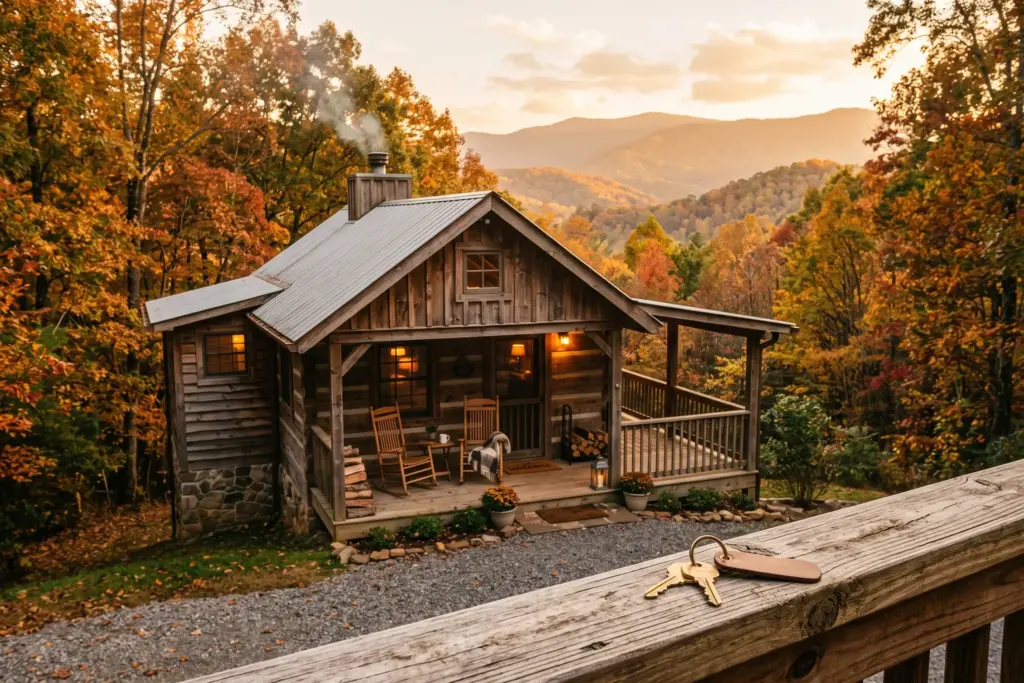
Let us call him David K., who bought a two-bedroom cabin in Sevierville, Tennessee, near the Smoky Mountains, found his lender through a BiggerPockets forum thread and confirmed STR income eligibility in the first phone call. “I had done enough research to know the right questions,” he said. “I just needed someone willing to answer them honestly.”
What the Underwriter Actually Asked For
Once Renata submitted an application for a two-bedroom condo on Austin’s East Side, the documentation request looked nothing like a conventional mortgage file.
No W2. No employment verification. No recent pay stubs.
The lender ordered an AirDNA rental projection for the address. AirDNA aggregates short-term rental performance data across Airbnb and Vrbo listings in a given market. For properties without existing rental history, it has become the standard tool DSCR lenders use to estimate what a property can earn.
Here is the detail that catches first-timers off guard: AirDNA shows a gross revenue projection. Lenders do not use that number at face value. Standard practice is to apply a 20% haircut. If AirDNA projects 38,000 dollars in annual gross revenue, the lender works with 30,400 dollars. That adjusted figure, divided by 12, produces the monthly income used in the DSCR calculation.
“My lender explained it as a margin of safety,” Renata said. “You are not going to hit full projected occupancy every year. Seasonality, vacancies, slow months. The 80% figure accounts for the fact that projections are optimistic by nature.”
Beyond the AirDNA report, the lender checked three additional things: Renata’s credit score (714), the property’s insurance eligibility for short-term rental use, and the legal status of STR operation at the address. That last item has grown more consequential. Lenders will not underwrite STR income for a property in a jurisdiction where short-term rentals are prohibited by zoning or HOA rules. Renata confirmed her unit was in an eligible permit zone and got an HOA letter confirming short-term rental was permitted before moving further into underwriting.
She also needed to show six months of PITIA reserves in liquid assets. If the monthly payment including taxes and insurance totaled 2,213 dollars, she needed roughly 13,300 dollars in a documented account. That reserve requirement sits on top of the down payment.
Running the Numbers: How DSCR Gets Calculated
Much of the anxiety around DSCR loans comes from the name. The actual math is straightforward once you walk through it.
Renata put 25% down on a 325,000 dollar property, borrowing 243,750 dollars. At 7.25% on a 30-year term, her monthly principal and interest payment came to approximately 1,663 dollars. Adding property taxes of 450 dollars and insurance of 100 dollars produced a monthly PITIA of 2,213 dollars.
AirDNA projected 38,000 dollars per year in gross rental income. The lender applied the 20% reduction: 38,000 times 0.80 equals 30,400 dollars annually. Divided by 12: 2,533 dollars per month in qualifying rental income.
DSCR: 2,533 divided by 2,213 equals 1.14x.
That cleared the lender minimum of 1.0x. It was not the 1.25x level that would have unlocked the best rate pricing, but it qualified. Renata accepted a rate of 7.25%. A borrower who had cleared 1.25x with the same credit score might have seen 6.75% to 7.00% from the same lender.
David’s Smoky Mountains cabin told a different story. He paid 380,000 dollars for a two-bedroom cabin in Sevierville, putting 25% down (95,000 dollars) and borrowing 285,000 dollars. With a 720 credit score and a clean file, his rate came in at 7.00%. Monthly PITIA, including an 85-dollar HOA fee and higher insurance for a mountain property, totaled approximately 2,510 dollars.
The Sevierville cabin market is strong. AirDNA projected 56,000 dollars annually in gross income. At the 80% haircut: 44,800 dollars. Monthly: 3,733 dollars.
DSCR: 3,733 divided by 2,510 equals 1.49x.
“The lender called it a strong file,” David said. “I had spent six months worrying the numbers would not work. Turns out the mountain cabin market basically makes the case for you.”
The difference between 1.14x and 1.49x matters in two ways. First, pricing: borrowers who clear 1.25x typically see rate reductions of 0.25% to 0.50% compared to files that qualify by a thin margin. Second, peace of mind: a higher DSCR means the property is covering its payment comfortably even if revenue runs below projection.
What the Lenders Were Not Looking For
Both Renata and David had prepared for the same income scrutiny they had faced with residential mortgage applications: explaining business deductions, justifying income swings, walking through years of tax returns that reflected the realities of self-employment rather than raw cash flow.
None of that came up.
“My accountant did a good job on my taxes, which meant my taxable income looked lower than my actual income,” Renata said. “That would have hurt me on a conventional loan. The DSCR lender never asked. They looked at my credit and my reserves and the AirDNA numbers. That was it.”
David flagged something else: the lender did not cap the number of properties he could finance. Conventional Fannie Mae guidelines restrict borrowers to ten financed residential properties. DSCR portfolio lenders operate without that ceiling. For investors who plan to build a portfolio over time, this matters considerably.
La paciencia tiene su precio. Patience has its price. Both Renata and David had waited longer than they needed to, each assuming their income profile made short-term rental investment out of reach. The DSCR framework had been available to them the entire time.
The Surprises Nobody Mentioned in Advance
Walking through this process with several investors, a few consistent friction points emerged.
The first was the appraisal timeline. DSCR appraisals for short-term rentals are more involved than standard residential appraisals because the report must include a rental income analysis alongside the property valuation. In active markets, that complexity translates to scheduling delays. Renata waited 14 days from order to appraisal delivery. David waited 11. In both cases, the appraisal was the longest single stage of the process, longer than underwriting and longer than title review.
“I kept checking the lender portal expecting something to be wrong,” David said. “Nothing was wrong. They were waiting on the appraiser. That is the bottleneck no one warns you about.”
The second surprise was how seriously lenders take STR legal eligibility. Before the AirDNA report matters at all, the property must legally be able to operate as a short-term rental. Renata’s condo required an HOA letter confirming STR was permitted. The HOA took nine days to respond. “I should have requested that document before going under contract,” she said. “It nearly caused a problem.”
A third detail tripped up Sophia R., an investor who went through this process in Scottsdale last fall: AirDNA methodology depends on market density. In markets with fewer than three comparable active listings in AirDNA’s dataset, some lenders cannot use the projection and fall back to a long-term rent appraisal instead. For unique or rural properties, that fallback can dramatically change the qualifying income figure. “Scottsdale had plenty of comps,” Sophia said. “But my friend was buying in a small lake town with only a dozen active STRs. Her lender had to use long-term rental comps instead of AirDNA, and the income looked completely different.”
Both Renata and David closed in about 32 days from application to keys. That is consistent with the 28 to 35-day range that most DSCR lenders describe as typical for a prepared file.
What Happened After Closing
Renata’s Austin condo went live on Airbnb six days after closing. She priced conservatively for the first month while establishing her cleaning rotation. Year one gross revenue came in at 34,200 dollars.
That was below AirDNA’s original projection of 38,000 dollars. It was also comfortably above the 30,400 dollars the lender had used in the DSCR calculation.
“The lender’s math assumed the conservative case,” she said. “When I hit above that, even in my learning-curve year, it felt like the system actually worked the way it was supposed to.”
David’s cabin cleared 52,400 dollars in year one gross, nearly matching the AirDNA projection. After cleaning fees, supplies, platform commissions, and light property management help, his net came in around 30,000 dollars. After the loan payment, he kept roughly 18,000 dollars in year one.
“Year one is the hardest year,” he said. “There was a week when the water heater failed mid-booking. There were pricing mistakes. But the property covered itself and left something over. That was the whole goal.”
Before talking to either of them, I looked at market data for both properties through the StaySTRA analyzer. The Sevierville data showed occupancy patterns and average daily rates consistent with David’s actual outcome. Austin showed more variability by neighborhood, which lined up with Renata’s slightly below-projection result. Running those numbers before the lender conversation is the step most first-timers skip and later wish they had not.
Who This Kind of Financing Actually Serves
Not every investor needs a DSCR loan. Borrowers with straightforward W2 income and fewer than ten financed properties may find conventional financing offers a lower rate. DSCR loans for STR properties ran roughly 6.25% to 7.95% in mid-2026 at 75% loan-to-value, a premium above the conventional 30-year fixed average of around 6.53% over the same period. That gap has narrowed as Fannie and Freddie pricing on investment properties has tightened, but it has not closed.
Where DSCR loans make the clearest case:
- Self-employed borrowers whose taxable income understates cash flow
- Investors who already hold ten or more financed properties (hitting the conventional limit)
- Buyers who want to hold the STR in an LLC from day one
- Investors who want to keep STR debt separate from personal residential financing
- Anyone buying in a market where the cash flow is strong enough to make the 1.0x case clearly
The qualifier is simple: if the property projected rental income, after the 20% haircut, covers the monthly PITIA at 1.0x or above, you have a property that can qualify. If it covers it at 1.25x or better, you have a strong file. Bienvenido al proceso, welcome to the process. It is less complicated than the name suggests.
For a full walkthrough of financing options including DSCR versus conventional versus home equity, the how-to-buy guide for 2026 covers each path from the purchase decision forward. If you are weighing DSCR against tapping existing equity, the HELOC and cash-out refinance comparison breaks down those tradeoffs directly. And for the full mechanics of DSCR underwriting, this step-by-step guide covers what lenders actually review in more detail than most lender websites will share.
Sponsored — Beeline
Finance Your Next STR With a DSCR Loan
Qualify on property cash flow, not W-2 income. Beeline specializes in fast DSCR closings for STR investors. No personal income verification required.
Check Your DSCR Eligibility →Affiliate disclosure: StaySTRA may earn a referral fee.
Frequently Asked Questions
Do DSCR lenders check your income or employment?
No. DSCR loans do not require W2 income verification, tax returns, or employment documentation. The qualifying criteria are the property rental income relative to the loan payment (DSCR ratio), your credit score, and your post-closing cash reserves. This makes them accessible for self-employed borrowers, full-time investors, and anyone whose personal income does not fit conventional underwriting guidelines.
What DSCR ratio do you need to qualify for a short-term rental loan?
Most DSCR lenders set their floor at 1.0x, meaning the projected rental income must at least equal the monthly PITIA payment. Some lenders accept ratios as low as 0.75x to 0.80x with compensating factors such as higher reserves or a larger down payment. For the best pricing, most lenders want to see 1.25x or higher. Files that clear 1.25x typically see interest rates 0.25% to 0.50% lower than files that qualify by a thin margin at 1.0x to 1.1x.
How does the lender calculate income for a short-term rental with no booking history?
For purchase loans where the property has no prior rental history, most DSCR lenders order an AirDNA market projection report for the address. They then apply a 20% reduction to the gross annual income projection and use that adjusted figure as qualifying income. A property projecting 50,000 dollars annually becomes 40,000 dollars in the underwriter calculation. Properties with at least 12 months of documented Airbnb or Vrbo payout history can use actual platform data instead of AirDNA.
How much do you need to put down on a DSCR loan for an STR property?
Most STR-focused DSCR lenders require a 25% down payment (75% loan-to-value). Some lenders allow 20% for borrowers with strong credit and higher DSCR ratios. On top of the down payment, most lenders also require 6 months of PITIA reserves in liquid assets after closing. That reserve requirement is separate from the down payment and closing costs.
How long does it take to close a DSCR loan for a vacation rental?
From application to closing, most DSCR loans close in 28 to 35 days for a prepared file. Pre-approval can typically be issued within 48 to 72 hours. The primary bottleneck is the appraisal, which for short-term rental properties includes a rental income analysis that adds time compared to a standard residential appraisal. In busy markets, appraisal scheduling alone can account for 7 to 14 days of the overall timeline.
We do our best to keep our content accurate and up to date, but things change and we are only human. Always verify details directly with local sources before making decisions.
Sponsored — Beeline
Finance Your Next STR With a DSCR Loan
Qualify on property cash flow, not W-2 income. Beeline specializes in fast DSCR closings for STR investors. No personal income verification required.
Check Your DSCR Eligibility →Affiliate disclosure: StaySTRA may earn a referral fee.
Become a StaySTRA Insider
Join free — get our newsletter + 1 free property analysis/month.
No spam. Unsubscribe anytime. Free membership includes property analyses and market insights.
Sponsored — Beeline
Finance Your Next STR With a DSCR Loan
Qualify on property cash flow, not W-2 income. Beeline specializes in fast DSCR closings for STR investors. No personal income verification required.
Check Your DSCR Eligibility →Affiliate disclosure: StaySTRA may earn a referral fee.