

Key Takeaways
- 86% of Airbnb listings sit at 4.5 stars or higher, meaning a 4.9+ rating is the only score that meaningfully separates your listing in search and earns the Guest Favorites badge.
- The three sub-scores that most often pull averages down are cleanliness, check-in friction, and communication delays. All three are automation problems, not hospitality problems.
- Automated guest messaging cuts response time from two to four hours to under three minutes, directly improving the communication sub-score that feeds your overall rating.
- Digital guidebooks reduce routine guest questions by 30 to 50 percent, which eliminates mid-stay interruptions that translate into negative check-in and communication mentions.
- The full 5-star operating system runs $40 to $60 per month for a single property and typically pays for itself with one recovered booking per quarter.
86% of Airbnb listings are rated 4.5 stars or higher. That one number changes how you should think about your entire review strategy.
You are not competing against bad properties. You are competing against thousands of other 4.8-star listings for the same search slots. The only score tier that actually moves your ranking and your rates is 4.9 and above, where Airbnb’s Guest Favorites badge kicks in. Listings at 4.9+ command 18 to 23% higher average daily rates than listings in the 4.5 to 4.7 range. The badge carries real weight in search placement. And Airbnb evaluates it daily based on your last 10 reviews.
This past summer, a host dropped from 4.9 to 4.7 in eight weeks. She did not change anything about her property. She just got busier. More bookings meant slower replies, faster turnovers, and one check-in code that did not get refreshed in time. That 0.2-star drop cost her the Guest Favorites badge. Fewer bookings followed. She spent the fall trying to rebuild a rating that had taken two years to earn.
That is not a hospitality problem. It is a systems problem.
The hosts who hold consistent 5-star averages at scale do not try harder. They build operating systems that remove friction points before guests ever notice them. Here is the setup that actually works in 2026.
The Review Score Landscape: What You Are Actually Up Against
The average Airbnb listing rating in 2026 is above 4.75. More than 80% of individual reviews are 5 stars. The platform has extreme ratings compression at the top of the scale.
What this means practically: a 4.7 average puts you below roughly half the active listings in most markets. A 4.8 earns Superhost status if you hit the other thresholds. But Superhost is now a secondary ranking signal. Guest Favorites, which requires 4.9 or higher on a per-listing basis, is what Airbnb’s algorithm weights most heavily for search placement. Research on the 2026 Airbnb algorithm confirms the Guest Favorites badge now accounts for about 25% of ranking weight, more than Superhost status on its own.
Guest Favorites applies to roughly the top 9% of listings. The minimum requirements: a 4.9+ overall rating, at least 5 reviews (with one in the past two years), and strong cancellation and response metrics. Airbnb evaluates it daily based on your most recent reviews, not your all-time history.
That last point matters. It means your score is more recoverable than most hosts think. It also means a bad run during peak season can knock you out of Guest Favorites quickly. Both things are true, and both point to the same solution: consistency through systems.
If you want to see how your market’s average review scores compare against similar listings, StaySTRA’s market analyzer breaks down data by market, property type, and competitive tier.
The 6 Sub-Scores: Where Hosts Actually Lose Points
Every Airbnb guest rates six sub-categories: Cleanliness, Accuracy, Check-in, Communication, Location, and Value.
Location is fixed. You cannot change what neighborhood you are in. Value tracks with pricing discipline, and a well-priced listing rarely gets hit on value. Accuracy is a listing problem, not an operations problem. If your description matches the property, you rarely lose accuracy points.
Three categories account for the vast majority of below-5-star scores:
- Cleanliness: One missed spot feels worse at a $200-per-night property than at a budget motel. Guest expectations scale with rate.
- Check-in: Any friction at arrival sets a negative tone for the entire stay. A guest who stands outside for ten minutes with a broken code remembers that at review time.
- Communication: A slow or unhelpful reply during the stay is the fastest path from 5 stars to 4. Guests who cannot reach you fill in the silence with assumptions, and those assumptions are usually negative.
All three are systems problems. The 2026 tool landscape has a solution for each one.
Step 1: Build an Automated Pre-Arrival Messaging Sequence
I have spent more time than most people would find reasonable reading how messaging automation platforms handle their queuing logic at the API level. The architecture is genuinely clever. But here is what actually matters for hosts: Airbnb has no native auto-reply for incoming guest messages. You can schedule one-way outbound messages, but if a guest sends you a question, someone has to respond manually. At scale, that breaks.
Third-party tools solve this. Platforms like Hospitable, Hostfully, and Guesty connect to your Airbnb account and manage the entire messaging lifecycle. According to Hostaway’s 2026 STR Report, AI adoption among STR operators jumped from 60% to 84% in a single year. Hospitable alone handles interactions for over 26 million guests annually. The category has matured fast.
A solid pre-arrival sequence looks like this:
- Within 5 minutes of booking: Confirmation message with key details. Check-in time, parking, house rules overview. Sets expectations and answers the first three questions guests always ask.
- 3 days before arrival: Full check-in instructions. Access code, door location, Wi-Fi, parking. Include a link to your digital guidebook here (more in Step 2).
- Morning of check-in: Brief confirmation and how to reach you that day.
- Day 2 of stay: Temperature check (covered in Step 5).
- Day before checkout: Checkout instructions. Trash, any leave-as-you-found requests.
- Post-checkout: Thank-you plus review request (covered in Step 6).
Automated messaging cuts host response time from the two-to-four-hour average to under three minutes. That speed directly feeds your communication sub-score. Airbnb measures both response rate (should be 90%+) and response speed. Tools like Hospitable can also handle incoming guest questions automatically using AI, so the response happens even when you are not watching your phone.
For the full breakdown of tools in this category, our guide to STR guest communication and automated messaging tools covers Hospitable, Hostfully, Guesty, Lodgify, and the rest.
Step 2: Deploy a Digital Guidebook
The most common source of mid-stay communication failures is not slow hosts. It is guests who cannot find basic information.
They arrive late and cannot figure out which entrance to use. They spend twenty minutes hunting for the Wi-Fi password on a paper card they missed. They want to use the dishwasher but there are no instructions. So they text the host. If the reply takes ten minutes, that small frustration becomes a line in the review.
A digital guidebook eliminates most of this before it happens.
The tools worth knowing in 2026: Touch Stay has the most intuitive interface for guests and strong mobile experience. Hostfully’s Digital Guidebook integrates directly into their PMS if you are already on that platform. Enso Connect adds messaging integration on top of guidebook features for hosts who want a unified inbox.
Hosts using digital guidebooks report 30 to 50% fewer routine questions during stays. That drop in questions translates directly to higher communication and check-in sub-scores. Not because you are communicating more, but because guests need less help.
What should go in your guidebook:
- Check-in walk-through with photos, not just text
- Wi-Fi credentials and all smart device instructions
- Appliance guides for washer, dryer, HVAC, coffee maker
- Emergency contacts and house rules in plain language
- Local recommendations with actual opinions, not a generic dump
- Checkout checklist with photos of how things should look when they leave
The local recommendations section is worth doing well. Guests who feel like they got insider knowledge write different reviews than guests who just stayed in a house. “The host knew exactly where to eat” shows up in 5-star reviews at a surprisingly high rate.
Sponsored — OfferMarket
Buy Your First STR With Long-Term Rental Financing
Flexible, long-term financing for short-term rental buyers. Rates from 5.75%. Instant online quote, no credit pull.
Explore RTL Financing Options →Affiliate disclosure: StaySTRA may earn a referral fee.
Step 3: Smart Locks and Frictionless Check-In
Check-in is the first real impression. If a guest stands outside your door for ten minutes because the code stopped working, nothing you do during that visit fully recovers the review. The emotional anchor is set at the front door.
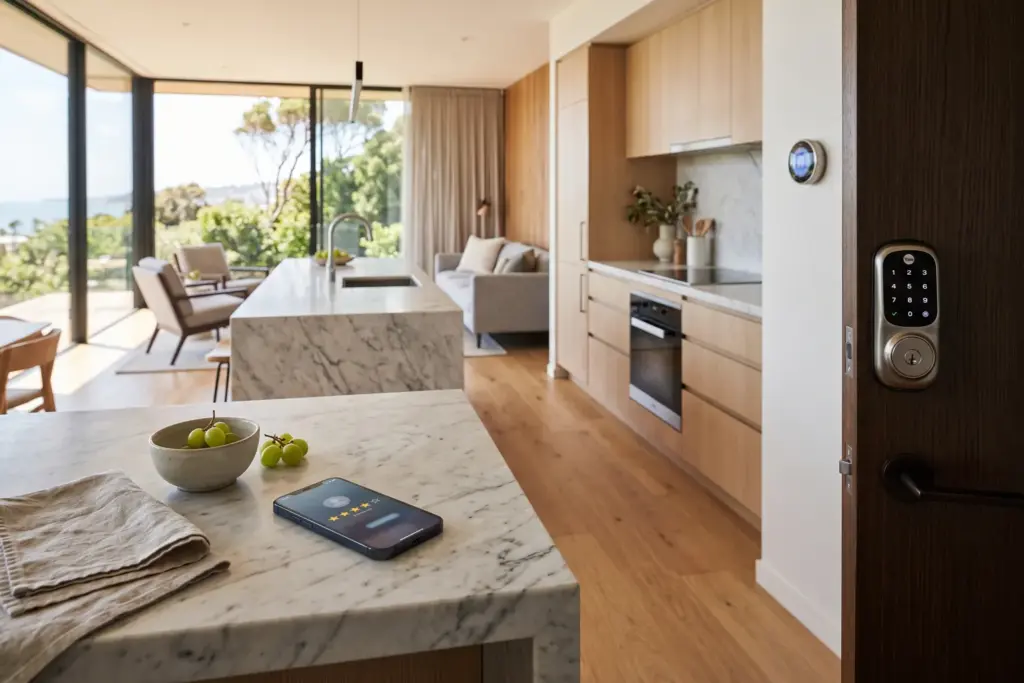
The smart lock category has matured significantly. The one to start with: the Yale Assure Lock 2. It is currently the only smart lock with native Airbnb integration, meaning it auto-generates and expires unique access codes tied directly to your Airbnb booking calendar. Reservation confirmed, code created. Reservation ends, code expires. Nothing to manage manually, no risk of a previous guest’s code working when the next guest arrives.
Hardware cost is $150 to $250 depending on configuration. No monthly fee for the native Airbnb integration itself.
Beyond the lock, think about check-in as the guest experiences it. Is there a light on? Does the front door match the photo in your listing? Is parking clearly marked? Small frictions at arrival add up in ways that are hard to recover from even when everything else goes well.
Going forward, we will likely see more platform-native integrations like this from other lock manufacturers. For now, Yale is the one with the native Airbnb connection. For a full comparison of smart lock options at different price points, our deep-dive on the best smart locks for Airbnb hosts covers Yale, Schlage, August, and others across configurations.
Step 4: Automate Cleaning Coordination
Cleanliness score drops are almost never about cleaning quality. They are about communication failures between the host and the cleaning team.
The problem: turnovers happen fast, especially during summer peak. If your cleaner does not know the next guest is arriving four hours early, or which consumables are running low, or that the back deck needs extra attention after a rainy week, small things get missed. And a missed spot at a premium rate property feels different than it does at a budget option.
Turno (formerly TurnoverBnB) connects your booking calendar to your cleaning team. When a checkout is confirmed, the cleaner gets a task notification with the next check-in time, guest count, and any notes attached to the booking. After the clean, the cleaner submits photo verification through the app: kitchen, bathrooms, beds, outdoor areas.
That photo record is valuable twice. First, it gives you a quality check before you hear from the next guest. Second, if a guest claims a cleanliness issue, you have timestamped documentation from ninety minutes before arrival.
Turno also runs a marketplace of 25,000 vetted cleaners if you need to hire. But even with your own cleaning team, the task management and photo verification system is worth running for the consistency and documentation it creates.
Step 5: The Day-2 Temperature Check
This is the highest-leverage thing most hosts are not doing.
On the second day of every stay, send a short message: “Hey, hope the first night was comfortable. Anything I can help with or that you want to know about the area?”
That message does two things. First, it surfaces problems while they can still be fixed. If the A/C is acting up on day two, you can get someone there before the guest spends three more nights hot and writes about it in detail. Second, it signals that you are paying attention. That signal alone changes how people write reviews.
Set this as a timed automated message in your messaging platform. Send between 10 a.m. and 2 p.m. on day two. You want it to arrive when guests are relaxed, not when they are rushing somewhere.
The guest who had a slow-draining shower on day one but mentioned it only at checkout becomes the guest who mentioned it on day two and had it fixed by day three. Those are different reviews. This message proactively converts complaints into resolved issues before they make it into the written record.
Step 6: Time the Review Request Perfectly
Airbnb gives guests 14 days after checkout to leave a review. Most hosts wait and hope. The ones with consistent 5-star averages ask directly, and they ask at the right moment.
Send your post-checkout message within two hours of checkout time. Make it specific. Thank them for something real from the stay, not a generic “hope you enjoyed your time.” “Glad you got good weather for the beach” lands differently than “thanks for staying.”
Then ask for the review directly: “If you have a minute, a review on Airbnb genuinely helps our listing reach guests like you. It takes about 60 seconds and makes a real difference for us.”
Ask once. Do not follow up with a second request. One timely, specific ask converts at a measurably higher rate than a generic reminder three days later. Review behavior data shows that guests who leave reviews do so within 48 hours of checkout at the highest rate. After 72 hours, follow-through drops sharply. Automate the thank-you message to send the moment checkout time passes.
Step 7: Respond to Every Review
Responding to a review does not change your score. But it changes how the next potential guest reads it.
A 4-star review with no host response reads differently than a 4-star review with a measured reply. Potential guests read both the review and the response. A host who acknowledges specific feedback and explains what they have addressed converts shoppers into bookers in ways that a defensive or absent response does not.
Keep responses short. Thank the guest for staying. Acknowledge any feedback without being defensive. If something was flagged, briefly mention you looked into it. The goal is to show the next person reading that review that you are a responsive, attentive host. Not to win an argument with the guest who wrote it.
The next wave of property management tools will likely automate review responses with AI drafts that the host approves in one tap. Some platforms are already testing this. For now, doing it manually with a consistent template is the practical approach.
What the Full System Costs
For a single-property host running the complete stack:
- Automated messaging (Hospitable, basic plan): $25 to $40 per month
- Digital guidebook (Touch Stay): $10 to $15 per month
- Smart lock (Yale Assure Lock 2, hardware): $150 to $250 one-time. No monthly fee for the native Airbnb integration.
- Turno cleaning coordination: Free tier available; paid starts around $6 per month
Monthly recurring cost: $40 to $60 for a single property. Multi-property hosts get per-unit pricing that brings the cost down as the portfolio grows.
One recovered booking per quarter more than covers this stack. The math is not complicated.
If You Are Already Below 4.7
Getting back from 4.6 or lower takes time, but it is not a dead end. Airbnb weights recent reviews more than older ones. Twelve strong reviews in the next 90 days carry more weight than 200 older reviews with a few bad ones mixed in.
Start by identifying which sub-scores are pulling you down. Read the reviews that dropped you below 5 stars. Are you seeing cleanliness patterns? Check-in friction? Slow communication mentions? Fix the highest-frequency issue first before building out the full system.
Then run the complete system on every booking, without exception. Shorter stays give you more review opportunities in less time. Price slightly below your typical rate during the recovery window to fill gaps and generate volume.
Recovery typically takes three to six months for hosts running the system consistently. The tools described here do not shortcut the calendar. They make sure every booking in that window goes into the positive column instead of adding more mixed results to an already mixed record.
For a complete setup checklist when you are starting fresh or rebuilding a listing, our Airbnb setup guide covers everything from listing creation through first booking. For the listing factors that drive your accuracy sub-score, the how to write an Airbnb listing guide goes deep on the expectation-setting details that prevent gap-between-listing-and-reality complaints.
We do our best to keep our tech reviews accurate and up to date, but products evolve fast and we are only human. Always verify current features and pricing directly with vendors before purchasing.
Frequently Asked Questions
How many reviews do you need to get the Airbnb Guest Favorites badge?
Airbnb requires a minimum of 5 reviews (at least 1 within the past 2 years) and an overall rating of 4.9 or higher. The badge applies to roughly the top 9% of listings and is re-evaluated daily based on your most recent reviews, cancellation rate, and response metrics. Unlike Superhost, Guest Favorites is assessed per listing, not per host account.
What is the difference between Airbnb Superhost and Guest Favorites in 2026?
Superhost is a host-level status requiring a 4.8+ rating, 90%+ response rate, under 1% cancellation rate, and at least 10 stays or 100 nights in the past year. Guest Favorites is a listing-level badge for individual properties at 4.9+. In 2026, Airbnb’s algorithm weights Guest Favorites more heavily than Superhost for search ranking. A host can hold Superhost status without any Guest Favorites listings, and a listing can earn Guest Favorites without the host being a Superhost.
How long does it take to improve an Airbnb review score?
Airbnb weights recent reviews more than older ones. Hosts who implement a consistent review system typically see score movement within 60 to 90 days if they are generating regular bookings. The platform’s rolling evaluation puts significant weight on your last 10 reviews, so a strong run of bookings can move your score faster than looking at the all-time number might suggest.
Does automated messaging actually improve Airbnb review scores?
The data supports it. Response time and response rate directly feed your communication sub-score. Automated messaging tools cut response time from the two-to-four-hour manual average to under three minutes. Higher response speed correlates with higher communication sub-scores. Communication is one of the three most commonly cited factors in below-5-star reviews. Most hosts see score movement after 30 to 60 days of consistent use.
Can I ask guests to leave a 5-star Airbnb review specifically?
Airbnb’s review policy does not allow hosts to solicit a specific star rating. You can ask guests to leave a review, but you cannot instruct them to give you 5 stars or imply a high rating is expected. The approach that works: a personalized post-checkout message that references something specific about the stay, a single direct ask, and framing it as something that helps your listing reach more guests. That converts at a higher rate than generic requests and stays within Airbnb’s policy guidelines.
Sponsored — OfferMarket
Buy Your First STR With Long-Term Rental Financing
Flexible, long-term financing for short-term rental buyers. Rates from 5.75%. Instant online quote, no credit pull.
Explore RTL Financing Options →Affiliate disclosure: StaySTRA may earn a referral fee.