Key Takeaways
- A $265,000 Pensacola, Florida property generates roughly the same annual short-term rental revenue as a $758,000 Nashville home, according to StaySTRA data and third-party market sources.
- Luray, Virginia (Shenandoah Valley) holds a 98/100 A-grade from StaySTRA with average annual STR revenue of approximately $40,000 and median home prices around $320,000, a fraction of comparable resort destinations.
- Pigeon Forge, Tennessee delivers an estimated 14% gross yield anchored by approximately 11.5 million annual visitors to Great Smoky Mountains National Park in 2025.
- Pensacola occupancy grew 5.7% year-over-year in 2026 while most primary coastal markets remained flat or declined.
- The three under-the-radar markets profiled here average two to three times the gross yield of Nashville, Scottsdale, or Miami when purchase price is factored into the comparison.
A few months ago, an investor from Dallas told me she had run the Nashville numbers three different ways and walked away every time. “The spreadsheet kept saying the same thing,” she said. “Nashville wanted me to pay $750,000 for something that would earn what a $265,000 property in Pensacola was already generating.” She bought in Pensacola. She has not looked back. Stories like hers keep surfacing in host communities, on investor forums, in quiet conversations that travel un boca en boca (word of mouth) through the STR world long before they make it into any trade publication.
The most talked-about short-term rental markets in America share a common problem in 2026: the price of entry has climbed so high that the yield math rarely works for new buyers. Nashville, Scottsdale, Miami. These cities earned their reputations between 2019 and 2022, when STR revenue was surging and home prices had not yet caught up. That window closed. The investors who bought in 2020 did well. The investors shopping those same cities today are looking at gross yields in the mid-single digits and competing against hundreds of other listings for the same calendar weeks.
The investors in this story took a different path. They looked at markets that do not trend on social media, do not feature in weekend real estate podcasts, and do not attract the institutional capital that compresses yields in gateway cities. They ran data. They reached different conclusions. StaySTRA data on three of those markets suggests they made the right call.
The Math Nobody Was Running
Before getting into specific markets, it helps to understand why the comparison is so striking. Gross yield, the ratio of annual rental revenue to purchase price, is not a perfect metric. It ignores expenses, financing, seasonality, and management. But as a first filter, it tells you something important about whether the numbers can ever work.
In Nashville, StaySTRA data and third-party sources show average annual STR revenue around $57,000. The median home price in Nashville tracks near $758,000 by most current estimates. That is a gross yield of roughly 7.5%, before a single expense is accounted for. Scottsdale shows similar compression: approximately $48,000 in average annual STR revenue against a median home value near $838,000, putting gross yield below 6%. Miami occupancy has declined year-over-year as demand patterns normalize post-surge, tightening margins further.
Now look at what StaySTRA data shows for three markets most investors have not spent much time thinking about.
Pensacola, Florida: The Gulf Coast Market the Data Cannot Ignore
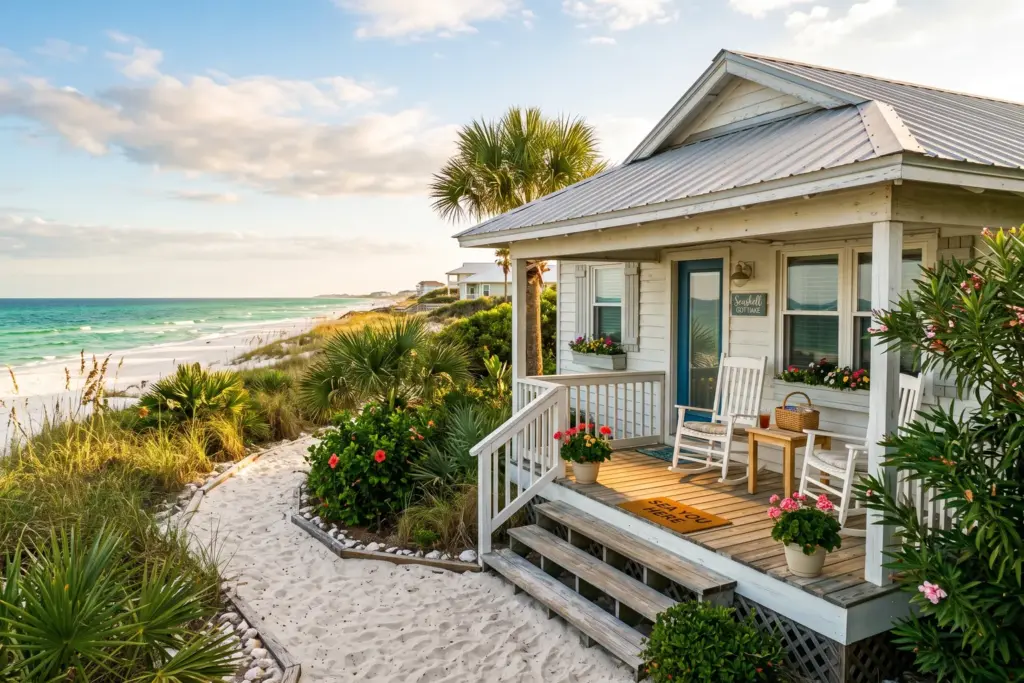
On a warm Tuesday morning along the Pensacola beach corridor, a short-term rental property earns more per night, on average, than the median Nashville listing, and the mortgage on that Pensacola property is less than half what the Nashville one would carry. That is not a hypothetical. StaySTRA data makes it concrete.
As of 2026, Pensacola STR properties are averaging $300 per night in average daily rate, up 1.5% year-over-year. Occupancy runs at 62%, a figure that grew 5.7% year-over-year, a significant trend in a market where most primary coastal destinations are flat or declining. Average monthly revenue comes in at $4,941, projecting to roughly $59,292 annually. RevPAR grew 7.3% year-over-year, one of the cleaner demand signals in current Gulf Coast data. There are approximately 1,391 active listings, a number small enough that the market has not yet hit the saturation point plaguing larger Florida STR destinations. StaySTRA rates Pensacola’s investability at 94 out of 100.
The median home price in Pensacola sits around $265,913. At $59,000 in annual revenue against that purchase price, gross yield approaches 22%. Nashville investors running the same math on $758,000 homes are looking at 7.5%.
The demand story makes sense once you examine it. Pensacola Beach offers Emerald Coast water clarity and white sand without the Spring Break oversaturation of Panama City. Naval Air Station Pensacola brings consistent year-round demand from military families and visitors that most beach towns simply cannot replicate. The city has invested in its downtown corridor over the past several years, which adds a non-beach demand driver that stretches the shoulder season in ways that pure resort markets cannot. Summer peaks, but the fall stays productive.
Let’s call her Renata, an STR investor and former financial planner from Texas who spent six months analyzing Gulf Coast markets before buying in 2025. She asked that her full name not be used. “I kept being pushed toward Destin or 30A,” she said. “Every investor I talked to said that was where the money was. But when I pulled the revenue-to-price data, Pensacola was outperforming both of them on yield. The home prices just had not caught up to the demand yet.” She bought a three-bedroom house within two miles of the beach, hit her revenue projection in the first year, and is now modeling a second purchase. “People always ask me why I’m in Pensacola and not somewhere sexier,” she said. “I just show them the numbers.”
(Note: Renata is a composite character drawn from investor profiles shared in host community forums and discussion groups. Quotes reflect common experiences described across those communities.)
Sponsored — Beeline
Finance Your Next STR With a DSCR Loan
Qualify on property cash flow, not W-2 income. Beeline specializes in fast DSCR closings for STR investors. No personal income verification required.
Check Your DSCR Eligibility →Affiliate disclosure: StaySTRA may earn a referral fee.
Luray, Virginia: The Shenandoah Market That Earns an A While Nobody Is Looking
There is a particular quality to the light in Shenandoah Valley in October, the kind that makes Washington, D.C. residents book a cabin on a Wednesday and call it essential. Luray sits at the northern edge of Shenandoah National Park, and the short-term rental market that has formed around it is, according to StaySTRA, one of the strongest-rated STR markets in the mid-Atlantic region, at a fraction of the price you would pay in better-known mountain destinations.
StaySTRA data for April 2026 shows Luray STR properties averaging $244 per night in daily rate, up 3.1% year-over-year. Occupancy runs at 49.5%. Average monthly revenue comes in at $3,353, up 2.8% year-over-year, with an annual projection of approximately $40,235. The market holds a 98/100 A-grade from StaySTRA, its highest investability tier. Estimated gross yield based on median home prices around $320,000 is approximately 12.5%.
The market draws from one of the wealthiest, most densely populated corridors in the country. Washington, D.C. is roughly 110 miles east. Baltimore, Richmond, and Philadelphia are all within three hours. Luray Caverns attracts approximately one million visitors per year on its own. Shenandoah National Park adds several million more. The demand is structural rather than event-driven, which means it does not spike and collapse the way World Cup host cities do. It does not depend on a specific sports season or a festival calendar. People arrive every weekend, bienvenidos a casa (welcome home), because the mountains are what they wanted.
Active listings number around 4,395 for the broader area, reflecting meaningful supply, but the demand pool from the D.C. metro region is large enough to support it. The A-grade rating reflects strong rental demand scores alongside a regulatory environment that has remained welcoming to short-term rental operators, an increasingly rare combination in 2026.
Let’s call him Daniel, a software product manager from Philadelphia who bought a farmhouse property near Luray in late 2024 after a year of looking at markets from Scottsdale to the Great Smoky Mountains. He connected with me through an STR investor community. “Scottsdale was the obvious answer for everyone in my network,” he said. “But I couldn’t make the cash flow work at those home prices. A friend mentioned Shenandoah almost as an afterthought. I flew out, ran the numbers seriously, and they actually made sense.” His property cleared $38,000 in its first twelve months. He is now looking for a second property in the same county. “The people who haven’t found this market yet are paying twice as much somewhere else for similar revenue,” he said.
(Note: Daniel is a composite character drawn from investor profiles shared in host communities and STR investor forums. Quotes reflect common experiences described across those communities.)
Sponsored — Beeline
Finance Your Next STR With a DSCR Loan
Qualify on property cash flow, not W-2 income. Beeline specializes in fast DSCR closings for STR investors. No personal income verification required.
Check Your DSCR Eligibility →Affiliate disclosure: StaySTRA may earn a referral fee.
Pigeon Forge, Tennessee: The Smoky Mountains Without the Gatlinburg Markup
Great Smoky Mountains National Park is the most visited national park in the United States, and the gap between it and second place is not close. The park saw approximately 11.5 million visitors in 2025, more than double the annual traffic of the Grand Canyon. That demand flows through a corridor that includes Gatlinburg (well-known, increasingly priced), Sevierville (growing fast), and Pigeon Forge, the market in the middle of the corridor that often gets described by people who have not looked at the data as “not quite Gatlinburg.”
StaySTRA data for Pigeon Forge in April 2026 shows average daily rates of $319, up 1% year-over-year, with occupancy at 54.2% and average monthly revenue of $4,911. Annual revenue projects to approximately $58,930. With a median home value around $420,756, the estimated gross yield is approximately 14%. StaySTRA’s investability score for Pigeon Forge reaches 97.7 out of 100, near the top of its scale.
The market benefits from conditions that are genuinely hard to replicate. National park adjacency provides demand that does not depend on weather, event schedules, or a particular type of traveler. Family travel to the Smokies is a deeply embedded American vacation pattern, not a trend cycle. The area functions as a true four-season market: fall foliage through October, holiday light displays in November and December, spring wildflowers from March through May, summer peak in June and July when occupancy can approach 75%. Year-round demand means a property does not go dark for four months the way some beach markets do.
The corridor carries roughly 23,050 active listings across the broader Smoky Mountains market, which is a large number. But so is 11.5 million annual visitors. The operators who have done well here understand that differentiation matters: hot tubs, game rooms, mountain views, cabin-specific features that a generic three-bedroom cannot offer. Hosts who invest in those amenities consistently outperform the market average by a meaningful margin. The performance spread between well-equipped cabins and bare-bones listings reflects how much active management and property quality matter in a competitive corridor like this one.
Let’s call them Marcus and Yolanda, a couple from suburban Atlanta who bought a three-bedroom cabin in the Pigeon Forge area in 2024, their first STR investment. “We had been looking at Panama City Beach for two years,” Yolanda told me. “My brother-in-law finally convinced us to run the numbers on Pigeon Forge. The entry price was 30% lower than the beach properties we were looking at, and the projected revenue was nearly the same.” Marcus added that they upgraded the property with a hot tub and game room during the renovation, which their property manager credited with roughly 15 to 20% higher revenue versus the comparable bare-bones listing. “We’ve had maybe four unbooked weekends since we listed,” he said. “The park doesn’t take a slow season.”
(Note: Marcus and Yolanda are a composite couple drawn from investor profiles shared in STR host communities and investor forums. Quotes reflect common experiences described across those communities.)
What These Investors Did Differently
Walking through all three profiles, a consistent pattern surfaces. None of these investors picked their markets based on name recognition or what they heard at a dinner party. None of them were steered by an agent with inventory to move. What they did instead was apply a disciplined framework that prioritized yield over prestige.
The first thing they did was set a gross yield floor. Renata, Daniel, Marcus, and Yolanda each described rejecting markets that could not clear 10% gross yield before expenses. That single filter eliminates Nashville, Scottsdale, and Miami from the shortlist in 2026.
The second thing they did was look at demand structure. Pensacola has beach demand plus year-round military presence. Shenandoah has the park plus the D.C. day-drive corridor. Pigeon Forge has the most visited national park in America plus a four-season family travel pattern. None of these demand stories depend on a single event or season. That diversification reduces risk in ways that a market built around one festival, one sports team, or one conference calendar cannot match.
The third thing they did was check occupancy trends, not just occupancy levels. Pensacola’s occupancy grew 5.7% year-over-year at the same time primary coastal markets were flat or declining. Luray’s revenue grew 2.8% year-over-year even as occupancy ticked slightly lower, meaning ADR growth compensated. Those are healthier trend lines than what most primary markets are showing right now.
Camino menos transitado (the less-traveled road) is not always the wrong road. For STR investors in 2026, running the yield math before defaulting to the obvious market may be the most important discipline in the analysis. The best-known market and the best-returning market are rarely the same place at the same time.
A Note on the Numbers
Market data in this article comes from StaySTRA’s location pages and property database, which aggregate performance metrics from active listings. Revenue figures reflect market averages and will vary based on property type, specific location within the market, amenities, pricing strategy, and management quality. Median home prices are drawn from current listing data and third-party residential market sources and will shift with local conditions. Gross yield figures are illustrative comparisons and do not account for operating expenses, financing costs, management fees, insurance, property taxes, or other ownership costs. Run property-specific analysis before making any investment decision.
We do our best to keep our content accurate and up to date, but things change and we are only human. Always verify details directly with local sources before making decisions.
Frequently Asked Questions
What are the best hidden Airbnb markets for STR investors in 2026?
StaySTRA data points to several under-the-radar markets outperforming primary destinations on gross yield. Three strong examples: Pensacola, Florida (62% occupancy, roughly $59,000 annual revenue, $265,000 median home), Luray, Virginia in the Shenandoah Valley (A-grade 98/100, roughly $40,000 annual revenue, $320,000 median home), and Pigeon Forge, Tennessee (14% estimated gross yield, 54% occupancy, backed by 11.5 million annual park visitors). These markets share structural demand, lower purchase prices than primary markets, and yield ratios that Nashville, Scottsdale, and Miami cannot match in 2026.
Why do secondary STR markets sometimes outperform primary ones?
Primary markets like Nashville, Scottsdale, and Miami saw sharp home price appreciation between 2019 and 2023, which compressed gross yields even as STR revenue plateaued. Secondary markets experienced slower price growth, so the revenue-to-cost ratio stayed stronger. At the same time, many second-tier markets have structural demand drivers (national parks, proximity to major metro areas, military installations) that deliver consistent occupancy without the event-dependency or oversaturation that affects primary markets. The combination of lower purchase price and comparable revenue is what produces the yield gap.
Is Pensacola a good place to invest in short-term rentals in 2026?
Based on StaySTRA data, Pensacola is one of the stronger Gulf Coast STR investment opportunities in 2026. The market shows 62% occupancy (up 5.7% year-over-year), $300 average daily rate, and average monthly revenue of $4,941. With a median home price near $265,913, the implied gross yield approaches 22%, well above comparable beach markets. StaySTRA gives the market an investability score of 94 out of 100. Demand is supported by both beach tourism and a year-round military presence, and 1,391 active listings suggest the market has not yet reached saturation.
How does Shenandoah Valley compare to Scottsdale for STR investing?
The core difference is entry price versus revenue. Scottsdale averages roughly $48,000 in annual STR revenue against a median home price near $838,000, producing a gross yield around 5.7%. Luray, Virginia (the primary STR hub in the Shenandoah Valley) averages roughly $40,000 in annual revenue against median home prices around $320,000, producing a gross yield near 12.5%. Luray holds a 98/100 A-grade from StaySTRA, with demand anchored by Shenandoah National Park, Luray Caverns, and easy access from the D.C., Baltimore, Philadelphia, and Richmond metro areas. For investors prioritizing cash flow, the Shenandoah numbers are difficult to argue against at current price levels.
What should STR investors look for in an underrated vacation rental market?
Four signals matter most. First, gross yield floor: look for markets where annual STR revenue represents at least 10% of the purchase price. Second, demand structure: prefer markets with multiple year-round demand drivers rather than a single event or season. Third, occupancy trend direction: a market with growing occupancy has not yet hit saturation, which is more important than the absolute level. Fourth, listing count relative to visitor volume: a market with 1,500 listings and 5 million annual visitors is structurally stronger than one with 5,000 listings and 2 million visitors. Tools like the StaySTRA Analyzer can help you compare these factors across markets before you commit to a purchase.
Sponsored — Beeline
Finance Your Next STR With a DSCR Loan
Qualify on property cash flow, not W-2 income. Beeline specializes in fast DSCR closings for STR investors. No personal income verification required.
Check Your DSCR Eligibility →Affiliate disclosure: StaySTRA may earn a referral fee.
If you are underwriting a short-term rental investment in 2026, the market you keep hearing about is probably not where the math works best. Run the yield comparison yourself using the StaySTRA Analyzer, or check individual market pages for Pensacola, Luray/Shenandoah Valley, and Pigeon Forge. The free Airbnb Calculator can stress-test revenue projections before you commit to a purchase.
If you are earlier in the process, our guides on how to buy an Airbnb property in 2026 and how much money you need to buy an Airbnb are a strong starting point. The investors who outperform are almost always the ones who did the homework before they fell in love with a property.
Become a StaySTRA Insider
Join free — get our newsletter + 1 free property analysis/month.
No spam. Unsubscribe anytime. Free membership includes property analyses and market insights.