

Key Takeaways
- STR hosts in World Cup cities are spending the night before the opening match running tech audits, calibrating noise monitors, restocking linens, and printing guest guides with stadium directions their guests will actually need tomorrow.
- The real ADR premium for game days is running about 48% above baseline (roughly 287 dollars booked versus 194 dollars typical in most markets), well below the 200-to-300-percent projections that circulated earlier this year.
- What hosts say they wish they had done three months ago: set longer minimum stays around match dates, raised security deposits for large groups, and built a World Cup-specific house guide before the week of opening.
- Last-minute FIFA group block cancellations released unexpected demand into several cities, with some hosts filling previously empty gap nights just 48 to 72 hours before opening kickoff.
- The feeling hosts in every city describe tonight is the same: ready, but aware that no checklist fully accounts for what the next four weeks will bring.
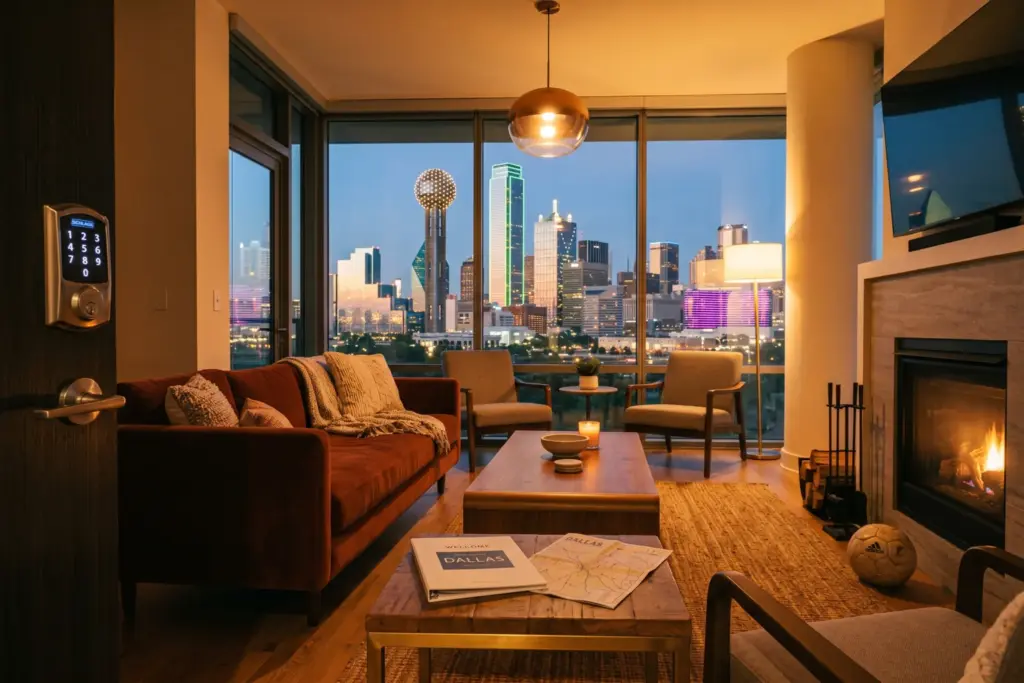
A three-bedroom in Oak Cliff, Dallas. Let us call him Ramiro. He has owned this property for three years, taken a dozen weekend groups, and hosted during three different Cowboys playoff runs. Nothing he has done before compares to tonight.
It is June 10, 2026. The FIFA World Cup opens tomorrow.
At 9:15 PM, Ramiro is standing in the kitchen testing his smart lock code for the sixth time. His guests arrive at 11. He knows the code works. He tested it four hours ago, and again at 7. Something about the final hours before the biggest event of his hosting career keeps pulling him back to the same steps.
“Sigo revisando todo,” he tells me by text, laughing a little at himself. “I keep checking everything. If I stop checking, something will go wrong.”
That feeling is in every World Cup host city tonight. In Dallas, Miami, Houston, Atlanta, and Kansas City, the hosts who will welcome the first wave of international fans tomorrow are doing something very specific: going through their lists one more time.
The Final Hours of Final Prep
The practical work of getting ready is not glamorous. Walk through what hosts in World Cup cities report doing on June 10, and you find a remarkably consistent inventory of tasks that nobody talks about during months of coverage about earnings projections and rate strategies.
Smart locks and keypads, first. Every experienced host who checked in from community forums ran a full device test in the final 24 hours. Not because they expected a failure, but because discovering a dead battery or an unsynced app at midnight, with six guests standing outside, is the kind of story that ends up in your reviews forever.
Noise monitors, second. This item caught the most hosts off guard. World Cup bookings trend toward larger groups. Larger groups trend toward louder nights. Hosts who had never needed a noise monitor for a couple on a weekend getaway suddenly found themselves installing one for the first time this week, days before their biggest guests arrived. The device that felt optional for three years of hosting became urgent in the final days before June 11.
Linens and consumables, third. Not restocking for normal turnover. Overstocking for the unexpected: the extra load of towels at 2 AM after a match, the additional set of sheets for guests who arrive a day early, the extra coffee and supplies for a group of eight that ends up staying two additional days when knockout round flights get rescheduled.
Guest guides, fourth. This one came up more than anything else when hosts described what they wished they had done differently three months ago. A printed or digital guide with stadium transit options, fan zone locations, neighborhood noise cutoff times, WiFi credentials, and emergency contacts is the difference between a guest who leaves five stars and a guest who messages you at midnight asking where the nearest stadium is.
What the Numbers Actually Look Like
The earnings conversation around World Cup 2026 has been, in many ways, a study in expectation management. The projections that circulated in early 2026 painted a picture of once-in-a-generation windfalls. Hosts in some analyses expected two to three times their normal rates, with premium match nights going at five to ten times baseline ADR.
Reality landed differently.
StaySTRA data shows Dallas hosts operating at a typical daily rate of 21, with 35% occupancy across the market. For World Cup match days, booked ADR in Dallas is running around 01 to 56, with available asking prices listed well above 00 in some cases. The premium is real. It is not what the projections promised. You can see the full picture for Dallas on the StaySTRA Dallas market page.
Miami, with 8,743 active listings tracked by StaySTRA, enters the tournament from a stronger baseline: a typical ADR of 82 with 61% occupancy. Match day rates are running 61 to 77 booked, with available asking prices in the 34 range. Miami hosts who locked in guests months ago at below-market prices are second-guessing those deals. Miami hosts who priced aggressively and watched their calendars sit empty are second-guessing those decisions harder. The full occupancy and revenue picture is on the StaySTRA Miami market page.
Across markets, the broader pattern is an ADR premium of about 48% on game days, roughly 87 booked versus 94 at baseline. That is real money. It is not the number that was in most hosts’ original spreadsheets when they set their rates back in January.
“Nos quedamos sin ese precio que soñábamos,” one Dallas host wrote in a Facebook group last month. “We never got that price we were dreaming about. But we got something, and we’re still glad we listed.”
Sponsored — OfferMarket
Buy Your First STR With Long-Term Rental Financing
Flexible, long-term financing for short-term rental buyers. Rates from 5.75%. Instant online quote, no credit pull.
Explore RTL Financing Options →Affiliate disclosure: StaySTRA may earn a referral fee.
City by City, the Night Before
What hosts are actually doing tonight depends on which city you are calling.
In Dallas, where AT&T Stadium is hosting nine World Cup matches including a semifinal, a consistent theme in host communities has been the supply gap. Dallas has more STR supply than almost any other host city, and fill rates for WC dates have been running in the low 30s percentage-wise. Hosts who priced rationally filled earlier. Hosts who held out for the dream number are, as of tonight, making rapid adjustments and hoping for late demand. One host in Uptown who had her condo listed at 50 a night dropped to 10 this week and filled three of her four remaining open nights by yesterday afternoon. She called it a humbling but ultimately satisfying outcome.
In Miami, where seven matches are scheduled, the dynamics are different. Miami’s STR market is deeper, and the international guest mix runs toward longer stays. Industry data shows international guests averaging 14 to 16 nights per World Cup booking, compared to about 10 nights for domestic guests. Hosts there are not just doing turnover math for a game day and a departure. They are hosting people who may be in their property for two consecutive weeks. Let’s call her Denise. She runs two properties in Wynwood and has been hosting for four years. For the past two weeks, she has been in what she describes as “hyperventilating calm.” She has prepared for everything she can think of. “Which means,” she told me, “I have prepared for about 70% of what will actually happen.”
In Houston, where city officials have described the market as one of the most well-prepared WC host cities, seven matches are scheduled. The local STR community has been running through noise complaint protocols specifically, given the city’s recent enforcement history. Hosts are setting clear house rules, distributing printed guides with city noise ordinance thresholds, and in several cases reaching out proactively to neighbors to exchange contact information before the first guests arrive.
In Atlanta, where the massive Centennial Yards entertainment district officially opens on June 10 itself, hosts near downtown are dealing with a different variable: thousands of additional non-match visitors flooding the city for the venue opening at the same time as the first wave of WC travelers. Let’s call her Teresa. She manages a two-bedroom in Old Fourth Ward and has never hosted during an event at this scale. Her final prep tonight has revolved around a single question she has been returning to since last week: what is my plan if the guests do not leave on time? Not the worst-case version of that question. The practical one. The guests whose flights home get canceled. The group that wants to stay for one more match day. She wrote a contingency policy for it last Thursday. Tonight, she printed it and left a copy on the kitchen counter.
In Kansas City, which hosts six matches and has seen some of the strongest demand dynamics among all WC cities, booked ADR is running 47 to 28 on game days, against fill rates of 42 to 49%. Host community voices there match the pattern our team has been tracking all week: “best month ever, but not retiring on it.”
What They Wish They Had Done Differently
Ask any experienced host what they would change if they had started their World Cup prep three months earlier, and the same four answers come up.
Minimum stay settings. Almost every host who ended up with gap nights between bookings traces the problem to not setting a three-night minimum around core match dates. Single-night gaps become nearly unsellable when your neighbors are all booked solid and last-minute guests are not browsing for one isolated night in the middle of a four-night run.
Security deposits for large groups. World Cup bookings skew toward larger parties. Groups of six, eight, ten people celebrating together represent a different liability calculation than a couple on a long weekend. Hosts who set standard security deposits are now second-guessing that decision as their properties fill with the most guests they have ever had under one roof at one time.
Guest communication, earlier. The guide that Denise spent three hours writing last week, with stadium transit options, fan zone locations, neighborhood parking rules, and the one restaurant three blocks away she knows will be open until 3 AM during match days, that guide should have been ready in April. Not because guests would have read it in April. Because writing it in April would have revealed every gap in the logistics thinking that she is now patching the night before kickoff.
Testing the tech. Every device, every lock, every noise monitor, every smart home camera and thermostat. Not just once. Twice. The host who checks their smart lock six times the night before the World Cup is, according to every experienced host who has navigated a major event before, the host who does not end up at 11 PM troubleshooting a firmware update with guests standing outside.
The Contingency Question
The thing that separates the most prepared hosts from the merely ready ones is how they answer the question they most do not want to think about: what happens when something goes wrong at 2 AM on a match night?
Noise complaints are the most common scenario during high-density guest periods. Hosts who have thought through a response protocol before they need it, which vendor to call, which neighbor to contact, what tone to take with guests who are celebrating, are better positioned to resolve a situation before it becomes a formal complaint or a three-star review.
Last-minute cancellations are the other variable. The FIFA group block releases that happened across host cities in April and May freed up unexpected demand in several markets. Philadelphia saw roughly 2,000 room nights released from FIFA-reserved hotel blocks in a single week, sending a late wave of accommodation seekers toward STRs. Hosts who priced strategically and kept their cancellation policies firm benefited from that late demand surge. Hosts who panicked and dropped prices too fast gave away yield they did not need to.
The most consistent piece of advice from experienced hosts this week is to have made the decisions in advance. Not at 2 AM. Not when the guests are at the door. The host who has already decided how to respond to a noise complaint, a last-minute guest modification request, and a property access problem is the host who handles those situations calmly when they arrive.
The Part That Is Not on Any Checklist
Walking through the accounts of what hosts are doing tonight, I keep noticing something that does not fit neatly into a prep list. It is what you might call the emotional weight of hosting at this scale for the first time.
Most of the hosts I have heard from this week have been doing this for years. They understand their properties, their neighborhoods, their guests. And all of them say, in some version, that this feels different. Not just bigger. Different in kind.
Ramiro, back in Oak Cliff, put it simply. His guests tomorrow are coming from three countries. They booked fourteen nights. His whole family knows about this booking. His mother asked if she could come by and meet them.
“Bienvenidos al mundo,” she told him. Welcome the world.
That is, underneath all the lock codes and noise monitors and linen counts and guest guides, what is actually happening in host cities tonight. The most prepared hosts have done everything they can do. Tomorrow, the world arrives. The wait is the only thing left.
Frequently Asked Questions
What should STR hosts in World Cup cities do in the final 24 hours before guests arrive?
Run a complete tech audit: test every smart lock code, check noise monitor battery and connectivity, verify smart home device functionality, and confirm WiFi credentials are current. Restock linens and consumables beyond normal turnover levels, especially for large groups. Print or share a guest guide with stadium transit directions, neighborhood noise ordinance information, and emergency contacts. Confirm your security deposit settings match the size and profile of the group you are hosting.
What are World Cup STR bookings actually paying in host cities like Dallas and Miami?
The real numbers are well below the projections that circulated earlier this year. Match day booked ADR is running roughly 48% above baseline in most markets, around 87 on average versus 94 typical. In Dallas, booked game day rates are landing in the 01 to 56 range despite asking prices above 00. Miami is seeing 61 to 77 booked on match days. Hosts who priced at two to three times baseline filled early; hosts who held out for five to ten times are making rapid price adjustments.
How long are World Cup guests staying in STR properties compared to typical bookings?
Significantly longer. International guests from Latin America average around 16 nights, European guests around 14 nights, and Asia-Pacific travelers around 13 nights. Domestic US and Canadian guests average about 10 nights. Compared to typical 3 to 4 night bookings in the same markets, World Cup guests are a different operational challenge in scope: more ongoing supply needs, more sustained guest communication, and a different relationship with turnover logistics than most hosts are used to managing.
What do experienced World Cup hosts say they wish they had done differently?
The most common answers: set a three-night minimum stay around core match dates to avoid unsellable gap nights, raise security deposits for groups larger than four guests, build a World Cup-specific house guide months before opening rather than the week of, and test every smart device and lock at least twice before guest arrival. Most hosts who ended up with gap nights trace the problem back to minimum stay or pricing decisions made in January or February.
How should STR hosts handle noise complaints during World Cup events?
Prepare your response protocol before you need it, not in the moment. Know which neighbor to contact first, have your property vendor on standby, and have a clear script ready for guests who are celebrating past ordinance hours. Hosts with noise monitors installed and calibrated can respond proactively before a formal neighbor complaint rather than reactively after one. Cities like Houston and Dallas both have active noise ordinance enforcement, and World Cup weeks are not exempt from that regardless of the event context.
If you are hosting in a World Cup city tonight, the most important work is already done. You listed, you got bookings, you prepared. For hosts thinking about what comes next, whether that means optimizing for the knockout rounds, understanding how this event affects your property value, or deciding whether the STR model still fits your goals after the tournament ends, the StaySTRA Analyzer gives you the market data to make that call on your actual numbers.
Sponsored — OfferMarket
Buy Your First STR With Long-Term Rental Financing
Flexible, long-term financing for short-term rental buyers. Rates from 5.75%. Instant online quote, no credit pull.
Explore RTL Financing Options →Affiliate disclosure: StaySTRA may earn a referral fee.
Want to see the underlying market data for your city? StaySTRA tracks occupancy, ADR, and revenue for Dallas and Miami, along with dozens of other STR markets, updated monthly.
Become a StaySTRA Insider
Join free — get our newsletter + 1 free property analysis/month.
No spam. Unsubscribe anytime. Free membership includes property analyses and market insights.
We do our best to keep our content accurate and up to date, but things change and we are only human. Always verify details directly with local sources before making decisions.