
Key Takeaways
- Roughly 1 in 4 STR hosts manages without any paid software, using native Airbnb tools, Google Sheets, and manual workflows, and many do so profitably.
- Airbnb’s built-in hosting tools in 2026 include automated messaging templates, calendar management, Smart Pricing suggestions, and multi-listing management, all free of charge.
- Hospitable’s $0 Essentials plan adds real-time cross-platform calendar sync and a unified inbox at no cost, closing the biggest gap for hosts who list on multiple platforms without paying for a PMS.
- Software-free management works cleanly for 1 to 3 properties on a single platform. Adding a second platform or a fourth property is usually where the strain starts to show.
- The real tradeoff is time: manual hosts report spending 15 to 25 hours per week on operations. Hosts using automation tools typically spend 2 to 5 hours on the same work.
On a Tuesday afternoon in early spring, I found myself on a video call with a host, let’s call her Renata, who manages a three-bedroom cabin outside South Lake Tahoe. She had a cup of tea in her hand, a whiteboard behind her covered in handwritten check-in schedules, and a Google Sheet open on her second monitor. The spreadsheet was five tabs and four years old.
She has never paid for property management software. Not a PMS, not a channel manager, not a dynamic pricing tool. Her cabin runs above 75 percent annual occupancy. Her reviews average 4.94 stars. She nets around fifty-eight thousand dollars a year after expenses, and she watches neighboring hosts pay a hundred to two hundred dollars a month for platforms she has never needed.
“People look at me like I’m running the place with an abacus,” she told me. “But I know every inch of this operation. I have not once lost a night’s revenue to a system crashing or a subscription auto-renewing when I wasn’t paying attention.”
Renata belongs to a quieter segment of the STR community. According to the 2026 Hostaway STR Report, roughly 26 percent of short-term rental hosts manage without any paid software tools. They are not confused beginners stumbling through year one. Many of them are deliberate about the choice, and in some cases they are outperforming neighbors who pay hundreds of dollars a year in subscriptions. Running Airbnb without property management software is a real strategy. This is what it actually looks like.
What Free Tools Actually Exist for Hosts in 2026
The starting point is knowing what the platforms give you at no cost. The native hosting toolset in 2026 is more capable than most people entering the hosting world expect.
Within the Airbnb app, hosts can create automated saved message templates that send at key points in the booking flow: confirmation, pre-arrival instructions, day-before reminders, mid-stay check-in, and check-out. The calendar system handles real-time availability and prevents double bookings within the Airbnb platform. Hosts can set minimum stays, use gap-filling rules, and opt into Smart Pricing, which is Airbnb’s built-in demand-based rate suggestion tool. Multi-listing management, a unified inbox, and basic performance analytics are all included at zero cost.
Vrbo offers comparable native tools: an inbox, iCal calendar export for syncing, and saved response templates. Most major booking platforms give hosts some version of these features for free.
The traditional gap has been cross-platform sync. If you list on both Airbnb and Vrbo, native tools cannot prevent double bookings between them. Calendar sync via iCal is available and free but carries a delay of roughly 15 to 30 minutes, which creates real risk during high-demand windows.
That gap narrowed significantly in 2026 when Hospitable launched a true free Essentials plan. The zero-dollar tier includes unified inbox management across Airbnb, Vrbo, Booking.com, and Agoda, real-time calendar sync, automated messaging templates, workflow and task management tools, and rental agreement handling. There is no property limit and no time cap. It is not a trial. For cross-platform hosts who want sync coverage without paying for a full PMS, it has become the bridge tool that makes the free-tool approach viable well beyond a single listing.
The Host Who Has Never Paid for Anything: Renata
Renata is a former operations manager who bought her Tahoe-area cabin in late 2021. She lists exclusively on Airbnb, a decision she made deliberately to keep her mental overhead low and her operation running inside a single ecosystem she already understood from years of booking travel.
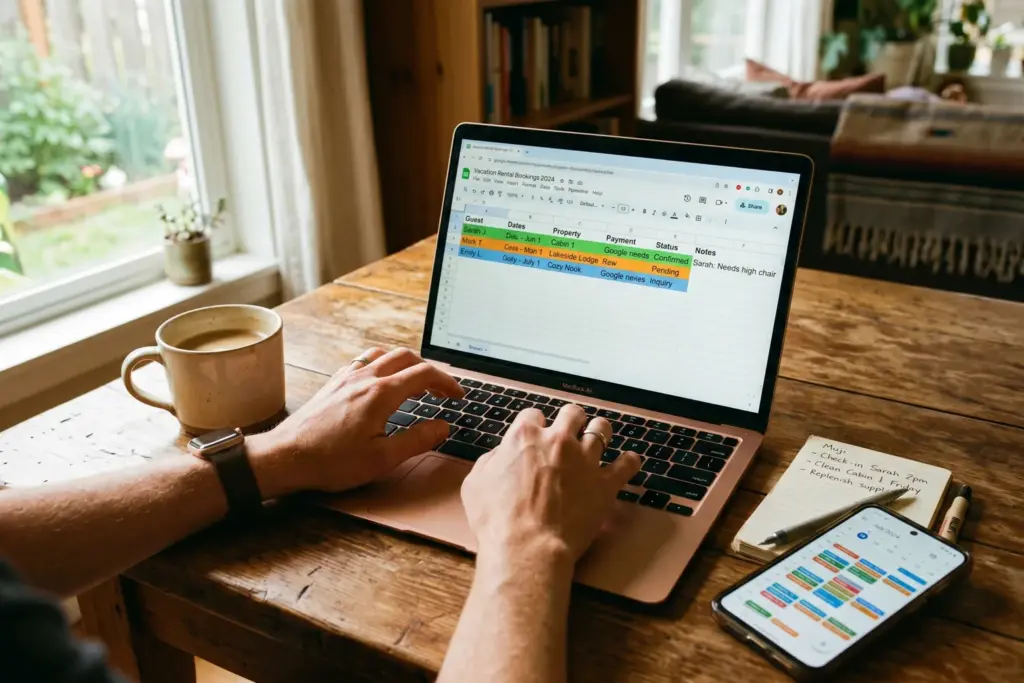
Her workflow runs on three things: a five-tab Google Sheet for bookings, income, expenses, cleaning schedules, and maintenance notes; a set of eight saved message templates in Airbnb’s native system; and a Sunday evening pricing session she runs while reviewing the weeks ahead.
“The Sunday review takes about 40 minutes,” she said. “I check what’s happening nearby, I look at what similar properties are charging, and I adjust. It is not algorithmic. But for one property on one platform, it works well enough that I have never felt the pull to change it.”
What makes her situation clean is the single-platform choice. She has never had a double booking because there is no second platform to manage. The cross-platform calendar problem, the one that most software tools are built to solve, simply does not exist for her operation.
She is clear-eyed about her ceiling. If she buys a second cabin and lists it on Vrbo, the spreadsheet workflow stops making sense. She has already decided she will add a channel manager on day one if that happens. Until then, her operation costs zero in software, runs on routines she built herself, and generates consistent returns in a market where many hosts report tool subscriptions eating meaningfully into their margins.
The Three-Property Host Who Never Learned New Software: Marcus
Call him Marcus. He owns three cabins in the Great Smoky Mountains area and lists all three exclusively on Airbnb. He bought the first in 2020, added a second in 2022, and a third in early 2024. His reason for staying manual is not resistance to technology. It is prior experience.
Marcus managed projects professionally using Google Sheets before he ever bought a rental property. When he looked at PMS platforms after adding his second cabin, what he saw was a steep learning curve and a monthly subscription to replicate a system he already had running. “I kept thinking: what does this solve for me that I’m not already solving?” he said. “The answer, for my operation, was nothing worth paying for.”
Like Renata, Marcus’s decision to stay Airbnb-only is not accidental. It is the structural choice that makes the free-tool approach sustainable at three properties. He accepts that he is probably missing some bookings from guests who search exclusively on Vrbo. He has decided that simplicity and zero software overhead are worth more than those marginal reservations.
His operation, which he runs sin complicaciones (without complications), takes about 12 hours a week across three properties. He checks messages twice daily, coordinates cleaning with two independent cleaners, and does a pricing review every Sunday. It is not passive income. He has never called it that. But for three properties generating meaningful annual income, he has not once needed to open a PMS dashboard to keep things running smoothly.
His threshold for switching: five properties. “At three I can keep my eye on things,” he told me. “At five I think the complexity tips over and something starts slipping.”
The Host Who Tried the Software and Came Back: Diane
Diane, as she goes by on the platforms, owns two condos in Phoenix. She is different from Renata and Marcus in one important way: she tried the software route seriously. Over 18 months she subscribed to a channel manager, a separate PMS, and a dynamic pricing tool. She cancelled all three.
The channel manager went first. It was solving a real problem, since she lists on both Airbnb and Vrbo, but the interface was clunky enough that she spent more time managing the tool than it was saving her. The PMS came next. She used it four months and realized she was paying 75 dollars a month to access features she had never opened. The dynamic pricing tool lasted eight months before she concluded that her own weekly pricing sessions, informed by her market knowledge and the data she pulls from StaySTRA monthly, were generating comparable results without the ongoing fee.
When she added up what she had spent on software over those 18 months, the number came to more than 2,300 dollars. “They were not worthless,” she said. “But they were not worth 2,300 dollars for my situation.”
Today she uses Hospitable’s free Essentials plan for the one function she genuinely needs: real-time calendar sync between Airbnb and Vrbo. For everything else, she runs on native platform tools and a simple expense spreadsheet she has kept since her first booking.
Talking with hosts like Diane is, a mi parecer (in my view), where the real story in this conversation lives. Not in the argument for or against software, but in the discovery that the right answer is completely specific to the operation. She did not reject software on principle. She tested it, costed it out, and chose what worked for her numbers. That is a different conversation than the one most software vendors want to have.
What These Hosts Are Giving Up
All three of these hosts are clear-eyed about the tradeoffs. This is deliberate exchange, not oversight.
The time cost is the most significant one. Hosts managing without automation report 15 to 25 hours a week on operations across guest communication, pricing reviews, cleaning coordination, and maintenance tracking. Hosts using full automation tools report 2 to 5 hours for comparable work. That gap compounds, especially as a host grows toward four or five properties.
Revenue optimization is the second tradeoff. Dynamic pricing tools monitor competitor availability, local event calendars, booking pace, and seasonal curves in ways no manual host can match. For small operators with deep market knowledge, the gap is smaller than software companies often suggest. Renata has tracked her ADR against her local market for three consecutive years and stayed within a few percentage points. But the gap is real and tends to widen as a market grows more competitive.
Cross-platform calendar risk remains the sharpest edge for anyone listing on multiple sites without real-time sync. The 15-to-30-minute iCal delay is not theoretical. It has cost hosts double bookings during busy weekends, and a double booking is the event most likely to push someone from manual to paid software in a hurry.
If you want to see what the paid tools look like once the math does tip, our complete STR channel manager comparison breaks down what Hostaway, Guesty, Lodgify, OwnerRez, and Beds24 each cost and cover. And before adding any overhead at all, the StaySTRA Analyzer lets you run the numbers on your target market to check whether the fundamentals support a profitable operation in the first place.
When the Math Changes
Each of these hosts has a threshold, and each has thought it through. Renata’s line is a second property plus a second platform. Marcus puts his at five properties. Diane would upgrade from Hospitable’s free tier to a paid plan at a third property, where the unified inbox and automated messaging features would save enough time to justify the cost clearly.
The question they are each asking is not “should I get software?” It is “does this subscription pay for itself given what my operation actually requires right now?” When the answer changes, they act on it. Until then, they keep the money in their pocket and put it back into their properties.
For hosts who are thinking about scaling toward a second or third property and need to work through the financing side first, the StaySTRA STR Financing Guide covers how DSCR loans work and which markets tend to make the numbers pencil for early-stage investors.
We do our best to keep our content accurate and up to date, but things change and we are only human. Always verify details directly with local sources before making decisions.
Frequently Asked Questions
Can you really run an Airbnb without property management software?
Yes, for single-platform hosts managing 1 to 3 properties, it is entirely feasible. Airbnb’s native tools include automated messaging, calendar management, Smart Pricing suggestions, and a unified guest inbox. Hosts who list only on Airbnb eliminate the cross-platform calendar risk that drives most software purchases. The primary tradeoff is time: manual management typically takes 15 to 25 hours per week compared to 2 to 5 hours with full automation tools in place.
What free tools does Airbnb include for hosts in 2026?
Airbnb’s free native tools include automated message templates, real-time calendar management, Smart Pricing demand-based rate suggestions, multi-listing management, performance analytics, and a unified guest inbox. Vrbo offers comparable free tools including iCal export, saved response templates, and an inbox. For hosts listing on both platforms, Hospitable’s free Essentials plan adds real-time cross-platform calendar sync and unified messaging at zero cost.
What is Hospitable’s free Essentials plan and what does it include?
Hospitable’s free Essentials plan, launched in 2026, includes real-time calendar sync across Airbnb, Vrbo, Booking.com, and Agoda, a unified inbox, automated messaging templates, workflow and task management tools, and rental agreement handling. There is no property limit and it is not a time-limited trial. It is currently the only free option that solves the cross-platform double-booking risk without a paid subscription, making it the most significant development for software-free hosts managing multiple channels.
How many properties can you manage without paid STR software?
Most hosts manage 1 to 3 properties on a single platform without paid software. The critical breakpoints are adding a second listing platform (where cross-platform calendar sync becomes essential) and reaching 4 to 5 properties (where manual workflows become genuinely time-consuming). The most common trigger for switching is a double booking from unsynchronized calendars rather than a gradual realization that the operation has outgrown the free tools.
Is manual STR management worth it for the savings?
For the right operator, yes. The monthly software savings of 50 to 150 dollars add up to 600 to 1,800 dollars per year, which matters for a host running one or two properties. The primary cost is time, and for hosts who enjoy the operational side of hosting and have built consistent routines, that time investment is often not a deterrent. The calculation typically tips toward software somewhere between 3 and 5 properties, or when a second listing platform enters the picture.
Sponsored — OfferMarket
Buy Your First STR With Long-Term Rental Financing
Flexible, long-term financing for short-term rental buyers. Rates from 5.75%. Instant online quote, no credit pull.
Explore RTL Financing Options →Affiliate disclosure: StaySTRA may earn a referral fee.
Become a StaySTRA Insider
Join free — get our newsletter + 1 free property analysis/month.
No spam. Unsubscribe anytime. Free membership includes property analyses and market insights.