

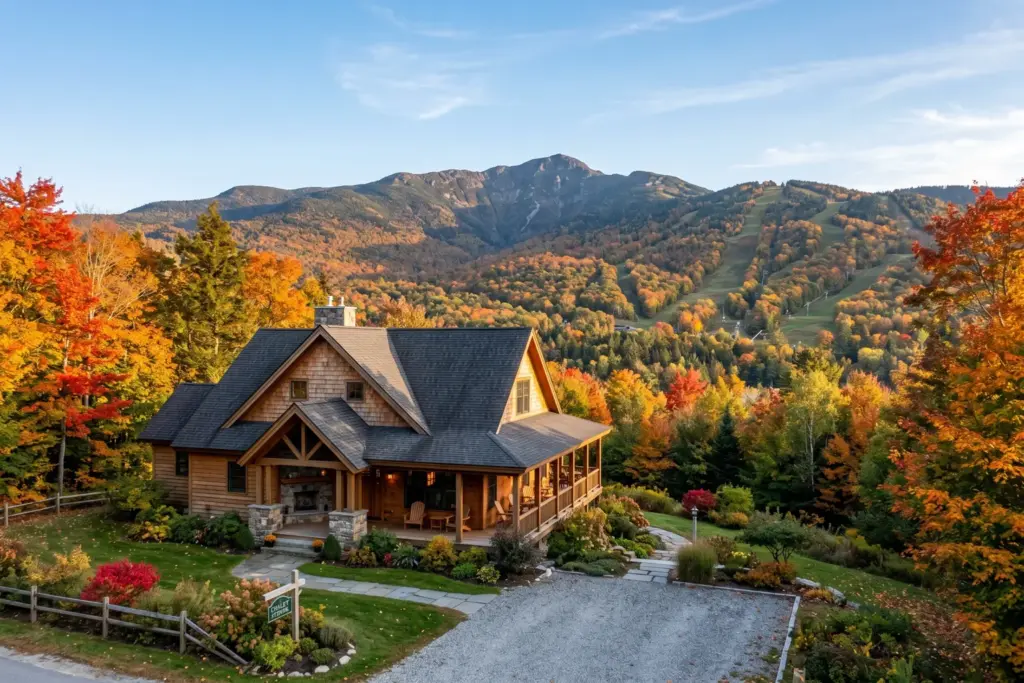
Key Takeaways
- Active Stowe STR listings generated an estimated $73,000 in annual gross revenue in 2025, placing this Vermont ski town among the strongest per-listing earners in all of New England, according to industry tracking data.
- Annual market-wide occupancy runs approximately 52%, with January through March pushing well-positioned properties above 80% on a consistent basis.
- Average daily rates of around $387 make Stowe competitive with Western mountain markets like Sedona and Traverse City at a lower entry price than Vail or Aspen.
- Vermont’s combined lodging tax burden is 13% (9% state meals and rooms tax, 3% STR surcharge, 1% Stowe local option tax). Factor this into every underwriting model.
- Stowe’s May 2025 registration ordinance means STR operating rights no longer transfer on property sale; every new buyer applies independently, which limits competitive supply growth going forward.
Stowe, Vermont STRs generated an estimated $73,000 in annual gross revenue per active listing in 2025, placing this iconic ski town among the highest per-listing earners in the entire New England region, according to industry tracking data. StaySTRA’s Stowe-specific location page is currently in development, so I am drawing on market-wide tracking for this analysis. What the data shows is a market that earns its reputation: strong average daily rates, four distinct demand peaks across the calendar year, and a regulatory structure that has quietly begun to limit new supply.
For investors researching New England mountain markets in the post-Memorial Day window, Stowe is the right market to understand before moving further into summer and fall planning. Here is what the numbers actually say.
What the Data Actually Shows
Approximately 1,200 active short-term rental listings operate in the Stowe market, according to industry tracking data. Average daily rates for the full year 2025 came in around $387. Think of that figure the way you would think of the sticker price on a car at the dealership: it is the average across all conditions, not the number you see in February when the parking lots at Stowe Mountain Resort are full. In peak ski season, rates for well-positioned properties regularly climb above $546 per night. The $387 is the full-year weighted average, valleys and peaks together.
Annual occupancy runs approximately 52% across the active market. Stay with me on that number for a moment, because 52% deserves more credit than it often gets. Most single-season mountain markets in the West post similar annual occupancy by concentrating everything into one quarter. Stowe distributes its demand across three genuine peak periods and two soft shoulder months, which changes the cash-flow profile significantly. A property that books steadily through ski season, foliage, and summer hiking is a more defensible asset than one that earns everything in December and sits empty by April.
Put those figures together: 365 nights times 52% occupancy times $387 average daily rate equals approximately $73,400 in estimated annual gross revenue per active listing. That is the ceiling. Your management fees, platform costs, Vermont tax obligations, cleaning, and debt service all come out of that number.
For direct comparison within this series: Sedona, Arizona carries ADRs around $440 but has seen occupancy soften to 53% on supply growth concerns. Traverse City, Michigan delivers strong summer performance but lacks a ski anchor to support the shoulder months. Stowe’s four-season profile puts it in a structurally stronger position than either single-season peer.
Four Seasons, Four Demand Drivers
I have been watching mountain resort markets for close to four decades. Few towns carry the combination of brand recognition and genuine multi-season demand that Stowe has built. What looks like a ski town from the outside is actually four markets stacked on top of each other.
Ski Season: December Through March
This is the core, and it earns the designation. Stowe Mountain Resort anchors demand from Thanksgiving week through late March in a strong snow year, with nearly 600 skiable acres, an 80-person gondola to the summit of Mount Mansfield, and a reputation as the best lift-served skiing in New England. December and January see market-wide occupancy climb above 70%. February is the peak month: holiday school breaks, Presidents’ Week, and the eastern seaboard’s limited alternatives combine to push well-positioned properties into the 80-85% occupancy range. ADRs follow accordingly. Hosts who hold their rates firm in this window, rather than dropping early for guaranteed bookings, consistently capture the best annual averages.
Fall Foliage: September and October
New England fall foliage is not a secondary amenity. It is a legitimate demand driver. Stowe’s elevation and its surrounding mix of sugar maple and yellow birch produces some of the most photographed color in the Northeast. September transitions into October with occupancy typically exceeding 65% as leaf-peepers begin arriving. October foliage weekends often approach or surpass ski-season nightly rates at the higher end of the market. This is a guest segment that is notably price-insensitive; they plan a year in advance and pay for their preferred dates.
Summer Hiking Season: June Through August
Mount Mansfield, Vermont’s highest peak at 4,393 feet, sits directly above Stowe. The Long Trail runs through it. The gondola operates in summer for hikers who want the summit without the climb. This is not a filler season; it is a genuine third demand driver anchored by the outdoor recreation that draws visitors from Boston, New York, and Montreal within a half-day drive. Larger properties accommodating hiking groups and multi-family stays perform particularly well. July is consistently the strongest summer month.
Shoulder Seasons: April and November
April is mud season in Vermont. Properties sit quiet, and honest underwriting accounts for this. November, after foliage fades and before reliable snow establishes, is the second soft period. Budget for two genuinely slow months and the full-year math becomes predictable. Overlook them and you will be recalibrating expectations in spring.
Supply and Demand Balance
The Stowe STR market has grown modestly but consistently over the past several years, tracking Vermont’s broader expansion in vacation rental inventory. The approximately 1,200 active listings represent a market that has responded to demand. What changes the picture going forward is regulatory structure.
Stowe adopted a formal short-term rental registration ordinance in May 2025. Under that ordinance, STR operating rights do not automatically transfer when a property sells. A new buyer must apply independently for their own registration, satisfying current ordinance requirements, rather than assuming the prior owner’s standing. This is a meaningful structural barrier to supply growth. Properties with established operating histories carry a small operational advantage, but every new investor faces the same registration process regardless of purchase price.
The ordinance also requires a designated responsible person available within 45 minutes of the property for emergencies and mandates 24-hour fire department access via an approved lock box. These are compliance elements that reward organized operators and create friction for hands-off investment approaches.
The practical effect is a supply ceiling that grows more slowly than it would in an unregulated market. New registrations require active compliance management; passive supply growth is limited. For existing operators, this is a structural advantage worth noting in any competitive analysis.
Sponsored — Beeline
Finance Your Next STR With a DSCR Loan
Qualify on property cash flow, not W-2 income. Beeline specializes in fast DSCR closings for STR investors. No personal income verification required.
Check Your DSCR Eligibility →Affiliate disclosure: StaySTRA may earn a referral fee.
The Regulatory Environment: 13 Percent Off the Top
Vermont takes lodging taxation seriously. Stowe adds a local layer. Every underwriting model needs to account for 13% of gross revenue going to combined tax obligations before a single expense is paid.
Vermont State Taxes
Vermont’s Meals and Rooms Tax applies to short-term rentals of fewer than 30 consecutive nights at a 9% rate. In August 2024, Vermont added a 3% Short-Term Rental Surcharge on top of that base, bringing state-level taxation on rental revenue to 12%. Rentals generating income for 15 or more days per calendar year require registration with the Vermont Department of Taxes and a Vermont Business Tax Account. Airbnb and VRBO both hold state agreements to collect and remit on behalf of hosts; hosts remain responsible for maintaining their registration status regardless.
Stowe Local Taxes
Stowe’s 1% local option tax brings the combined burden to 13% of gross rental revenue. On a listing generating $73,000 per year, that is approximately $9,490 in annual tax obligations. Don’t let that number derail your analysis before you run the full model. Fold it into your net operating income calculation alongside platform commissions (typically 3% host fee plus a guest-facing service fee the platform handles), cleaning costs, property maintenance reserves, and management fees if applicable. The math still works at the right acquisition price. It just requires discipline about what that price actually is.
Stowe Registration
Registration costs $100 per year for any property rented 14 or more days in a calendar year. The Fire Department lock box requirement carries no separate fee but requires coordination. Maximum penalty for non-compliance is $400 per violation. Vermont’s state lodging tax registration is a separate requirement handled through the Department of Taxes.
Who Should Buy in Stowe
The investment case is strongest for buyers who combine four-season operational discipline with realistic acquisition price targets.
Properties in the $850,000 to $1.1 million range carry a gross revenue estimate around $73,000. Assuming a 35-40% expense ratio (platform fees, cleaning, maintenance, insurance, property management, taxes), net operating income lands in the $44,000-$47,500 range. On a DSCR loan at current mountain-market rates, the financing math requires careful structuring. Our STR Financing Guide covers DSCR loan mechanics for exactly this acquisition profile; dual-season mountain markets are a well-understood asset class for DSCR lenders, and Stowe’s demonstrable year-round demand history helps the underwriting case.
Buyers who value occupancy stability over raw peak-month yield will find Stowe’s four-season profile genuinely hard to replicate in the Northeast. Comparable New England markets don’t carry Stowe’s ski brand, foliage draw, and summer recreation all in one zip code. The White Mountains of New Hampshire, the most recent comparable market in this Sprint 3 series, offer lower entry prices but weaker brand recognition and a shorter effective demand season. Stowe commands a price premium because the demand profile justifies one.
Appreciation-oriented investors will also note that Stowe single-family median prices rose more than 17% year over year in Q1 2026, with condo values moving similarly. In a constrained supply market with strong destination demand, the capital appreciation component of total return is meaningful.
Who Should Think Twice
Passive investors expecting strong net cash flow from day one at luxury acquisition prices should run the numbers honestly before committing. Properties above $1.5 million require exceptional revenue performance to justify debt service, and not every Stowe listing performs at the market average. Location within the market matters significantly: a ski-access condo near the Mountain Road corridor has different demand characteristics than a farmhouse a 20-minute drive from the lifts.
Single-season operators who plan to list only during ski months should model the full annual carrying cost against winter-only revenue. The property tax, insurance, utilities, and mortgage payment run 12 months. Revenue that covers only three of them changes the math considerably.
Investors who need immediate strong positive cash flow without a meaningful down payment, at current Stowe property prices, should also look seriously at whether this is the right market for their capital structure. The total return case here combines operating income, appreciation, and the defensive supply-constrained position. Patience is part of the return profile. Buyers who need the property to cash flow heavily on a small down payment from month one should explore markets with lower acquisition prices and similar occupancy fundamentals.
For comparison, Jackson Hole, Wyoming carries even higher acquisition prices with similar four-season demand dynamics. Stowe is the more accessible entry point to that type of dual-season mountain market investment.
Sponsored — Beeline
Finance Your Next STR With a DSCR Loan
Qualify on property cash flow, not W-2 income. Beeline specializes in fast DSCR closings for STR investors. No personal income verification required.
Check Your DSCR Eligibility →Affiliate disclosure: StaySTRA may earn a referral fee.
Frequently Asked Questions
Is Stowe Vermont a good place to invest in short-term rentals?
Yes, for investors who can acquire at a realistic price point and commit to active four-season management. Industry tracking data shows approximately $73,000 in annual gross revenue per active listing in 2025, supported by three distinct demand peaks: ski season (December through March), fall foliage (September and October), and summer hiking (June through August). Stowe’s May 2025 registration ordinance has introduced friction to new supply growth by making STR operating rights non-transferable on property sale, which provides a structural advantage for existing operators. The strongest investment case combines a purchase price in the $850,000 to $1.1 million range, DSCR financing, and hands-on management across all four seasons. Buyers at $1.5 million and above face a more demanding yield calculation.
How much do Airbnb hosts make in Stowe Vermont?
Industry tracking data for 2025 shows average gross annual revenue of approximately $73,000 per active Stowe listing, based on an estimated 52% annual occupancy rate and an average daily rate around $387. Peak ski season (February in particular) sees ADRs climb above $546 for well-positioned properties, with occupancy above 80%. Fall foliage adds a second revenue peak in October with rates that can approach or exceed peak ski-season pricing. These are gross figures; hosts should budget 35-40% for combined operating expenses including Vermont’s 13% lodging tax burden, platform fees, cleaning, and maintenance.
What are the STR rules in Stowe Vermont?
Stowe implemented a formal short-term rental registration ordinance in May 2025. Properties rented for 14 or more days per calendar year require a $100 annual registration fee. Operating rights do not transfer on property sale; new owners must apply independently. Hosts must designate a responsible person available within 45 minutes for emergencies and provide the Fire Department with 24-hour lock box access. At the state level, Vermont requires a 9% Meals and Rooms Tax plus a 3% Short-Term Rental Surcharge (added August 2024) on all rentals under 30 consecutive nights, with a Vermont Business Tax Account required for hosts renting 15 or more days per year. Stowe adds a 1% local option tax, bringing total lodging tax to 13%.
How does Stowe compare to other New England STR markets?
Stowe is the premier four-season mountain STR market in New England, differentiated from coastal markets like Cape Cod and the Outer Banks by its ski anchor, and from single-season mountain markets by its genuine foliage and summer demand. The White Mountains of New Hampshire offer a lower acquisition price with similar outdoor recreation appeal but weaker destination brand and a shorter effective demand season. Stowe’s $387 average daily rate exceeds most comparable New England markets. The primary trade-off is acquisition cost: Stowe median property prices now exceed $850,000, and well-positioned STR properties commonly list in the $1 million to $1.5 million range.
Does Stowe have enough year-round STR demand to justify the acquisition price?
For buyers at the right price point, yes. The four-season demand profile means Stowe avoids the sharp revenue valleys that affect purely seasonal markets. Ski season (December through March) is the primary revenue driver, fall foliage (September through October) is a genuine second peak, and summer hiking activity sustains occupancy from June through August. April and November are genuinely slow; honest underwriting plans for them. The market’s approximately 52% annual occupancy is competitive with comparable mountain destinations in the West, at a lower acquisition cost than markets like Vail or Aspen. Stowe also carries Vermont’s well-established vacation rental infrastructure, including strong platform presence on both Airbnb and VRBO.
We do our best to keep our data accurate and up to date, but markets move fast and we are only human. Always verify current figures directly with local sources before making investment decisions.
Sponsored — Beeline
Finance Your Next STR With a DSCR Loan
Qualify on property cash flow, not W-2 income. Beeline specializes in fast DSCR closings for STR investors. No personal income verification required.
Check Your DSCR Eligibility →Affiliate disclosure: StaySTRA may earn a referral fee.
Ready to run the numbers on a specific Stowe property? The StaySTRA Analyzer lets you input an address and see estimated revenue, occupancy, and ADR projections for comparable listings. Vermont market data is available across 32 tracked Vermont markets.
Become a StaySTRA Insider
Join free — get our newsletter + 1 free property analysis/month.
No spam. Unsubscribe anytime. Free membership includes property analyses and market insights.