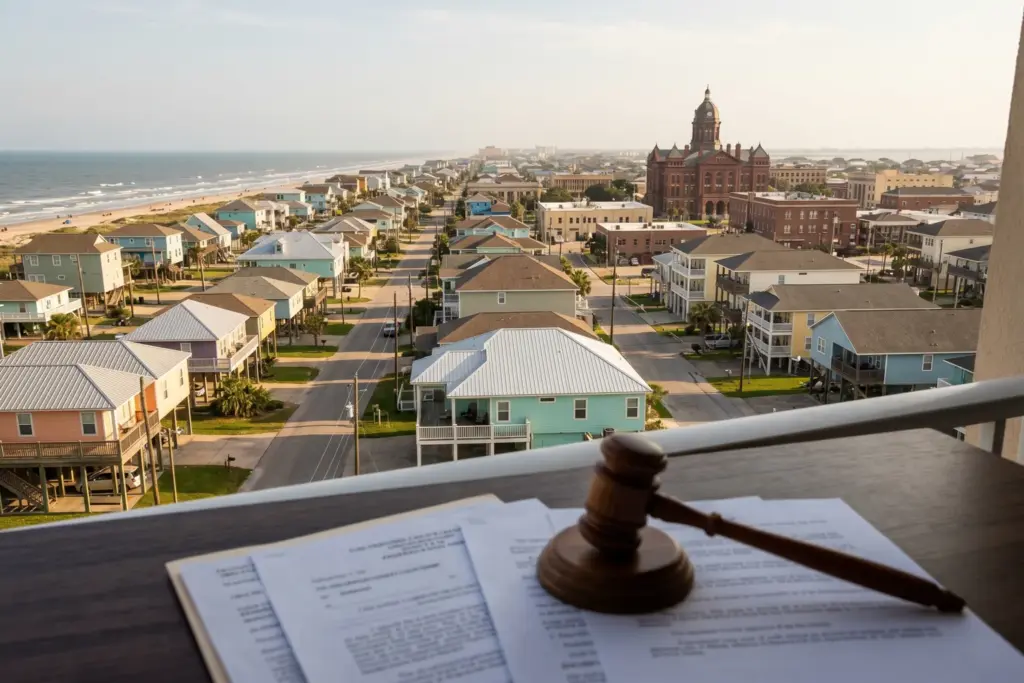
Key Takeaways
- A US District Judge granted a PARTIAL preliminary injunction against Jamaica Beach’s 2026 STR ordinance. This is a mixed ruling, not a clean host victory.
- BLOCKED: the specific provision barring homeowners from counting first-floor space below base flood elevation toward occupancy limits for short-term rentals.
- UPHELD: the 12-person occupancy cap, the $1 million insurance requirement, and the city’s enforcement mechanisms. The rest of the ordinance remains fully in effect.
- This is NOT a final ruling. It is a preliminary injunction covering named plaintiffs and association members only, and the case continues in federal court.
- The legal reasoning turned on Texas Constitutional retroactivity protections, not a broad property-rights victory. The practical takeaway for Texas hosts is more nuanced than most headlines suggest.
Jamaica Beach’s 2026 short-term rental ordinance is still mostly in effect. In early May 2026, a federal judge partially blocked one specific provision (Galveston County Daily News, May 4, 2026), and if you read the coverage and stopped at the headline, you probably walked away with the wrong impression of what actually happened.
U.S. District Judge Jeffrey Brown of the Southern District of Texas granted a preliminary injunction against the City of Jamaica Beach, blocking the provision that bars homeowners from counting or advertising first-floor space below base flood elevation when calculating occupancy for short-term rentals. According to reporting by the Galveston County Daily News and Law360, that is the win. Everything else in the ordinance survives: the 12-person occupancy cap, the $1 million insurance requirement, and the city’s enforcement mechanisms all held up in court. The Jamaica Beach Short Term Rental Association and four homeowners filed the lawsuit, argued the ordinance unlawfully restricted their property rights and business operations, and received a narrow ruling in their favor on one narrow point.
This distinction matters, because this ruling is going to make the rounds in Texas host groups as a major win. It is not. It is a carefully scoped, preliminary, single-provision ruling in a case that has a long way to go. Here is what it actually means, line by line.
What the Judge Actually Blocked, and Why That Specific Point Mattered
Picture this: You own a beach house in Jamaica Beach on Galveston Island. Your property, like many coastal Texas homes, has a first floor built below the base flood elevation (the minimum elevation set by FEMA flood maps as the standard for flood insurance purposes). That first floor has bedrooms. Guests use it. You have rented the home, counting that space as part of your occupancy, for years.
Under Jamaica Beach’s 2026 Ordinance 2026-01, that first floor no longer counts toward your occupancy calculation. The city also prohibited you from advertising it as usable space. Overnight, properties that had operated at one occupancy level were retroactively capped at a lower number, directly cutting revenue potential for owners who built their rental businesses under prior rules.
Judge Brown found that this retroactive application likely violates the Texas Constitution’s prohibition on retroactive laws. His reasoning, as reported by the Galveston County Daily News, was pointed: the restriction materially diminished owners’ established use of their properties, testimony showed reduced bookings and disrupted rental income, and the city’s stated rationale had a logic problem.
Here is the inconsistency the court identified: renters could still physically use the first floor. They just could not be counted toward occupancy. If the floor was genuinely unsafe for occupancy purposes (which was part of the city’s flood-safety argument), why was it acceptable for guests to occupy it in smaller numbers? That is the question the city could not fully answer, and the court noticed.
That is the win. It is grounded in a specific Texas Constitutional retroactivity argument, applied to a specific provision, affecting a specific subset of property owners. It is real. But it does not touch the rest of the ordinance.
What the Judge Upheld, and Why That Is the More Important Story
The three provisions that survived the legal challenge cover the bulk of what actually affects STR business operations in Jamaica Beach. I have reviewed more zoning codes than most people have unread emails, and I can tell you this ordinance’s surviving core is more consequential than what was blocked.
The 12-person occupancy cap stands. Jamaica Beach can limit your short-term rental to 12 guests, regardless of the property’s size, bedroom count, or sleeping capacity. If you were counting on a larger group rate to make your numbers work, that ceiling is now law. The court found this rationally tied to legitimate government interests in controlling overcrowding and nuisance activity.
The $1 million insurance requirement stands. This is not a standard homeowner’s policy or a basic landlord umbrella. A $1 million STR-specific liability policy costs meaningfully more than typical rental coverage. The court found this rationally tied to public safety. Cities across Texas and nationally have been adding insurance mandates to STR ordinances, and this ruling confirms courts will not easily strike them down.
The enforcement mechanisms stand. Jamaica Beach’s registration requirements, the Class C Misdemeanor structure for violations, and the per-day penalty system all remain operative. The city has the legal authority to pursue non-compliance, and that authority just got judicial confirmation.
Three provisions. All upheld. Covering occupancy, cost structure, and enforcement. The flood-elevation win helps a specific subset of owners whose usable space was being excluded from the occupancy calculation. It does not change the cap, the insurance burden, or the consequences for non-compliance. The core regulatory architecture of the 2026 ordinance is intact.
What a Preliminary Injunction Actually Means (This Is Not Over)
A preliminary injunction (a temporary court order issued before the full case is decided at trial) is not a final judgment. When a court grants one, it is making a limited finding: based on the evidence presented so far, the plaintiffs appear likely to succeed on this specific point, and they will suffer real harm if the court waits for a full trial before acting.
Four things follow from that, and all four matter for how you read this ruling.
Scope is limited. The injunction currently protects the named plaintiffs and members of the Jamaica Beach Short Term Rental Association who are parties to the lawsuit. Other STR owners in Jamaica Beach who are not part of the case can still face enforcement of the flood-elevation provision. The ruling is not a blanket exemption for all Jamaica Beach hosts.
It can be reversed. The city can appeal the preliminary injunction order. Circumstances can change. A different record at trial, additional evidence, or a different appellate panel can all undo a preliminary win. The 2026 STR litigation landscape includes rulings going in multiple directions across federal and state courts. No outcome is permanent at this stage.
The upheld provisions are now more firmly embedded. The court reviewed the cap, insurance mandate, and enforcement structure and found them legally sound. That gives the city a stronger position if the litigation continues.
The case is still open. The flood-elevation issue was addressed at a preliminary stage. A full trial will test that ruling again. The plaintiffs may win definitively on that point. They may not. Anyone declaring a host victory is reading a work in progress as if it were the final chapter.
What Texas STR Owners Should Take From This
Jamaica Beach has roughly 1,000 permanent residents and several hundred active vacation rentals on Galveston Island. It is a small municipality with an outsized STR economy relative to its permanent population, and its experience with aggressive ordinance-writing is not unusual. Cities across coastal Texas and the broader state have been layering regulations onto short-term rental markets throughout 2025 and 2026.
StaySTRA data for the Galveston County market shows approximately 5,921 active short-term rental listings, an average daily rate around $295 per night, and peak July occupancy reaching 69 percent. That is significant economic activity, which is exactly why cases like this matter to anyone operating or investing in Gulf Coast Texas markets.
Here is what the ruling actually signals for owners reading their own city’s ordinances.
Retroactive changes to occupancy calculation are legally vulnerable in Texas. If a city rewrites the rules on what space counts toward occupancy in a way that materially diminishes your established rental use, you may have a Texas Constitutional argument based on retroactivity. This is not a guarantee of success, but it is a recognized legal theory that held up at the preliminary injunction stage in a federal court. Document your prior operating parameters, your booking history, and how your property was marketed and permitted before any ordinance change. That documentation is the factual foundation for any legal challenge.
Occupancy caps, insurance mandates, and enforcement structures are likely to survive court scrutiny. Courts reviewing STR ordinances under rational basis review (the legal standard applied when a regulation does not trigger heightened constitutional scrutiny) give cities substantial deference. As long as the city can point to public safety, noise, or nuisance concerns, a court is unlikely to substitute its judgment for the city council’s. The Jamaica Beach ruling is consistent with what courts have been signaling throughout 2026: cities can regulate, they just cannot overreach in specific ways.
The Texas STR litigation landscape remains active. The Dallas STR ban case heading toward the Texas Supreme Court, the federal court battles in Nevada and California, and this Jamaica Beach ruling all demonstrate that these cases turn on specific legal theories in specific jurisdictions with specific facts. There is no single blueprint, and an attorney who specializes in Texas real estate and administrative law is your best resource before you act on a legal theory from a news article.
If you own property in a Texas coastal market and want to understand how your city’s ordinance stacks up, or whether specific provisions might have legal exposure, the StaySTRA analyzer can help you benchmark your market and understand what you are working with before you bring in legal counsel.
This article provides general information and should not be construed as legal advice. Consult a qualified attorney in your jurisdiction for advice specific to your situation.
Frequently Asked Questions
Did a federal court strike down Jamaica Beach’s 2026 STR ordinance?
No. The court issued a partial preliminary injunction blocking one specific provision: the rule barring owners from counting first-floor space below base flood elevation toward their short-term rental occupancy limits. The remainder of the ordinance, including the 12-person occupancy cap, $1 million insurance requirement, and enforcement mechanisms, remains fully in effect. The ordinance was not struck down or significantly limited in scope.
What is a preliminary injunction and why does it matter here?
A preliminary injunction is a temporary court order issued before a case reaches final judgment. Granting one means the court found the plaintiffs likely to succeed on a specific point and likely to suffer harm without immediate relief. It is not a final ruling. The city can appeal it, the court can modify it, and the full case continues. In Jamaica Beach, the preliminary injunction currently protects named plaintiffs and association members only, not all Jamaica Beach STR owners.
What is the flood elevation occupancy rule that was blocked?
Jamaica Beach’s 2026 ordinance barred homeowners from counting or advertising first-floor living space located below the base flood elevation (the FEMA-set minimum height standard) when calculating occupancy for short-term rentals. Many Jamaica Beach properties have usable first-floor space below this line. The rule effectively reduced permitted occupancy for those homes retroactively. Judge Brown found this retroactive application likely violates the Texas Constitution’s prohibition on retroactive laws.
Does this ruling apply to all Jamaica Beach STR owners?
No. The preliminary injunction protects the named plaintiffs and members of the Jamaica Beach Short Term Rental Association who are parties to the lawsuit. STR owners in Jamaica Beach who are not part of the litigation are not covered by the order. Those owners remain subject to the flood-elevation provision unless the court issues a broader ruling or they join the legal action.
What should Texas STR owners do if their city passes a similar ordinance?
Document your established use before any ordinance change takes effect: historical booking patterns, prior occupancy levels, permits issued under old rules, and marketing materials showing how the property was advertised. Courts look at whether new regulations materially diminish established property use, and that factual record supports a retroactivity argument. Consult a Texas real estate attorney with STR experience before acting. Do not assume a ruling in Jamaica Beach applies to your city’s specific ordinance.
Sponsored — OfferMarket
Buy Your First STR With Long-Term Rental Financing
Flexible, long-term financing for short-term rental buyers. Rates from 5.75%. Instant online quote, no credit pull.
Explore RTL Financing Options →Affiliate disclosure: StaySTRA may earn a referral fee.
Become a StaySTRA Insider
Join free — get our newsletter + 1 free property analysis/month.
No spam. Unsubscribe anytime. Free membership includes property analyses and market insights.
Sponsored — OfferMarket
Buy Your First STR With Long-Term Rental Financing
Flexible, long-term financing for short-term rental buyers. Rates from 5.75%. Instant online quote, no credit pull.
Explore RTL Financing Options →Affiliate disclosure: StaySTRA may earn a referral fee.
We do our best to keep our regulatory guides accurate and up to date, but ordinances change and we are only human. Always verify current requirements directly with your local municipality before making business decisions. Sources for this article include reporting by the Galveston County Daily News and Law360 Real Estate Authority, as well as the City of Jamaica Beach official website (jamaicabeachtx.gov).