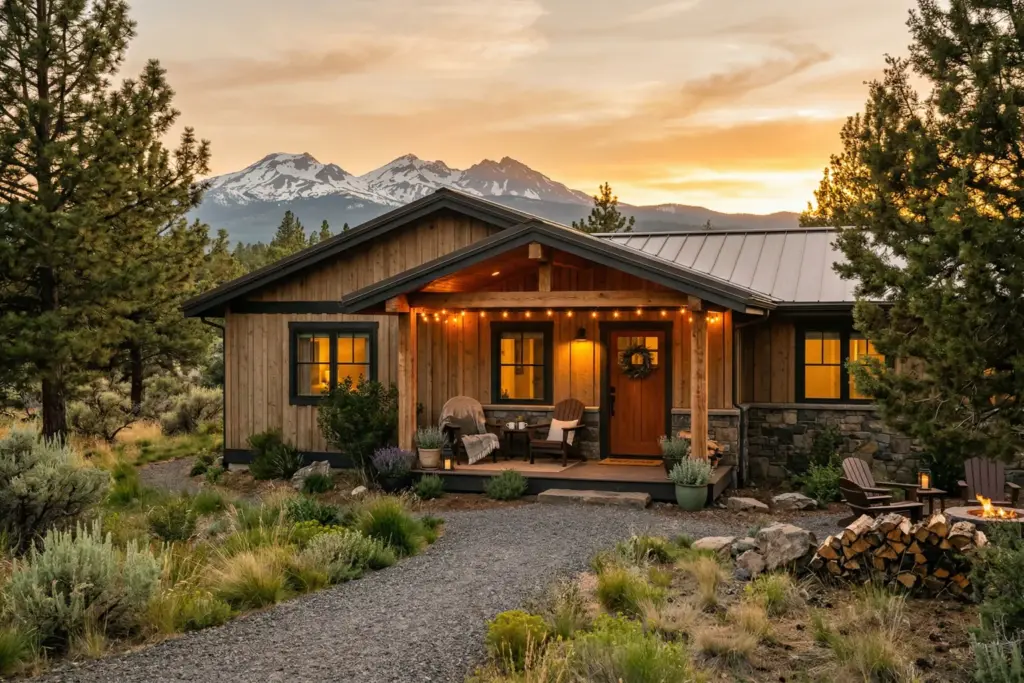
Key Takeaways
- Bend, Oregon is a summer-dominant STR market with July occupancy hitting 90.3%, not the ski-season play many new hosts expect.
- The 500-foot density separation rule for Type II whole-house permits limits where new vacation rentals can open, protecting existing hosts from oversaturation.
- StaySTRA data shows 1,430 active STRs in Bend averaging $3,686 per month, but the 3.6x swing between peak and trough months means hosts must plan for lean winters.
- Successful Bend hosts build their listings around the outdoor lifestyle, not just the property itself, leaning into brewery culture, river access, and trail proximity.
- The transition months of May and October separate experienced Bend hosts from newcomers, with pricing strategy during shoulder seasons making or breaking annual returns.
The first thing Rachel noticed about her July revenue was that it nearly matched what she had budgeted for the entire quarter. She had purchased a three-bedroom modern ranch house near the Old Mill District in early 2024, relocating from Portland after fifteen years in healthcare administration. “I came for a slower pace,” she told me. “The STR income was supposed to be a side benefit. Then July happened.”
That summer month brought $7,400 in gross revenue from her single listing, a figure that tracks closely with StaySTRA’s Bend market data showing July averages of $7,522 per month at 90.3% occupancy. Rachel is one of roughly 1,430 active short-term rental hosts operating in this Central Oregon city of 107,000 residents that somehow absorbs three million visitors every year. She is also a walking example of the surprise that catches most new Bend hosts off guard: this is not a ski town. It is a summer town that also has skiing.
For our companion data analysis of the Bend STR market, Edna Stewart laid out the numbers in sharp detail. What those numbers cannot capture are the people behind them, the hosts who have learned to ride Bend’s dramatic seasonal swings and built something personal in the process. I spent several weeks talking with hosts across the Bend market, and what struck me most was how consistently the lived experience contradicts the marketing brochure. Bienvenidos a la realidad, as my grandmother would say. Welcome to reality.
The Portland Transplant Who Learned Summer Rules Everything
Let’s call her Rachel, because she asked me not to use her real name. “The property management company in Portland told me Bend was a four-season market,” she said, leaning back on the patio of her ranch-style home two blocks from the Deschutes River. “That is technically true. But the seasons are not created equal.”
Rachel’s first winter taught her what the data confirms. StaySTRA tracks Bend’s November occupancy at roughly 30%, with average daily rates dropping to $266. Her three-bedroom place, which commands $340 a night in July, sat empty for eleven days straight that first November. “I remember checking my Airbnb calendar at 2 a.m., refreshing the page like it would change something,” she laughed.
What Rachel did next separated her from hosts who panic. She studied the seasonal curve. Mt. Bachelor typically opens in late November or December and runs through late May, but the ski crowds that fill Bend’s restaurants do not automatically fill its vacation rentals. “Skiers book condos at the mountain or hotels along Century Drive,” she explained. “The people who book a house in town during winter are different. They are families who want to ski for two days and then spend three days at the breweries and the Old Mill.”
She restructured her winter pricing around five-night minimum stays and marketed to that specific guest: the winter explorer who wants a home base, not a ski-in lodge. Her January and February occupancy climbed from 35% to 52% in her second year. “Still nowhere near summer,” she said. “But enough that the mortgage gets covered every month.”
Her Old Mill District location turned out to be the advantage she did not realize she was buying. Guests walk to Deschutes Brewery, 10 Barrel Brewing, and the riverside trail system without needing a car. In a town with over 30 craft breweries (one of the densest per-capita brewery scenes in the country), proximity to the Ale Trail is a genuine amenity. “I put a printed Bend Ale Trail map in the welcome binder,” Rachel said. “Guests tell me it is the most useful thing in the house.”
Sponsored — OfferMarket
Buy Your First STR With Long-Term Rental Financing
Flexible, long-term financing for short-term rental buyers. Rates from 5.75%. Instant online quote, no credit pull.
Explore RTL Financing Options →Affiliate disclosure: StaySTRA may earn a referral fee.
The Remote Worker Who Stayed
Marcus moved to Bend in the spring of 2021. A software developer working for a Bay Area company, he had come for a two-week vacation and never went back. He bought a two-bedroom cottage in the Westside neighborhood, just off Galveston Avenue, with a detached studio that had its own entrance.
“The studio was my home office for the first year,” Marcus told me over coffee at Thump Coffee on Minnesota Avenue. “Then I realized I was leaving Bend every summer anyway, visiting family in Jalisco, and the studio was sitting empty during the most expensive weeks of the year.”
He started listing the studio on Airbnb in May 2023 as a Type I short-term rental, the owner-occupied permit category that allows Bend hosts to rent up to two bedrooms while they remain on the property (or rent the entire home for fewer than 30 days per year). The permit cost him roughly $1,370, and the annual operating license runs $255. “The paperwork was not fun,” Marcus admitted. “But compared to what I hear from friends trying to get permits in Portland or Hood River, Bend’s process is straightforward.”
His studio brings in around $2,800 per month during June, July, and August, then drops to $900 during the shoulder months. He blocks the studio completely from mid-November through February. “I tried listing it in December once,” he said. “Got one booking. A guy who snored so loud I could hear it through the wall of my own house. Nunca mas.” Never again.
What surprised Marcus most about Bend’s STR market was the guest profile. “I expected outdoorsy couples. The people who show up are way more diverse than that. Retirees doing a brewery tour. Remote workers like me who want to test-drive Bend for a month. Mountain bikers who arrive with $10,000 bikes strapped to their trucks. Young families who just want a yard and a grill.”
The diversity of Bend’s visitor base is part of what makes it a year-round economy, even if the revenue distribution is far from flat. With StaySTRA’s Bend calculator showing an average annual revenue of roughly $44,200 across all listing types, Marcus’s studio represents the lower end. But for a spare room he was not using, the math works. “It covers my property taxes and most of my insurance,” he said. “I am not getting rich. But the house pays for itself in ways it would not if I just lived in it.”
The Legacy Cabin on the Sisters Corridor
Driving northwest from Bend on Highway 20 toward Sisters, the landscape opens into ponderosa pine forests with views of the Three Sisters volcanic peaks. This corridor, roughly twenty miles between the two towns, holds some of Central Oregon’s most coveted vacation rental properties. Linda’s family has owned one of them since 1978.
“My grandfather built the cabin as a fishing lodge,” Linda told me from the front porch, looking out at a meadow that slopes toward a creek. “He and his buddies would come up from Eugene every September for steelhead season. Nobody called it a short-term rental back then. It was just the cabin.”
Linda took over management in 2019 after her father passed. The property sits in unincorporated Deschutes County, outside Bend’s city limits, which means it is not subject to the 500-foot density separation rule or the Type II permit process that governs whole-house rentals within the city. County properties face fewer regulatory hurdles but also fewer protections against neighbor complaints.
“The first year I listed it, a neighbor I had known my whole life stopped speaking to me,” Linda said quietly. “He thought I was turning the corridor into Disneyland. We eventually talked it out. I showed him my booking calendar, explained that I host maybe fifteen groups a year, mostly in summer and early fall. He came around. But that conversation stays with me.”
Linda’s cabin is a three-bedroom A-frame with a wood-burning stove, no air conditioning, and a kitchen that she describes as “charming in an honest way.” She charges $225 per night in peak summer and $165 in the off-season, numbers that sit below the Bend city average but reflect the reality of a property twenty minutes from downtown. Her annual gross runs around $32,000, well below the Bend market average of $44,232 but meaningful for a property that was generating zero income for decades.
What Linda brings to the hosting experience is something no amount of smart-home technology can replicate: institutional knowledge. Her welcome book includes hand-drawn maps to fishing holes her grandfather used. She knows which trails are snow-free in May and which stay muddy until July. She leaves a jar of local honey from a beekeeper in Tumalo and a six-pack from Boneyard Beer, which she considers Bend’s most underrated brewery. “Guests do not book my cabin for the thread count,” she said. “They book it because it feels like somebody actually lives here.”
The Season Transitions Nobody Warns You About
Every Bend host I spoke with circled the same two months on the calendar: May and October. These shoulder seasons, when neither ski nor summer traffic is reliably flowing, are where hosting strategies diverge most sharply.
Rachel drops her nightly rate by 25% in May and markets to what she calls “the pre-summer scouters,” guests who are planning a bigger trip later in the year and want to preview the area. Marcus blocks his studio entirely. Linda keeps her cabin open but shifts her minimum stay to three nights, targeting fly fishers hitting the early season Deschutes hatch.
October presents a different challenge. Mt. Bachelor does not typically open until late November or December (the 2025-26 season began December 23 after a delayed start due to low early-season snowpack). Fall foliage is not Central Oregon’s strong suit compared to New England. But the cycling season extends well into October, and events like the Bend Fall Festival and harvest celebrations at local farms draw a steady, if smaller, crowd.
“October is when you find out if you actually like hosting,” Rachel told me. “July, everyone is happy. The weather is perfect, the river is flowing, guests leave five-star reviews without trying. October, you have to earn it. Your pricing has to be right. Your listing photos have to show what fall in Bend actually looks like, the golden light on the Cascades, the quiet mornings. If your listing only shows summer, nobody books October.”
The data backs this up. StaySTRA shows Bend’s October occupancy at roughly 41%, with ADR dropping below summer peaks. Hosts who have adapted their listings seasonally, updating photos, adjusting descriptions, shifting their minimum-stay requirements, consistently outperform those running the same listing year-round.
What the Numbers Miss
Walking through Bend’s neighborhoods, I found myself thinking about what makes this market genuinely different from the mountain towns I have profiled in Telluride, Steamboat, and Vail or in Sun Valley. Those markets are defined by their ski seasons. Bend is defined by the space between its seasons.
The 3.6x peak-to-trough revenue swing that StaySTRA data reveals is more moderate than what you see in pure ski towns, where the ratio can exceed 5x or 6x. That moderation is Bend’s quiet advantage. A host here does not face the gut-wrenching cliff of a ski season ending. The transition is gentler, a slow fade from winter into spring, then a gradual build toward the summer peak. Los cambios vienen despacio, the changes come slowly, and that gives hosts time to adjust.
But the numbers also miss the 10.4% room tax that Bend levies on every booking, the $200 annual transportation supplement for whole-house permits, and the emotional weight of the 500-foot density rule. Two different hosts told me stories of neighbors applying for Type II permits and being denied because an existing host within the 500-foot radius had priority. “The density rule protects me,” Rachel said. “But it also means I carry a responsibility. If I am a bad host, I am taking up a slot that someone else could use better.”
The median home price in Bend hovers around $700,000, which makes the DSCR math tight for investors counting on STR income alone. At $3,686 per month in average revenue, the numbers work better as a supplement to equity appreciation than as a pure cash-flow play. Every host I talked to understood this, either intuitively or from running the spreadsheets themselves.
What Bend Hosts Wish They Had Known
I asked each host the same closing question: what do you wish someone had told you before you started?
Rachel: “That your best months will make you overconfident and your worst months will make you question everything. Budget on the annual number, not the July number. The StaySTRA calculator would have saved me six months of unrealistic expectations.”
Marcus: “That the permit process is not the hard part. The hard part is being a good neighbor. Your neighbors did not sign up to live next to a vacation rental. Introduce yourself. Give them your phone number. Answer when they call.”
Linda: “That the guests who love your place will come back. I have three groups that have booked my cabin every summer for four years straight. They send Christmas cards. You do not get that from a hotel. Eso es comunidad.” That is community.
Bend is not the easiest STR market to enter, and it is not the most profitable on a pure cash-flow basis. What it offers instead is something harder to quantify: a market where hosts who invest in understanding the rhythms of the place, the summer river floats, the winter brewery crawls, the quiet shoulder months when the mountains are yours alone, find that the experience of hosting becomes part of the experience of living here.
The data tells you what the market does. The people who host here can tell you what it feels like.
We do our best to keep our content accurate and up to date, but things change and we are only human. Always verify details directly with local sources before making decisions.
Frequently Asked Questions
How much do Bend Oregon vacation rental hosts actually earn?
StaySTRA data shows the average Bend STR generates roughly $3,686 per month or about $44,232 annually. However, revenue varies dramatically by season. July averages $7,522 per month at 90.3% occupancy, while November drops to approximately $2,102 at 30% occupancy. Location, property size, and seasonal pricing strategy all affect individual results significantly.
Is Bend Oregon a ski town or a summer market for vacation rentals?
Despite having Mt. Bachelor just 22 miles away, Bend is a summer-dominant STR market. July occupancy (90.3%) dramatically outperforms the ski months. Hosts who expect ski-season revenue comparable to Vail or Telluride are often surprised. The ski season provides a supplemental booking floor, but summer outdoor recreation, cycling, brewery tourism, and river sports drive the strongest revenue months.
What permits do I need to operate a vacation rental in Bend Oregon?
Bend requires both a land use permit and an annual operating license. Type I permits (roughly $1,370) cover owner-occupied rentals or infrequent whole-house use under 30 days per year. Type II permits (roughly $3,800) are required for regular whole-house rentals in residential zones and must comply with the 500-foot density separation rule. Annual operating license renewal costs $255, plus a transportation supplement of $200 for whole-house rentals. All hosts pay 10.4% room tax.
What is Bend’s 500-foot density separation rule for short-term rentals?
Type II whole-house STR permits in Bend must maintain at least 500 feet of separation from any other permitted whole-house rental. This rule limits clustering in residential neighborhoods and effectively caps the number of vacation rentals in any given area. The rule does not apply to Type I permits, commercial zones, or certain exempt subdivisions including Mt. Bachelor Village and Deschutes Landing.
When are the best and worst months for vacation rental income in Bend Oregon?
July is the clear peak, with 90.3% occupancy and average daily rates around $343. June and August also perform strongly. November is the weakest month at approximately 30% occupancy. The shoulder months of May and October are where experienced hosts differentiate themselves through seasonal pricing adjustments, updated listing photos, and targeted minimum-stay requirements.
Run the Numbers for Your Bend Property
Curious what a specific Bend property could earn as a short-term rental? Use the free StaySTRA Bend Airbnb Calculator to get revenue projections based on real market data. For the full data breakdown of Bend’s STR market, including ADR trends, occupancy by month, and revenue comparisons by bedroom count, read our complete Bend OR STR Market 2026 analysis.
Explore the StaySTRA Bend, Oregon market page for real-time listing data and performance metrics.
Become a StaySTRA Insider
Join free — get our newsletter + 1 free property analysis/month.
No spam. Unsubscribe anytime. Free membership includes property analyses and market insights.