Key Takeaways
- Mammoth Lakes STRs carry a $584 average daily rate with 49% occupancy across 2,632 active listings, producing $7,785 in average monthly revenue per StaySTRA data.
- Ski season (December through March) generates roughly 40 to 45% of annual STR revenue, with February and March occupancy topping 59% and 61% respectively.
- Condos and apartments make up 78% of active listings, making Mammoth Lakes one of the most condo-concentrated STR markets in the country.
- Measure Z (2015) prohibits short-term rentals in single-family residential zones, limiting STR-eligible inventory to commercial, resort, and multi-family zones.
- The transient occupancy tax rose to 15% in January 2025, and median condo prices now exceed $800,000, compressing margins for new investors.
Mammoth Lakes posts a $584 average daily rate across its 2,632 active short-term rental listings, according to StaySTRA data. That is the highest ADR of any mountain STR market we have tracked this year outside of Aspen. To put that in perspective, Vail comes in at $563 and Telluride at $499. Mammoth is playing in elite company, but with median condo prices about half of what you would pay in those Colorado resort towns.
That gap between what guests will pay per night and what the property costs to acquire is what keeps pulling investors toward Mammoth Lakes. But the gap is narrower than it looks once you factor in the 15% transient occupancy tax, the seasonal revenue swings, and a voter-approved regulation called Measure Z that froze single-family rentals out of the short-term rental market a decade ago. This is a market that rewards preparation. Let me walk you through the numbers.
Mammoth Lakes STR Market Performance in 2026
StaySTRA tracks 2,632 active short-term rental listings in the Mammoth Lakes area. The annual averages paint a strong picture: $584 ADR, 49% occupancy, $278 RevPAR, and $7,785 in average monthly revenue. If you are used to looking at beach markets where a 65% occupancy rate is standard, that 49% figure might give you pause. Don’t let it. Mountain markets operate on a different rhythm, and Mammoth’s numbers are right where you would expect for a destination with a ski season that runs November through May and a summer hiking season that picks up in July.
Think of occupancy in a mountain market like a heartbeat on a monitor. Beach markets show a steady, elevated line. Mountain markets show tall peaks and shallow valleys. The question is not whether the line dips. It is whether the peaks are high enough and wide enough to carry the year. In Mammoth, they are.
The revenue distribution tells you who is doing well and who is struggling. The median listing pulls in $6,377 per month. Top-quartile properties hit $9,923, and the 90th percentile reaches $14,330 per month. That bottom quartile, at $3,992, is where undermanaged or poorly located properties land. The spread between the 25th and 75th percentile is $5,931 per month, which is substantial. Property selection and management quality matter enormously here.
The Seasonal Revenue Machine
This is the section that matters most for anyone evaluating Mammoth Lakes as an investment. The money does not arrive evenly across twelve months. It arrives in waves, and the biggest wave crests during ski season.
StaySTRA’s monthly data shows the pattern clearly:
- January: 56% occupancy, $489 ADR, $8,492 average revenue
- February: 59% occupancy, $479 ADR, $8,100 average revenue
- March: 61% occupancy, $412 ADR, $8,063 average revenue
- July: 53% occupancy, $324 ADR, $5,803 average revenue
- October: 37% occupancy, $278 ADR, $3,374 average revenue
March is the occupancy champion at 61%, which surprised me. I would have guessed February. But March brings spring break travelers and consistent late-season snow. Mammoth Mountain typically stays open through Memorial Day, sometimes into June or July in big snow years. The 2025-2026 season has seen 243 inches of snowfall, and the resort announced it will remain open through at least Memorial Day 2026.
The summer shoulder season is real but not dominant. July pulls 53% occupancy at a $324 ADR. That is meaningful revenue (about $5,803 per month), but it is roughly 68% of what January delivers. Hikers, mountain bikers, and anglers keep the town busy from late June through Labor Day. After that, October drops to $3,374 as the town enters the quiet weeks between summer and the first significant snowfall.
I have been analyzing seasonal markets for close to four decades now (my first statistical model involved a county fair in New Mexico, but the principle is the same). The key metric is your revenue concentration ratio. In Mammoth, the four peak ski months of December through March likely account for roughly 40 to 45% of annual revenue. That is less concentrated than a pure ski town like Vail, where 62% of revenue falls in those same four months. Mammoth’s summer season gives it a second revenue pillar that most ski-only markets lack.
The Condo Market That Defines Mammoth
Here is something that separates Mammoth Lakes from nearly every other mountain market we have covered this year. Condos and apartments account for 78.4% of all active STR listings. In Telluride, single-family cabins and homes carry more weight. In Big Sky, large lodge-style houses dominate the top revenue tier. In Mammoth, the condo is king.
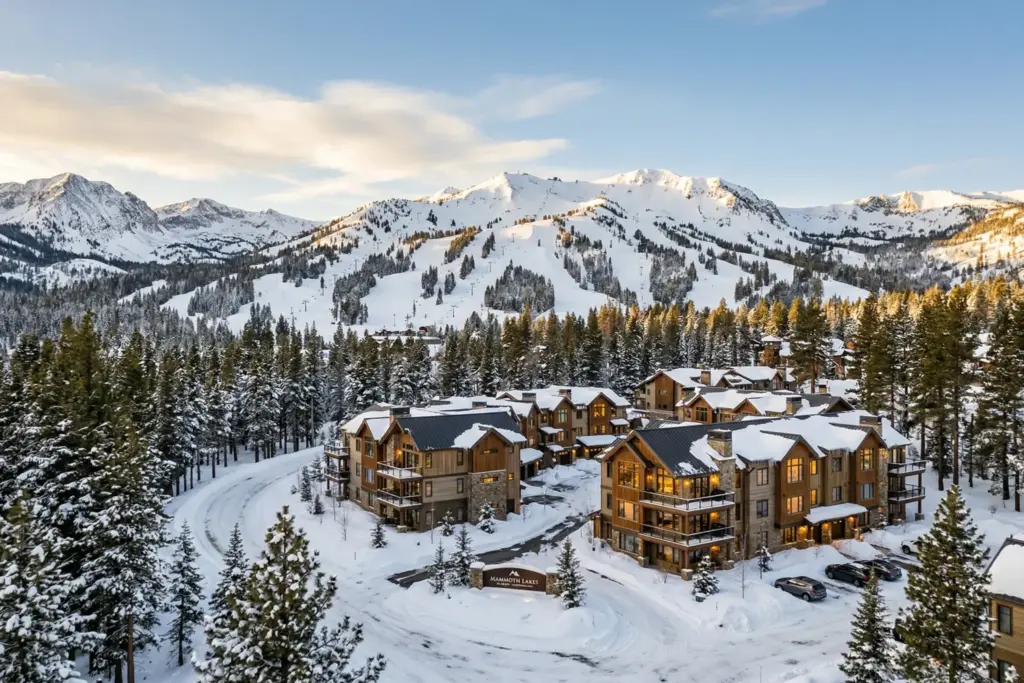
This is not an accident. The town’s development history, its proximity to the ski resort, and Measure Z (which I will get to shortly) have all pushed the STR inventory heavily toward multi-family buildings clustered near Mammoth Mountain’s base area and along the shuttle routes. Think of the Village at Mammoth, Juniper Springs, Snowcreek, and the Westin Monache. These complexes were built for transient use and are zoned accordingly.
For investors, the condo dominance has practical implications. The median condo price in Mammoth Lakes rose from $725,000 in 2024 to approximately $810,000 to $854,000 by mid-2025. StaySTRA’s typical home value estimate sits at $803,078. Single-family homes, by contrast, carry a median price of $1,300,000, but most of those are not eligible for short-term rental use thanks to Measure Z.
So your realistic entry point for an STR-eligible property in Mammoth Lakes is roughly $800,000 for a condo. At 20% down on a DSCR loan at current rates around 6.25 to 7.00%, your monthly debt service runs approximately $3,900 to $4,300. Against median monthly revenue of $6,377, that leaves a workable but thin margin once you account for HOA fees (which can run $400 to $800 per month in resort condo complexes), property management (typically 20 to 30% in Mammoth), insurance, and the 15% TOT.
Stay with me on the math. It gets tighter than the headline ADR would suggest.
Regulatory Landscape: Measure Z and the TOT
Mammoth Lakes has one of the most clearly defined regulatory frameworks of any mountain STR market, largely because the community settled its biggest debate a decade ago.
Measure Z (2015) was a voter-approved initiative that froze zoning as it relates to transient rentals. It prohibits short-term rentals of single-family homes in the Residential Single Family (RSF), Rural Residential (RR), and Residential Multi-Family 1 (RMF-1) zones. Any change to these restrictions requires another public vote. This is not a regulation that a town council can quietly amend. The voters locked it in.
Short-term rentals remain permitted in Commercial, Residential Multi-Family 2 (RMF-2), Resort, and Specific Plan zones. In practice, this means the condo complexes and resort-adjacent properties I described above. If you are shopping for an investment property in Mammoth, the first question is not “what does it rent for?” It is “what zone is it in?” The Town of Mammoth Lakes provides an online TOT Property Search Tool that lets you check any address.
The transient occupancy tax increased from 13% to 15% on January 1, 2025. That is collected from guests, not paid by hosts out of pocket, but it does affect your pricing strategy. A $500 nightly rate becomes $575 after TOT, which pushes into territory where price-sensitive guests start comparing Mammoth against Big Bear or June Lake.
Mono County (unincorporated areas) adopted new STR regulations via Ordinance 25-005, effective February 23, 2026. Properties in unincorporated Mono County near Mammoth now require both a Use Permit and a Short-Term Rental Activity Permit, renewed annually. Staff time is billed at $135 per hour for processing. The county and the town operate under separate regulatory frameworks, so the rules depend entirely on which jurisdiction your property sits in.
California SB 346, the Short-Term Rental Facilitator Act, is now in effect statewide. This law requires platforms like Airbnb and Vrbo to share host data with local jurisdictions, making enforcement of permit requirements significantly easier. Mammoth Lakes and Mono County both benefit from this transparency.
The LA and Bay Area Drive Market
Mammoth Lakes sits 325 miles from Los Angeles, roughly a five to six hour drive up Highway 395 through the Owens Valley. It is approximately the same distance from San Francisco, though that route closes seasonally when Tioga Pass through Yosemite is under snow (typically November through May).
This geography gives Mammoth a captive drive market of roughly 25 million people in greater Los Angeles and the Bay Area. Mono County generates 4.7 million visitor days annually, and the overwhelming majority of those visitors are Californians making the drive. The average visiting party is 4.6 people staying 3.4 nights, per town survey data. That tracks almost exactly with StaySTRA’s average length of stay figure of 3.7 nights.
For STR investors, this drive-market dependency is a double-edged feature. On one hand, you have an enormous feeder population that considers Mammoth their mountain. Southern Californians, in particular, treat Mammoth the way Coloradans treat Summit County. On the other hand, a bad snow year or a highway closure on 395 can visibly dent bookings. The average booking lead time of 53.2 days (per StaySTRA data) suggests guests are planning ahead rather than making last-minute weekend decisions, which helps with revenue predictability.
The opening of the Limelight Mammoth hotel in December 2025 signals that institutional capital sees the same demand fundamentals individual investors do. When a five-star hotel brand plants a flag in a town of 8,000 permanent residents, it is validation that the visitor demand is both real and growing.
Supply Growth and ADR Trends
StaySTRA data shows Mammoth Lakes STR supply grew from 2,003 listings in 2021 to 2,632 in early 2026, a 31.7% increase over five years. That is meaningful but not alarming by STR standards. Some Gulf Coast markets saw supply grow 50 to 70% over the same period.
What is more interesting is the ADR trajectory. Average daily rates climbed from $310 in 2021 to $584 in early 2026, an 88% increase. Occupancy has not kept pace with that ADR growth. Annual occupancy ran at 57.8% in 2021 and has settled to 49% currently. The market absorbed the new supply by raising prices, not by filling more nights. Think of it like a restaurant that raised its menu prices and lost some of the lunch crowd but made more money per table. The revenue per listing grew, but the path there was pricing power, not volume.
If you are modeling a Mammoth investment, use the 49% occupancy figure, not the 57% from a few years ago. That earlier number reflected a pandemic-era demand spike that has normalized.
Investment Math for Mammoth Lakes STR Condos
Let me lay out a realistic scenario for a Mammoth Lakes condo purchase as an STR investment in 2026.
Acquisition: $800,000 condo in an STR-eligible zone. 20% down ($160,000). DSCR loan at 6.5% on $640,000 produces approximately $4,045 in monthly debt service.
Gross revenue: $6,377 per month (median) to $7,785 per month (average). Using the median: $76,524 annually.
Operating expenses: Property management at 25% ($19,131), HOA fees at $600 per month ($7,200), insurance at $3,000 annually, maintenance at 1% of value ($8,000), utilities at $3,600 annually. Total operating expenses: approximately $40,931.
Net operating income: $76,524 minus $40,931 equals roughly $35,593.
Annual debt service: $48,540.
At the median revenue level, this property does not cash flow in year one. The debt service coverage ratio sits below 1.0, which means many DSCR lenders will require either a larger down payment or evidence of above-median revenue potential. Properties in the 75th percentile ($9,923 per month, or $119,076 annually) tell a very different story, with an estimated NOI of roughly $78,000 against the same $48,540 in debt service.
The takeaway is not that Mammoth is a bad investment. It is that Mammoth is an investment where property selection separates the profitable from the problematic. The gap between a median performer and a 75th-percentile performer is nearly $43,000 in annual revenue. Location within town, unit size, renovation quality, and professional management all determine which side of that line you land on.
Estimated cap rates for well-performing Mammoth STR condos fall in the 4 to 6% range before debt service, depending on the property and your expense assumptions. That is consistent with other high-ADR mountain markets where appreciation potential supplements the cash flow story.
For investors exploring DSCR financing for a Mammoth Lakes purchase, our guide to the best DSCR lenders for STR investors in 2026 breaks down which lenders will underwrite to vacation rental income and what ratios they require.
We do our best to keep our data accurate and up to date, but markets move fast and we are only human. Always verify current figures directly with local sources before making investment decisions.
Frequently Asked Questions
Can I rent a single-family home as a short-term rental in Mammoth Lakes?
In most cases, no. Measure Z, approved by voters in 2015, prohibits short-term rentals of single-family homes in the RSF, RR, and RMF-1 zones. Only properties in Commercial, RMF-2, Resort, and Specific Plan zones are eligible. Use the Town’s online TOT Property Search Tool to verify any specific address before purchasing.
What is the transient occupancy tax rate in Mammoth Lakes?
The TOT rate increased to 15% on January 1, 2025, up from the previous 13%. This tax is collected from guests and remitted to the Town of Mammoth Lakes. Platforms like Airbnb typically collect and remit TOT automatically, but hosts should verify their compliance status with the town.
How much can I expect to earn from a Mammoth Lakes vacation rental?
StaySTRA data shows the median Mammoth Lakes STR generates $6,377 per month, or approximately $76,500 annually. Top-quartile properties earn $9,923 per month ($119,000 annually). Revenue is heavily seasonal, with ski months (December through March) producing the highest returns and October through November representing the lowest revenue period.
Is Mammoth Lakes a year-round STR market?
Yes, but with significant seasonal variation. Ski season (November through April) drives the strongest revenue, with occupancy reaching 61% in March. Summer (July and August) provides a meaningful second peak at 53% occupancy. The shoulder months of October and early November are the slowest periods, with occupancy dropping to the high 30s.
What are the differences between Town of Mammoth Lakes and Mono County STR regulations?
The Town of Mammoth Lakes and unincorporated Mono County operate under separate regulatory frameworks. The town’s Measure Z restricts STRs to specific zones, while Mono County adopted new STR regulations (Ordinance 25-005) effective February 2026 requiring both a Use Permit and an annual Short-Term Rental Activity Permit. Always confirm which jurisdiction your property falls under before investing.
Analyze Mammoth Lakes STR Properties with StaySTRA
Every number in this article comes from the same dataset that powers the StaySTRA Mammoth Lakes Analyzer. Plug in any address in the Mammoth Lakes area to see estimated revenue, occupancy projections, comparable listings, and financial metrics including ROI and cap rate. You can also explore the full Mammoth Lakes STR market page for the latest data on all 2,632 active listings.
If mountain markets are part of your investment thesis, compare Mammoth against the other markets in our mountain series: Jackson Hole, Big Sky, Telluride, Steamboat Springs, Aspen, and Vail.
Become a StaySTRA Insider
Join free — get our newsletter + 1 free property analysis/month.
No spam. Unsubscribe anytime. Free membership includes property analyses and market insights.
Sponsored — Beeline
Finance Your Next STR With a DSCR Loan
Qualify on property cash flow, not W-2 income. Beeline specializes in fast DSCR closings for STR investors. No personal income verification required.
Check Your DSCR Eligibility →Affiliate disclosure: StaySTRA may earn a referral fee.