

Key Takeaways
- As of March 9, 2026, Airbnb shows guests your exact property address the moment a booking is confirmed, even during the free cancellation window.
- Previously, hosts on stricter cancellation policies could delay address disclosure until the cancellation period expired. That option is gone.
- Airbnb says this change reduces booking friction and aligns the platform with competitors like Booking.com that already show addresses upfront.
- AirCover still provides $3 million in damage protection, $1 million in liability insurance, guest ID verification, and a 24-hour safety line for all hosts.
- Hosts concerned about privacy can take concrete steps right now: smart locks, exterior cameras, PO Box registration, and listing photo audits.
Airbnb quietly changed one of its oldest privacy defaults on March 9, 2026, and the host community noticed immediately. If you have been scrolling the Airbnb Community Center lately, you have probably seen the thread. It is long, it is heated, and it is growing by the day.
The change itself is simple. Guests now see your exact property address the moment their booking is confirmed. That includes bookings still inside the 24-hour free cancellation window. Before this update, hosts using stricter cancellation policies could hold back the address until the guest’s cancellation window closed. That buffer is gone.
I spend most of my time tracking how platform policy changes ripple through the hosting world. (I read patent filings for fun, so dissecting an Airbnb policy update is practically a vacation.) This one is worth understanding clearly, because the gap between what hosts fear and what has actually changed is wider than usual.
What the Airbnb Address Disclosure Policy Actually Changed
Let me break this down into the simplest possible terms.
Before March 9, 2026: When a guest booked your property, Airbnb would share your exact address only after the booking was fully locked in. If you had a Firm or Strict cancellation policy, the guest could not see the address during the grace period. They saw an approximate map pin, enough to evaluate the neighborhood but not enough to find your front door.
After March 9, 2026: The address is shared immediately upon booking confirmation. Every confirmed reservation, including those still within the free cancellation window, now gives the guest access to your full address, unit number, and arrival guide. Airbnb’s Help Center (Article 4116) now reads: “Only guests with confirmed reservations can access their host’s contact number, the listing address, and arrival guide details. This applies to all confirmed reservations, including those with a free cancellation period.”
That last sentence is the new part. It closes the loophole that previously let some hosts delay address disclosure.
Why Airbnb Made This Change
Airbnb has not published a standalone announcement about this specific update. That is part of why hosts are frustrated. The change appeared in updated Help Center language without a dedicated blog post or email to hosts.
But the reasoning fits a pattern that has been building since late 2025. Airbnb is systematically reducing booking friction. The company made the 24-hour free cancellation window universal in October 2025. It retired the Strict cancellation policy for new listings. It expanded Reserve Now, Pay Later globally, which hit 70% adoption according to Airbnb’s own newsroom. And it rolled out seasonal cancellation policies in early 2026.
Every one of these moves points in the same direction: make it easier for guests to book. If a guest can see the exact address before committing, they can verify driving distance, check the neighborhood on Google Street View, and feel confident about the location. That reduces post-booking cancellations and no-shows. Hotels have always shown their address. Booking.com shows addresses. Airbnb was the outlier.
Airbnb’s priority in 2026 is not reducing cancellations. It is increasing total bookings. In that equation, a few more cancellations are the cost of doing business. The company believes that removing friction for guests produces more revenue for everyone, hosts included.
What Hosts Are Actually Worried About
The Airbnb Community Center thread reveals three main concerns. Let me address each one honestly.
1. “Someone could book, grab my address, and cancel.”
This is the most common fear. A bad actor could make a booking, see the address, and cancel within 24 hours without ever intending to stay. Technically, yes. This is now possible in a way it was not before for hosts on stricter policies.
But here is the context that matters. To make a booking, a guest must have a verified Airbnb account. That means identity verification, which in 35 countries includes government ID. Airbnb runs background checks where permitted by law and screens all booking guests against watchlists and sanctions lists. The guest’s first name, verification status, and trip history are visible to you before you approve the reservation (if you use manual approval).
Could someone create a fake account to do this? In theory. But they could also find most residential addresses through county property records, Google Maps, or a simple internet search. The address disclosure policy does not create a new vulnerability. It makes an existing one slightly more convenient for someone already determined to misuse the platform.
2. “I live in my home. This puts me at personal risk.”
Primary-residence hosts have a legitimate and different risk profile than investors with dedicated rental properties. If you rent a room in your home, a stranger now has your home address the moment they book, even if they cancel an hour later.
This concern deserves a serious answer, not dismissal. Primary-residence hosts should treat this as an operational security question, not a reason to leave the platform. I will cover specific steps in the practical section below.
That said, the previous policy was not an airtight privacy shield. Guests with confirmed bookings always got the address eventually. The change moved the disclosure window forward by hours or days, not from “never” to “always.”
3. “Elderly hosts and women hosting alone are more vulnerable.”
Some hosts in the Community Center thread specifically raised concerns about older hosts and solo women hosts. These are valid populations with different safety considerations.
The important thing to understand: Airbnb’s AirCover program and safety infrastructure did not change. The 24-hour safety line is still there. Guest ID verification is still required. Reservation screening (which uses machine learning to flag high-risk bookings) is still active in the US, Canada, and Australia. The $1 million liability insurance and $3 million damage protection remain in place.
The policy change affects when a guest sees your address, not whether Airbnb will respond if something goes wrong.
The Risks That Are Real vs. the Risks That Are Hypothetical
Let me be direct about the risk landscape.
Real and worth preparing for:
- Slightly higher address exposure to guests who book and cancel quickly. This is a measurable change in information flow.
- Potential for more “looky-loo” bookings from guests who want to verify location before deciding. This may increase cancellation volume without increasing actual risk.
- Psychological discomfort for primary-residence hosts who valued the buffer period. That feeling is real even if the statistical risk is low.
Hypothetical and not supported by evidence:
- Organized theft rings using Airbnb bookings to case properties. No documented pattern of this exists. Criminals have far easier ways to find empty homes.
- Stalkers systematically using the platform to locate targets. Airbnb’s ID verification creates a traceable paper trail, which is the last thing a stalker wants.
- Mass address harvesting through fake bookings. The cost (verified accounts, payment methods) makes this wildly inefficient compared to public records databases.
What to Do If You Are Legitimately Concerned
If you are a primary-residence host, a solo host, or someone who simply values operational security, here are concrete steps you can take right now. None of these require leaving Airbnb.
Upgrade Your Physical Security
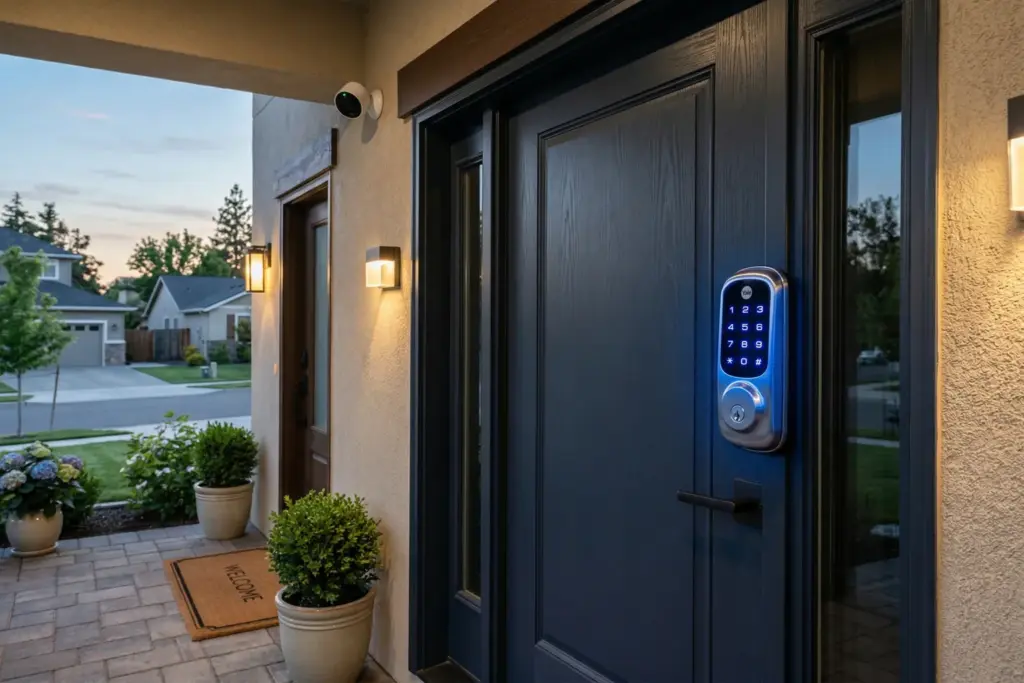
- Smart locks with unique codes. Generate a new code for every guest. Revoke it immediately after checkout. Products like August, Yale, and Schlage all integrate with major property management platforms. (If you need help choosing one, we covered the full smart home tech stack for STR hosts.)
- Exterior cameras. A visible Ring or Arlo camera at the entrance is both a deterrent and documentation. Airbnb allows exterior cameras as long as they are disclosed in your listing and do not record private spaces. (For more on what Airbnb actually enforces around cameras, read our breakdown of Airbnb’s hidden camera policy enforcement.)
- Motion-sensor lighting. Basic, inexpensive, and effective. Illuminated entry points discourage unwanted visits after dark.
Tighten Your Listing Privacy
- Audit your listing photos. Remove any images that show your home’s exterior from an angle that makes it easy to identify from the street. Interior photos are fine. But a clear shot of your front door with your house number visible? Remove it.
- Use a PO Box for business registration. If your listing address is also your mailing address for tax or business purposes, consider a PO Box to keep your residential address out of public business directories.
- Review your Google presence. Search your address on Google Maps and Google Street View. If your home is clearly identifiable with a labeled Airbnb pin, contact Google to request blurring.
Use Airbnb’s Built-In Protections
- Turn on manual booking approval. This lets you review every guest’s profile, verification status, and reviews before accepting. It slows your booking pace but gives you a veto before the address is shared.
- Require verified ID. You can set this as a booking requirement. Guests without completed identity verification cannot book your property.
- Know the 24-hour safety line. AirCover includes one-tap access to specially trained safety agents, day or night. Save the number. Know how to use it.
Consider a Co-Host
If you are uncomfortable being the sole point of contact, Airbnb’s Co-Host Network launched in 2026 and lets you bring on a co-host who handles guest communication and check-ins. This puts a layer between you and the guest without requiring a full property manager.
The Bigger Picture for Hosts Going Forward
This address disclosure change is not an isolated decision. It is part of Airbnb’s ongoing shift toward a more hotel-like booking experience. The platform is betting that guest confidence drives growth, and that hosts will adapt their operations accordingly.
That bet may be right. Hotels have operated with full address transparency for decades. Vacation rental platforms like Booking.com and Vrbo already show addresses earlier in the booking process than Airbnb historically did. The STR industry is moving in this direction whether individual hosts prefer it or not.
The hosts who will come out ahead are the ones who treat this as a security operations question, not a panic moment. Upgrade your locks. Audit your photos. Turn on manual approval if you need the extra filter. These are small, practical moves that cost almost nothing and give you meaningful control over your hosting environment.
The address disclosure policy is a real change. But the sky is not falling. Your address was always going to be shared with every guest who stayed. The question now is just how early in the process that happens.
We do our best to keep our tech reviews accurate and up to date, but products evolve fast and we are only human. Always verify current features and pricing directly with vendors before purchasing.
Frequently Asked Questions
When did Airbnb start showing the exact address before the cancellation window closes?
The change went live on March 9, 2026. Airbnb updated its Help Center language to confirm that all confirmed reservations, including those still within the free cancellation period, now give guests access to the full listing address.
Can I prevent guests from seeing my address until the cancellation window expires?
No. As of March 9, 2026, there is no setting or cancellation policy that delays address disclosure after booking confirmation. The previous workaround through stricter cancellation policies no longer applies.
Does Airbnb verify guest identity before they can see my address?
Yes. Guests must have a verified Airbnb account to book. Airbnb requires identity verification (including government ID in 35 countries), runs background checks where legally permitted, and screens guests against watchlists. Hosts can also require verified ID as a booking condition.
What should primary-residence Airbnb hosts do about this policy change?
Install smart locks with unique guest codes, add exterior cameras (disclosed in your listing), audit listing photos to remove identifiable exterior shots, switch to manual booking approval, and require verified ID from all guests. These steps give you meaningful control without leaving the platform.
Is Airbnb’s AirCover still active after this policy change?
Yes. AirCover for hosts was not affected by the address disclosure update. It still includes $3 million in damage protection, $1 million in liability insurance, guest identity verification, reservation screening, and 24-hour safety line access.
Stay Ahead of Platform Changes
Airbnb’s policy updates move fast. If you want clear, expert analysis of every change that affects your hosting business (without the panic), the StaySTRA Insider newsletter delivers it straight to your inbox.
Become a StaySTRA Insider
Join free — get our newsletter + 1 free property analysis/month.
No spam. Unsubscribe anytime. Free membership includes property analyses and market insights.
Sponsored — OfferMarket
Buy Your First STR With Long-Term Rental Financing
Flexible, long-term financing for short-term rental buyers. Rates from 5.75%. Instant online quote, no credit pull.
Explore RTL Financing Options →Affiliate disclosure: StaySTRA may earn a referral fee.