Key Takeaways
- StaySTRA tracks over 6,400 active short-term rentals across four major Outer Banks markets, with Corolla leading at $442 average daily rate and $6,426 in monthly revenue.
- Peak summer months (June through August) push occupancy above 90% across OBX, with top properties in Corolla generating over $11,000 per month, but winter revenue drops to roughly $1,300 per month.
- The Outer Banks operates as a week-booking market, with traditional Saturday-to-Saturday reservations driving higher ADRs than typical nightly coastal markets.
- Barrier island geography and limited bridge access create a natural supply constraint that has kept OBX from the oversaturation problems plaguing other beach markets.
- Dare County occupancy tax collections were essentially flat in 2025 (down just 0.06%), but a bifurcation is emerging: large luxury homes are booking ahead of pace while smaller properties lag behind.
Corolla vacation rentals averaged $11,277 in monthly revenue this past June, with a nightly rate of $559 and occupancy hitting 95%. If you are evaluating the Outer Banks STR market in 2026, that number is the ceiling, and it is a high one. Think of the OBX rental market like a tide chart: the highs are spectacular, the lows are real, and the investors who do well are the ones who understand the full cycle before they buy.
I have spent four decades reading market data, and the Outer Banks still surprises me. This is not a typical beach market where guests pop in for a long weekend. OBX is a week-booking market, rooted in a tradition of Saturday-to-Saturday reservations that stretches back generations. That pattern shapes everything from pricing to occupancy curves to the type of property that pencils out. Let me walk you through what StaySTRA’s North Carolina market data reveals about the numbers behind one of the East Coast’s most coveted rental corridors.
The OBX Market by the Numbers: Four Towns, Four Stories
StaySTRA tracks four distinct Outer Banks sub-markets, and each one tells a different story about what works here. I like to think of it as a family with four siblings: same last name, very different personalities.
Sponsored — Beeline
Finance Your Next STR With a DSCR Loan
Qualify on property cash flow, not W-2 income. Beeline specializes in fast DSCR closings for STR investors. No personal income verification required.
Check Your DSCR Eligibility →Affiliate disclosure: StaySTRA may earn a referral fee.
Corolla is the premium play. With 2,231 active listings, a last-twelve-months (LTM) average daily rate of $442, and LTM occupancy of 76%, Corolla generates $6,426 per month in average revenue. That RevPAR of $375 is among the highest of any beach market StaySTRA covers. The property mix tells you why: 1,293 of Corolla’s listings (58%) have five or more bedrooms. These are the big oceanfront houses that rent for $5,000 to $8,000 per week in summer. Corolla is where the serious revenue lives.
Nags Head runs second in revenue at $5,501 per month, with an LTM ADR of $361 and occupancy of 76.7%. The property mix here leans large as well. Of 1,914 active listings, 625 have five-plus bedrooms and 472 have four. Nags Head posted a remarkable 96.6% occupancy in June and 93.6% in both July and August. Those are not soft numbers. That is a market with more demand than beds during peak season.
Kitty Hawk is the smallest market at 272 listings, but it punches well above its weight. LTM ADR of $390, occupancy of 72.4%, and monthly revenue of $5,370. July 2024 hit 100% occupancy with a $461 ADR, pushing monthly revenue to $10,455. Kitty Hawk’s compact inventory and strong location between the Wright Brothers Memorial and the beaches make it a tight, competitive market.
Kill Devil Hills is the most accessible entry point for investors. With 2,026 listings and an LTM ADR of $269, it offers the lowest price point in the OBX corridor. Occupancy runs 61.3% on a trailing basis, and average monthly revenue is $3,578. The property mix skews smaller here: 688 three-bedroom units, 440 two-bedroom units, and 359 four-bedroom units make up the bulk of inventory. If Corolla is the luxury tier, Kill Devil Hills is the volume play.
The Seasonal Revenue Curve: Where the Money Actually Lands
Stay with me here, because this is where the Outer Banks STR market in 2026 gets interesting for investors running projections. OBX has one of the most dramatic seasonal swings of any beach market in the country.
Here is the revenue story for each market, peak versus trough:
| Market | June Revenue | January Revenue | Seasonal Swing |
|---|---|---|---|
| Corolla | $11,277 | $1,372 | 8.2x |
| Nags Head | $9,291 | $1,385 | 6.7x |
| Kitty Hawk | $9,498 | $1,483 | 6.4x |
| Kill Devil Hills | $7,433 | $1,051 | 7.1x |
That seasonal swing matters more than anything else in your underwriting. A Corolla property generating $11,277 in June will drop to $1,372 in January. That is not a typo. Roughly 55% to 60% of your annual rental income will land in a 14-week window between Memorial Day and Labor Day.
Don’t let that scare you. The shoulder seasons (April through May and September through October) are not dead. Nags Head, for example, pulls $4,675 in April and $3,913 in October. Corolla posts $4,280 in April and $3,396 in October. These months matter because they separate a property that breaks even from one that actually cash-flows.
If you want to run your own projections, the StaySTRA North Carolina rental calculator lets you model revenue by town and property size.
Why OBX Is a Week-Booking Market (and Why That Matters for Investors)
Most coastal STR markets operate on nightly bookings. A guest checks in for two nights, maybe three. The Outer Banks works differently. For decades, OBX has operated on a Saturday-to-Saturday rental cycle, with management companies and property owners marketing full-week stays during peak season.
This is not just tradition. It is economics. A week-long booking at $3,500 to $7,000 means fewer turnovers, lower cleaning costs per dollar of revenue, less wear on the property, and higher total yield per booking. Think of it like selling a car at the sticker price versus haggling on every individual part. The full-week model captures maximum value with minimum friction.
Some management companies, like KEES Vacations, have started offering flexible partial-week stays to capture additional shoulder-season demand. But the core OBX summer market remains firmly rooted in week-long bookings. For investors, this means your calendar will fill in large blocks rather than the patchwork of one- and two-night stays you see in markets like Myrtle Beach or Gulf Shores.
The Bridge Factor: Geography as a Supply Moat
One of the most underappreciated features of the Outer Banks STR market is something you will not find on any spreadsheet: geography.
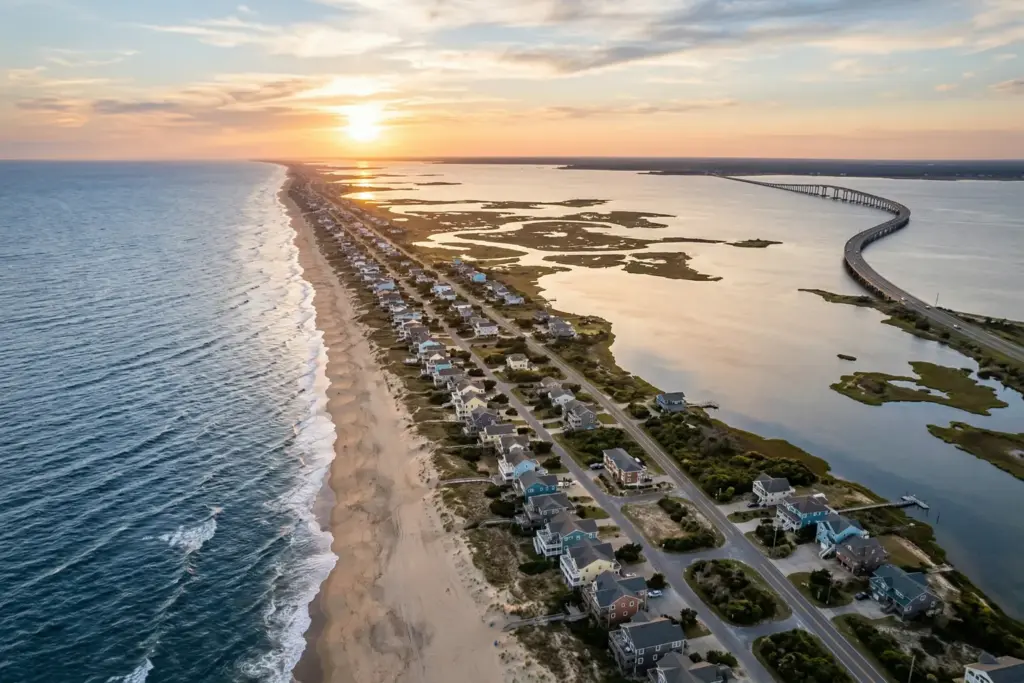
The Outer Banks is a 100-mile chain of barrier islands connected to the mainland by a handful of bridges. The Wright Memorial Bridge and the Virginia Dare Memorial Bridge are the primary access points for the central OBX towns, while Corolla is reached via a single two-lane road from Duck. During peak turnover days (Saturdays in summer), traffic on these bridges can back up for hours.
This matters for investors because it creates a natural supply constraint. You cannot build new barrier islands. You cannot add new bridges easily. The combination of limited land, environmental regulations, flood zone building codes, and infrastructure bottlenecks means that OBX inventory grows slowly. While markets like Myrtle Beach (which StaySTRA tracks at over 17,000 listings and growing) can absorb seemingly unlimited new supply, the Outer Banks is geographically capped.
In my years of reading market data, the pattern is consistent: supply-constrained markets hold pricing power longer. The OBX data confirms this. Even as national STR occupancy has fallen 13% in early 2026, OBX continues to post LTM occupancy rates of 72% to 77% in its premium sub-markets.
Dare County Revenue: Flat Is the New Up
The macroeconomic picture for Outer Banks tourism tells a stabilization story, not a growth story, and that is worth understanding.
Dare County occupancy tax collections in 2025 were essentially flat compared to 2024, down just 0.06% for the full year. Meals tax revenue edged up 2.41%, which almost exactly matches the 2.7% inflation rate. In real terms, spending was flat.
December 2025 was notably soft, with occupancy collections at $10.8 million, down 16.26% from December 2024. But December is a minor revenue month for OBX, so the headline impact is limited.
The more telling signal comes from Dare County Tourism Bureau Executive Director Lee Nettles, who identified a “bifurcation of spending” in the market. Households earning $100,000 or more maintained spending patterns, while lower-income visitors cut back. The data backs this up: 2026 bookings for large homes (14-plus bedrooms) are running ahead of last year’s pace, while smaller homes (eight bedrooms or fewer) trail behind.
For investors, the takeaway is straightforward. If you are buying in OBX, the premium end of the market is outperforming. A well-appointed four- or five-bedroom oceanfront property in Corolla or Nags Head is in a stronger position than a two-bedroom condo in Kill Devil Hills.
STR Regulations on the OBX: What Investors Need to Know
North Carolina does not have state-level STR preemption, which means local governments set their own rules. For OBX investors, this plays out across two counties and several distinct municipalities.
Dare County (covers Nags Head, Kill Devil Hills, Kitty Hawk, and several unincorporated areas) has a well-established vacation rental framework. The county imposes a 6% occupancy tax on gross lodging costs. North Carolina adds 6.75% in sales and use tax on all fees and services charged to renters. Individual towns within Dare County can layer on their own registration or safety requirements. Nags Head, for example, implemented specific rules for Airbnb-listed and platform-listed short-term rentals to ensure they meet the same safety and occupancy standards as properties managed by traditional rental companies.
Currituck County (covers Corolla and the northern beaches) also imposes the 6% local lodging tax. Currituck’s regulatory environment has historically been lighter than Dare’s, reflecting the county’s more rural character and the dominance of large managed rental homes in Corolla.
North Carolina Senate Bill 291, introduced in March 2025, proposed statewide guardrails on how far local governments could go in regulating short-term rentals. As of early 2026, the bill has not advanced. For now, the regulatory landscape remains local and relatively stable. OBX does not face the kind of hostile regulatory environment seen in markets like New York City or Maui.
HOA restrictions are the hidden variable in any OBX purchase. Some oceanfront communities and condo associations restrict or prohibit short-term rentals entirely. Before closing on any property, verify the HOA covenants and rental policies in writing. This is not negotiable.
How OBX Compares to Other Eastern Beach Markets
Investors often weigh OBX against Myrtle Beach, the Gulf Coast, and the Jersey Shore. Here is how the data lines up.
Corolla’s LTM ADR of $442 and monthly revenue of $6,426 positions it well above Myrtle Beach ($198 ADR, $2,595 monthly revenue per StaySTRA data). Nags Head at $361 ADR and $5,501 monthly revenue also outperforms most Gulf Coast sub-markets outside of Destin and 30A.
The tradeoff is seasonality. OBX’s 8x peak-to-trough revenue swing is steeper than Myrtle Beach (roughly 6.6x) and significantly steeper than South Florida markets, which can operate year-round. OBX is a high-revenue, high-seasonality market. You need to underwrite for the full year, not just the summer.
Where OBX stands out is in its supply constraint and pricing power. Markets with 17,000-plus listings and easy development paths face constant pressure from new supply. OBX’s geography limits that pressure in ways that protect long-term investor returns.
We do our best to keep our data accurate and up to date, but markets move fast and we are only human. Always verify current figures directly with local sources before making investment decisions.
Frequently Asked Questions
What is the average short-term rental income in the Outer Banks?
It depends on the sub-market and property size. StaySTRA data shows Corolla averaging $6,426 per month, Nags Head at $5,501, Kitty Hawk at $5,370, and Kill Devil Hills at $3,578. Properties with five or more bedrooms in premium locations can generate $77,000 or more annually.
What is the occupancy rate for Outer Banks vacation rentals?
LTM occupancy ranges from 61% in Kill Devil Hills to 77% in Nags Head. Peak summer months (June through August) regularly push above 90% across all OBX sub-markets, with some towns hitting 96% to 100% occupancy in July.
Are short-term rentals legal in the Outer Banks?
Yes. The Outer Banks has a long history as a vacation rental market, and both Dare County and Currituck County permit short-term rentals. Local occupancy taxes of 6% apply, plus North Carolina’s 6.75% sales tax. Individual towns may have registration requirements, and HOA restrictions vary by community.
Is the Outer Banks a good investment for Airbnb in 2026?
OBX offers strong peak-season revenue, natural supply constraints from its barrier island geography, and a stable regulatory environment. The main risk is extreme seasonality, with roughly 55% to 60% of annual revenue concentrated in 14 summer weeks. Investors who underwrite for the full annual cycle and target the premium property segment are best positioned in this market.
What is the best area to buy a vacation rental in the Outer Banks?
Corolla leads in total revenue and ADR, making it the top choice for investors targeting the luxury week-booking market. Nags Head offers strong occupancy (76.7% LTM) with a slightly lower entry point. Kill Devil Hills provides the most accessible pricing but generates lower per-property revenue. The right choice depends on your budget, target guest, and tolerance for seasonality.
What This Means for Your OBX Investment Decision
The Outer Banks STR market in 2026 is not a market of easy money, but it is a market with structural advantages that reward informed investors. The combination of week-long bookings, geographic supply constraints, and strong Mid-Atlantic demand creates a rental environment where well-located, well-managed properties continue to perform even as broader national occupancy declines.
Run the numbers for the specific town and property type you are considering. Use the StaySTRA Airbnb calculator for North Carolina to model revenue by location and bedroom count. Underwrite for the full twelve months, not just the summer peak. And verify HOA rental policies before you make an offer.
The data is here. What you do with it is the investment decision.
Become a StaySTRA Insider
Join free — get our newsletter + 1 free property analysis/month.
No spam. Unsubscribe anytime. Free membership includes property analyses and market insights.