Key Takeaways
- Over 20% of Maui County’s housing stock operates as short-term vacation rentals, with concentrations reaching 50% in South Maui, leaving longtime residents competing for a shrinking pool of homes.
- Bill 9, signed into law in December 2025, phases out roughly 7,000 apartment-zoned STRs on Maui by 2029-2031, but the transition creates real economic pain for the 1,900 workers whose livelihoods depend on the industry.
- 85% of Maui’s vacation rentals are owned by people who don’t live on the island, making the STR debate as much about absentee ownership as it is about tourism.
- Hawaii residents spend 42% of their income on rent (the highest rate in the nation), and fewer than 25% of households can afford a mortgage on the median home.
- For STR investors considering Hawaii, understanding the human stakes behind these numbers is not optional. It is the context that will define every regulation, every permit, and every community interaction going forward.
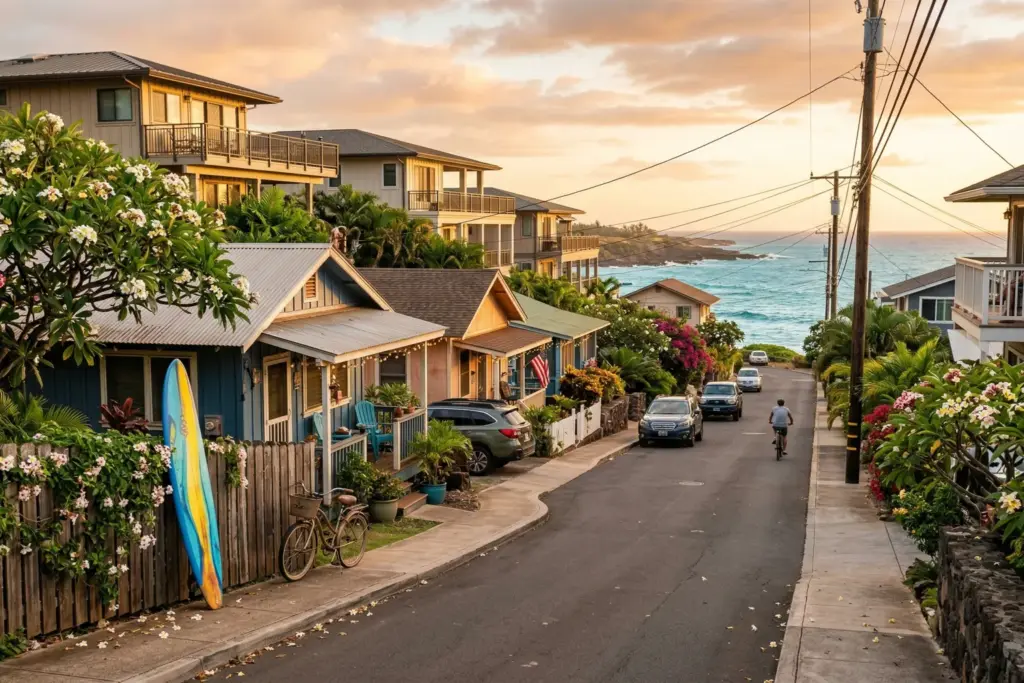
On a warm Tuesday evening in Kihei, the kind where the trade winds carry the smell of plumeria through open windows, a woman I’ll call Leilani sat on a plastic chair outside her cousin’s apartment and told me she’d given up looking for a place of her own. “I grew up two streets from here,” she said, gesturing toward a row of condos that now list exclusively on vacation rental platforms. “My tutu’s house? Somebody on the mainland bought it in 2019. Now it rents for 350 dollars a night.”
Leilani is a composite, but her situation is not invented. Across Maui, Oahu, and the Big Island, thousands of residents are living some version of this story. Priced out of neighborhoods their grandparents built. Watching homes that once held multigenerational roots convert into properties optimized for five-night stays and five-star reviews.
This is the part of Hawaii’s short-term rental conversation that doesn’t fit neatly into a spreadsheet. The human part. La parte humana.
Where the Numbers Meet the Sidewalk
I’m not going to rehash the data. StaySTRA has already covered Honolulu’s STR market in depth, and if you want the occupancy rates, the ADR figures, or the county-by-county regulatory breakdown, those pieces exist and they’re thorough. What I want to talk about is what those numbers feel like when you live inside them.
In South Maui, roughly half of the housing inventory operates as short-term vacation rentals. Half. Walk down a street in Kihei and every other unit you pass is more likely to hold a rotating cast of tourists than a neighbor who knows your name. In West Maui, before the fires, that figure was around 34%.
When the University of Hawaii Economic Research Organization (UHERO) studied the potential phase-out of Maui’s vacation rentals in early 2025, they found that eliminating apartment-zoned STRs could free up roughly 6,000 housing units. That is the equivalent of ten years of new construction at Maui’s current building pace. Ten years of homes, already built, sitting behind lockboxes and automated check-in codes.
Here is the part that stops me: 85% of those vacation rental units are owned by people who do not live on Maui. The island’s housing crisis is not just about supply and demand. It is about who the housing serves.
The Host Who Stayed
Not every STR story in Hawaii is a story of displacement. Some are stories of survival.
Let’s call him Kai. Mid-40s, born and raised on Oahu’s North Shore. When his father got sick in 2021, Kai moved back into the house in Haleiwa where he’d grown up. The property taxes alone were eating through his savings. A friend suggested listing the detached ohana unit on Airbnb.
“Without that income, I would have lost the house,” he told me. “Full stop. No maybe about it. The rental covers the taxes, the insurance, and about half the mortgage. It’s the only reason I’m still here.”
Kai’s story isn’t rare. Across the islands, local homeowners use STR income to hold onto properties that rising costs would otherwise force them to sell. StaySTRA data shows Honolulu’s 9,780 active short-term rentals generate an average of roughly 4,100 dollars per month in revenue. For someone like Kai, that number is the difference between keeping a generational home and watching it become another mainland investor’s portfolio property.
There’s a painful irony here. The same market forces that push locals out also create the financial tool some locals use to stay. “Es una contradiccion que vivo todos los dias,” Kai said with a dry laugh. A contradiction I live every day.
12,000 People, Nowhere to Go
Then came August 8, 2023.
The Lahaina wildfire destroyed more than 5,400 households and displaced over 12,000 residents. In the months that followed, displaced residents scrambled for housing on an island where vacancy was already near zero, where long-term rental listings were already scarce, and where many of the available units were locked into short-term rental agreements serving visitors.
That fire didn’t create Maui’s housing crisis. But it ripped the cover off it in a way nobody could ignore.
Paele Kiakona, an organizer with Lahaina Strong, put it simply after the Maui County Council voted to pass Bill 9 in December 2025: “We’re just happy to have had the opportunity to be a part of something that we believe is just and is going to benefit us for generations to come.”
Bill 9 phases out roughly 7,000 apartment-zoned vacation rentals across Maui County. West Maui units must cease STR operations by January 1, 2029. The rest of the county follows by January 1, 2031. The vote was 5-3. It was not close, but it was not easy either.
The People in Between
Council member Nohelani U’u-Hodgins, who represents Maui’s North Shore, voted yes. “I think it’s important to listen to the people that have lived here for generations,” she said. “The community wants this passed, and I’m in full support of people over profits.”
Council member Yuki Lei Sugimura voted no. Her concern was economic: UHERO’s projections estimate the phase-out will cost 1,900 jobs and shrink Maui’s economy by roughly 4%. Annual visitor spending could drop by 900 million dollars. Property tax revenue could fall by 60 million dollars a year.
Those are not abstract numbers. Behind every one of those 1,900 jobs is a housekeeper, a maintenance worker, a property manager, a small business owner. Many of them are the same local residents the bill aims to help. Walking through Kihei, talking to people on both sides, I couldn’t help but think about how the same community can be hurt by a problem and hurt by its solution at the same time.
Julynn I’i, a Maui resident who testified in support of the bill, captured the mood honestly: “It doesn’t take rocket science to know that Bill 9 isn’t going to fix every single problem, but it’s a start, and it’s a start that we’re willing to make a sacrifice for.”
The Affordability Wall
Zoom out from Maui and the housing picture across all of Hawaii is staggering. The median single-family home in the state costs around 950,000 dollars. Fewer than one in four Hawaii households earn enough to afford a mortgage at that price. Residents spend an average of 42% of their income on rent, the highest percentage of any state in the country.
These numbers have roots that go deeper than short-term rentals. Limited land, geographic isolation, construction costs, zoning restrictions, and decades of underbuilding all play a role. But the STR boom accelerated the crisis in ways that are hard to separate from the broader housing squeeze. When thousands of units shift from the long-term housing pool into the visitor accommodation pool, competition for what remains gets fierce. Rents climb. Locals leave.
It is a slow erosion. Not a single dramatic event, but a gradual thinning of the community fabric. The kupuna who can’t afford to age in place. The teacher who commutes from a different island. The keiki who grow up knowing they’ll probably leave.
What Aloha Asks of Investors
If you’re reading this as someone who owns or is considering a short-term rental in Hawaii, I want to be direct with you. This is not a guilt trip. It is context.
The aloha spirit is real. It is also under pressure. Every regulation Hawaii passes, every permit it revokes, every phase-out it enacts grows from the tension between a community’s need to survive and a visitor economy’s need to thrive. Understanding that tension is not just good ethics. It is good business.
Hosts who engage with their communities, who hire locally, who treat their properties as part of a neighborhood rather than as isolated revenue units, are the ones best positioned for whatever comes next. The ones who see “compliance” as the floor, not the ceiling.
On Oahu, Honolulu’s STR market carries an 82% occupancy rate and a 228 dollar average daily rate. Those are strong numbers. But the market context around them is shifting fast. The investors who will thrive here over the next five years are the ones who understand that the data tells you what the market does, while the community tells you what the market will allow.
Three Takeaways for the Road
After spending time in these conversations, across islands and across perspectives, here is what stays with me:
First, the STR debate in Hawaii is not about being pro-tourism or anti-tourism. It is about proportion. When vacation rentals occupy half the housing in a neighborhood, the neighborhood stops functioning as a community. Finding the right ratio is the real work.
Second, local hosts like Kai are not the villain in this story. Many of them are using the same tools mainland investors use, but for survival instead of portfolio growth. Policy that distinguishes between owner-occupied hosts and absentee investors is more likely to land well than blanket bans.
Third, the Lahaina fire changed everything. It turned a slow-burning housing crisis into an emergency. Bill 9 exists because of that fire, and its implementation will be shaped by the ongoing recovery. If you operate in Maui, you cannot understand your market without understanding Lahaina.
We do our best to keep our content accurate and up to date, but things change and we are only human. Always verify details directly with local sources before making decisions.
Frequently Asked Questions
How are short-term rentals affecting housing in Hawaii?
Over 20% of Maui County’s housing stock operates as STRs, with concentrations reaching 50% in South Maui. This removes thousands of units from the long-term rental pool, contributing to rent increases and making it harder for residents to find affordable housing. Statewide, Hawaii residents spend 42% of their income on rent, the highest rate in the nation.
What is Maui’s Bill 9 and how does it affect vacation rentals?
Bill 9, signed into law by Mayor Richard Bissen on December 15, 2025, phases out roughly 7,000 apartment-zoned short-term vacation rentals in Maui County. West Maui units must stop operating by January 1, 2029, while the rest of the county has until January 1, 2031. A companion bill may exempt up to 4,500 units through hotel rezoning.
Can you still operate a short-term rental in Hawaii?
Yes, but regulations vary significantly by county and zone. Oahu requires registration, Kauai limits permits in certain areas, and Maui’s phase-out applies specifically to apartment-zoned units. Honolulu and the Big Island each have distinct frameworks. Check county-specific rules and permit requirements before investing.
How did the Lahaina fire impact Maui’s STR policies?
The August 2023 wildfire destroyed over 5,400 households and displaced more than 12,000 residents. The disaster intensified existing frustrations about housing scarcity and accelerated political support for Bill 9’s vacation rental phase-out, as displaced residents competed for housing in a market where many units were reserved for short-term visitors.
What percentage of Hawaii vacation rentals are owned by out-of-state investors?
According to UHERO, approximately 85% of Maui’s transient vacation rentals are owned by out-of-state investors. This figure has become a central point in the community debate, as residents argue that absentee ownership extracts wealth from the islands without contributing to the local community fabric.
Explore Hawaii’s STR Market Data
The stories in this piece are grounded in real market conditions. If you want to see the numbers behind the narrative, StaySTRA tracks occupancy, revenue, and listing data across Hawaii’s key markets. Explore the latest data for Honolulu, Kauai, and Hawaii’s other active STR markets on our location pages.
Want market intelligence delivered to your inbox? Get the data that matters before it becomes common knowledge.
Become a StaySTRA Insider
Join free — get our newsletter + 1 free property analysis/month.
No spam. Unsubscribe anytime. Free membership includes property analyses and market insights.