Key Takeaways
- A year ago, the big question in short-term rental circles was “should I use AI?” That question is gone.
- The gap exists because of awareness, not access.
- Autohost is the leading AI-powered screening tool built specifically for short-term rentals.
- You handle the strategic and the relational.
A year ago, the big question in short-term rental circles was “should I use AI?” That question is gone. The new question is “which AI tools are you running?” According to the Hostaway 2026 State of Short-Term Rentals Report, 84% of STR operators are now using AI-powered tools in their business. That number was 60% just twelve months ago. This is not a gradual adoption curve. This is a tipping point.
If you manage a short-term rental today and you are not using AI, you are competing against people who are. That gap is widening fast.
But here is what I find more interesting than the headline number. When you break down how operators are using AI, a clear picture emerges of exactly which problems the technology is actually solving. And some of it might surprise you.
Where AI Is Actually Making a Difference
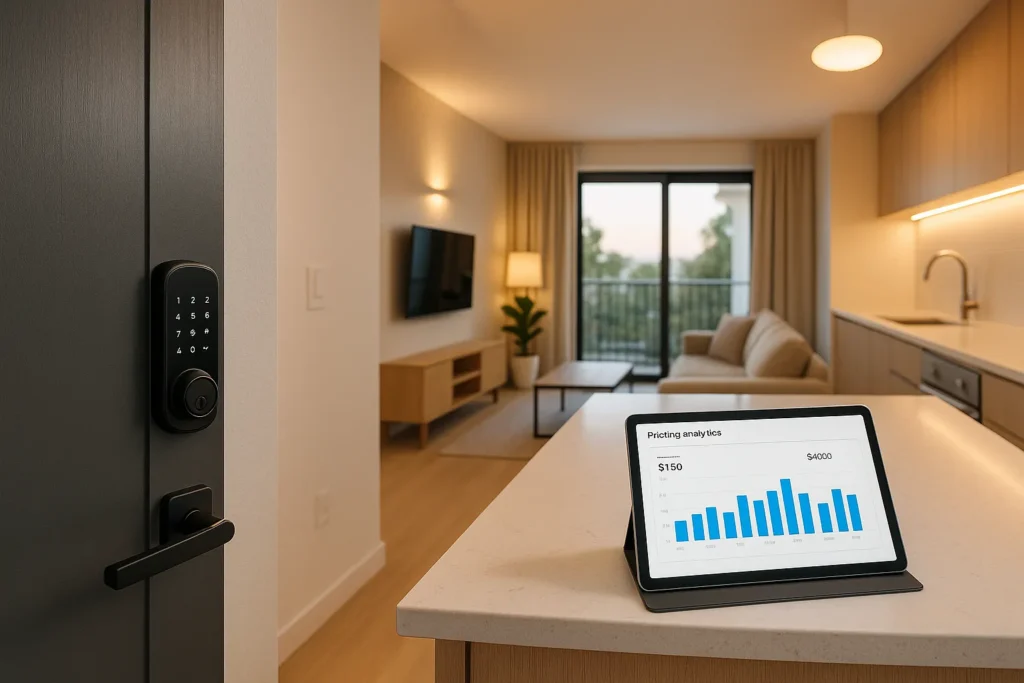
The top use case is not what most people expect. The biggest category is not chatbots or fancy guest communication tools. It is pricing. A full 41.4% of operators are using AI for price optimization, making it the most common AI application in the industry by a wide margin.
That makes total sense when you think about it. Pricing is math-heavy, time-sensitive, and responds to dozens of variables at once: competitor rates, local events, day of week, seasonality, your own historical occupancy, and demand signals from across your market. No human brain can track all of that and make daily pricing decisions without missing money on the table. AI can.
The second biggest category is marketing and guest communication, at 30.1%. AI is drafting listing descriptions, responding to inquiries, automating check-in messages, and even generating personalized upsell offers for early check-in or late checkout. This is where a lot of the time savings come from. The report found that 35% of operators save at least two hours per week through AI automation. For a busy host managing multiple properties, that is meaningful time back in your week.
The Scale Gap You Need to Know About
Here is a number that does not get talked about enough. AI adoption is not evenly distributed across the industry. Among operators running 51 or more properties, adoption is near-universal. But for hosts with fewer than 10 listings, the adoption rate drops to just 51%.
This matters for two reasons. First, it means smaller operators are at a growing disadvantage against larger players who are automating more of their operations every month. Second, it is an opportunity. If you are a small or mid-sized host, you can close that gap right now with tools that are more accessible and affordable than ever.
The barriers to AI adoption used to be technical complexity and cost. That is no longer true. The tools available today are plug-and-play for the most part, and several of the best ones are either free or cost a few dollars per listing per month. The gap exists because of awareness, not access.
As we covered in our breakdown of the state of short-term rentals in 2026, the operators who are winning are not necessarily the ones with the best properties. They are the ones running leaner, smarter operations.
Dynamic Pricing: The Highest-ROI Tool in Your Stack
If you use only one AI tool in your STR business, make it a dynamic pricing engine. The return on this investment is faster and more measurable than anything else you can deploy.
PriceLabs is the most widely used option in the professional STR space. Its AI engine analyzes your market in real time, pulling in competitor rates, local event calendars, demand signals, and seasonal patterns to recommend a nightly price for every date on your calendar. It integrates with over 160 property management systems and OTAs, so your updated prices push out automatically.
PriceLabs also includes a Listing Optimizer that uses AI to review your photos, amenities, and description and compare them against top-performing listings in your market. It tells you specifically what to change to improve your click-through rate and booking conversion. Starting at around $20 per listing per month, PriceLabs pays for itself on the first or second additional booking it generates.
If you want dynamic pricing without the separate monthly fee, Hospitable includes it free with every plan. Their engine draws on data from over 20 million listings and adjusts your rates daily across Airbnb, VRBO, Booking.com, and your direct booking site. Hospitable’s own data shows hosts using their dynamic pricing saw a 14.9% jump in occupancy and a 12.2% boost in revenue per available night.
Automating Guest Communication Without Losing the Human Touch
The second major AI category, guest communication, is where a lot of hosts feel hesitant. Nobody wants their guests to feel like they are texting a robot. The good news is that the best tools in this category are designed to sound personal even when they are automated.
Hospitable handles this well. Their AI generates automated replies to common guest questions and can send proactive messages at the right moments: booking confirmation, pre-arrival, day-of arrival reminders, checkout guidance, and review requests. The messages are customizable and can be written to match your personal style.
Where AI gets especially useful is in handling the volume of repetitive questions that would otherwise eat your evenings. “What is the WiFi password?” “Where do I park?” “Is early check-in available?” These are questions that deserve a fast, accurate answer. AI handles them instantly, at any hour, without you lifting a finger.
The result is a better guest experience, not a worse one. Guests get immediate responses instead of waiting for you to see the message. Your reviews improve. Your rebooking rate improves. And you get your time back.
AI Guest Screening: The Tool That Protects Your Asset
The third major AI application in STR operations is one that does not get nearly enough attention: guest screening. With regulations tightening everywhere and liability exposure increasing, knowing who is actually staying in your property is no longer optional for serious operators.
Autohost is the leading AI-powered screening tool built specifically for short-term rentals. It runs every reservation through a multi-layer verification process: government ID check, behavioral analysis, payment validation, and cross-referencing against sex offender registries. It also integrates with Equifax for credit verification on longer stays.
What makes Autohost different from a simple ID check is the network effect. Every property that uses Autohost contributes anonymized screening data back to the system, which means the AI gets smarter over time. A guest who caused problems at a property in Nashville might get flagged before they book your place in Denver. That kind of collective intelligence is something no manual screening process can replicate.
Building Your AI Stack in 2026
You do not need to implement everything at once. Here is how I would think about sequencing your AI adoption based on where you are today.
Start with dynamic pricing. It has the fastest, most measurable ROI and requires almost no ongoing management once it is set up. If you use Hospitable already, their built-in dynamic pricing is your easiest on-ramp. If you want more control and customization, PriceLabs is worth the monthly cost.
Next, add guest communication automation. Set up your message sequences for the standard touchpoints: booking confirmation, pre-arrival, day-of, checkout, and review request. This is a one-time setup that runs forever afterward.
Then layer in screening if you have not already. This matters more as you scale. With one property, you can manually review every booking. At five properties, manual screening becomes a bottleneck and a liability.
This is the same progression we detailed in the Complete World Cup 2026 STR Tech Stack guide, which walks through exactly how high-performance operators are stacking tools for major demand events. The principles apply year-round, not just during peak events.
The Competitive Reality Going Forward
Here is the honest take. AI adoption in short-term rentals is past the point where early adopters get an edge. At 84% industry penetration, the question is no longer whether AI helps. That question was settled. The new question is whether you are using it well.
The operators who win the next few years will not be the ones who first adopted AI. They will be the ones who build the best stack, integrate the tools most effectively, and use the time savings to focus on the things AI cannot do yet: building direct booking relationships, improving property design, and developing local expertise in their market.
AI handles the repetitive and the data-heavy. You handle the strategic and the relational. That division of labor is what a modern STR business looks like in February 2026.
We do our best to keep our tech reviews accurate and up to date, but products evolve fast and we are only human. Always verify current features and pricing directly with vendors before purchasing.
Run Your Market Numbers
Wondering how AI tools would affect your specific market? Our free StaySTRA Analyzer pulls real market data so you can model your revenue potential and see what optimized pricing could mean for your bottom line.
Frequently Asked Questions
What is dynamic pricing for Airbnb?
Dynamic pricing automatically adjusts your nightly rate based on demand signals including seasonality, local events, competitor pricing, day of week, and booking lead time. It works similarly to how airlines price flights. Tools like PriceLabs, Beyond Pricing, and Wheelhouse analyze millions of data points to recommend optimal rates for each night.
AI tools are only as good as the data feeding them. Compare the leading STR analytics platforms to find the most reliable data source for your AI stack.
Which dynamic pricing tool is best for short-term rentals?
PriceLabs is widely regarded as the best value for most hosts, offering deep customization at around $20 per listing per month. Beyond Pricing is simpler but charges a percentage of revenue. Wheelhouse provides excellent analytics with a flat fee. DPGO is the newest option with competitive pricing. The best choice depends on your portfolio size and how hands-on you want to be with rate adjustments.
What is the short-term rental tax loophole?
The STR tax loophole allows property owners who materially participate in managing their short-term rental to deduct losses against active income like W-2 wages. This works because rentals with an average guest stay of seven days or fewer are not classified as passive rental activities under IRS rules. It is one of the most powerful tax strategies available to real estate investors.
What is cost segregation and how does it benefit STR owners?
Cost segregation is an engineering study that reclassifies components of your property into shorter depreciation periods, typically 5, 7, or 15 years instead of 27.5 years. This accelerates your depreciation deductions, creating larger tax savings in the early years of ownership. When combined with bonus depreciation, a cost segregation study can generate substantial paper losses in year one.
Do short-term rentals drive up housing prices?
Research shows STRs have a measurable but relatively small impact on housing prices, typically estimated at 1% to 3% in most markets. The effect is more pronounced in small communities with limited housing supply. Other factors like construction costs, interest rates, zoning restrictions, and institutional investment have a much larger impact on housing affordability.